


- Trade fair
- Translated with AI
How galvanic technology becomes efficient through digitalization
Surface Technology GERMANY
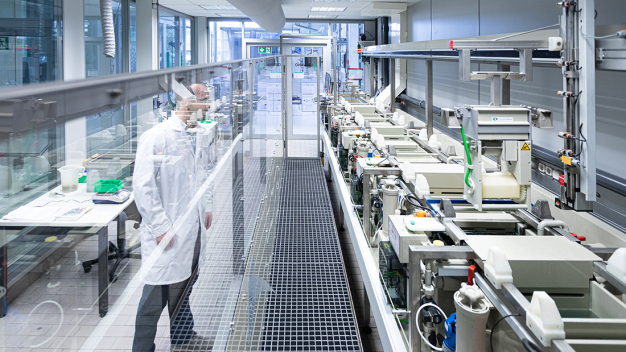
The learning electroplating at Fraunhofer IPA serves as a demonstrator and experimental platform for the digitalization of electroplating technology. © Fraunhofer IPA / Photo: Rainer Bez
Digitalization and Hard Chrome Plating from Chromium(III) Electrolytes: These are the two major topics currently being addressed by researchers from the Electroplating Department at Fraunhofer IPA. They will present their findings and developments from June 4 to 6, 2024, at the SurfaceTechnology GERMANY trade fair: Hall 1, Stand H16.
Energy and resources could be used more efficiently, production processes optimized, and product quality improved – digitalization in electroplating makes all this possible. However, a sufficiently broad data base is a prerequisite. A research team led by Peter Schwanzer from the Electroplating Department at the Fraunhofer Institute for Production Technology and Automation IPA has investigated how existing production facilities and processes can be digitally upgraded afterwards. This resulted in the so-called "Learning Electroplating." It serves as a development platform and demonstrator to better utilize the potentials unlocked by digitalization, develop new approaches, and test them.
The Learning Electroplating is, of course, too large to be exhibited at SurfaceTechnology GERMANY. What the researchers from Fraunhofer IPA will bring to the fair, however, is their knowledge about digital transformation and the experiences they have gathered over the past years. For example, they will demonstrate how digitalization can help identify and implement energy efficiency measures or how to determine and reduce the "Product Carbon Footprint." Additionally, they offer companies a "Readiness Check for Digitalization." They examine which data are needed, for example, for optimizing production, creating a climate balance, or increasing energy efficiency, which data are already available, and how to capture the missing data. From now on, so-called "Quick Checks" are also possible, where project ideas are evaluated for their feasibility.
Once the data source is flowing, it becomes possible to analyze it using machine learning methods. For instance, researchers Stefan Kölle and Peter Schwanzer managed to predict how the electrolyte during galvanizing would change after several hours of use, using artificial intelligence. They were supported by colleagues from the Center for Cyber Cognitive Intelligence at Fraunhofer IPA. Such forecasts are intended to reduce manual inspections in the future. Instead of expensive tests, simulations could show how coatings behave.
REACH Regulation: Chromium(III) is the best alternative to Chromium(VI)
However, when it comes to analyzing alternatives in ongoing authorization applications under the REACH regulation, simulations still do not provide precise forecasts. The team from the Electroplating Department has, over the past few years, largely focused on Chromium(III) as the most promising alternative to Chromium(VI). At SurfaceTechnology GERMANY, they will demonstrate the potential of hard chrome plating from trivalent electrolytes, as well as the current limitations.
Electrolyzers: Coated with one of the rarest elements ever
The research team from Fraunhofer IPA will also showcase electrochemically produced iridium coatings for future use in electrolyzers needed for hydrogen production. Iridium is among the rarest elements overall, with an annual production of only a few tons, and is accordingly expensive. In the research project "Iridium-Reduced Anode Catalysts for PEM Water Electrolysis" (IREKA), scientists from Fraunhofer IPA and the Leibniz Institute for Catalysis are exploring ways to minimize iridium demand. First promising results are already available.
Special Forum: Lectures on Digitalization and Energy Efficiency
The themes of Fraunhofer IPA are also reflected in the special forum. On June 4 at 3:00 PM, Peter Schwanzer will speak about "Digitalized Electroplating and Data Utilization." The next day, June 5 at 2:20 PM, Stefan Kölle will present his research results in his lecture "On the Path to Climate Neutrality – Energy-Efficient Electroplating."
Stuttgart Surface Technology Award "DIE OBERFLÄCHE": Who has won?
The jury is currently meeting, and the winners will be announced on June 4. This year, the SurfaceTechnology GERMANY will award the Stuttgart Surface Technology Prize "DIE OBERFLÄCHE." Since 2012, this award has recognized innovative applications and technologies across all disciplines of surface technology. Until April 8, individuals and organizations were invited to apply for the prize. The three-member jury will then shortlist the best five submissions from all applications, and on June 4, starting at 1:00 PM in the special forum, they will announce the three winners.
Fraunhofer-Institut für Produktionstechnik und Automatisierung IPA
Nobelstraße 12
70569 Stuttgart
Germany
Phone: +49 711 970 1667
email: joerg-dieter.walz@ipa.fraunhofer.de
Internet: http://www.ipa.fraunhofer.de