




- Translated with AI
How do we perceive textiles?
"Touché" – a European research consortium investigates the perception of textile surfaces on the skin.
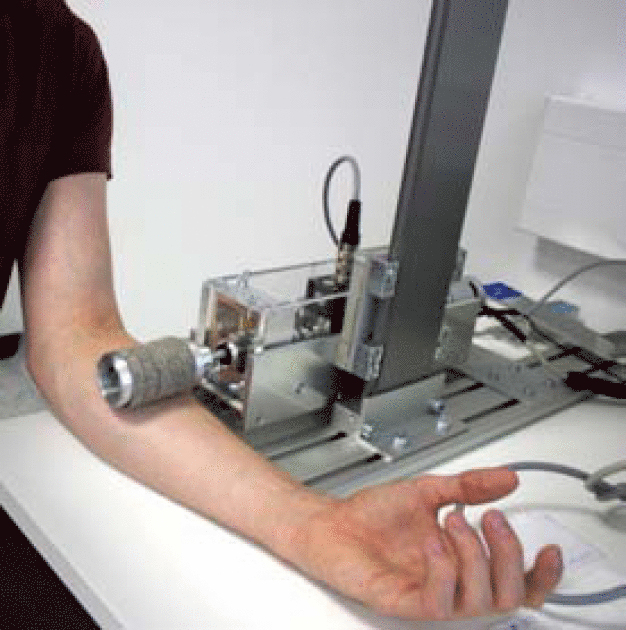
With the help of the electromechanical textile applicator SOFIA 2, textiles can be applied in a standardized manner to various parts of the body with different pressure and speed on the skin. At the same time, the coefficient of friction is determined. (© Hohenstein Institute)
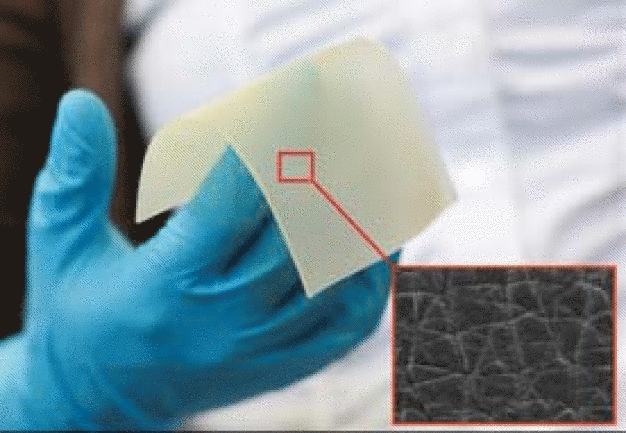
To investigate human-textile interaction, the Hohenstein Institutes developed an artificial skin called HUMskin. (© Hohenstein Institute)
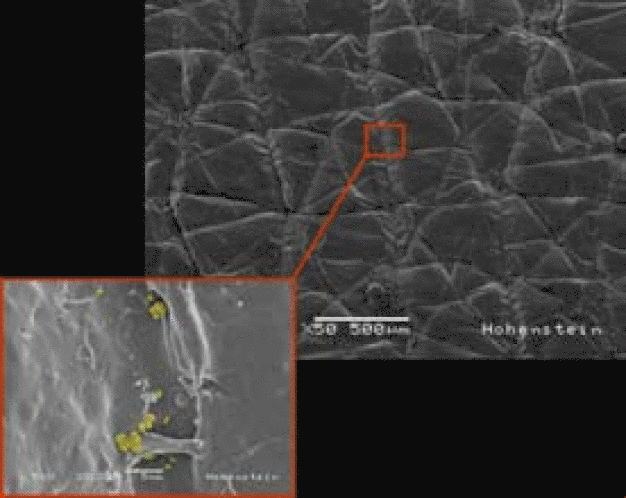
HUMskin displays numerous physiological properties of human skin as well as the surface profile of the epidermis. (© Hohenstein Institute)
At the beginning of the year, the European research project "Touché" was launched with the title "Boosting innovation through application of a basic understanding on the process and testing of textile touch and fabric feel." The German-Belgian joint project, part of the CORNET call by the Working Group of Industrial Research Associations "Otto von Guericke" e.V. (AiF, No. 137 EN), addresses unresolved questions regarding the interactions of human skin with textiles and their perception.
The German research team at the Hohenstein Institutes specifically investigates the interactions and perception of textiles on the human skin surface, i.e., when wearing clothing, which is referred to as "fabric feel." Simultaneously, the project partners from the University and the University of Applied Sciences in Ghent are exploring whether active touching of textiles (the so-called "hand of touch" or "textile grip") can be measured instrumentally. With their overarching research approach, the scientists are examining how tactile stimuli generated by touching differ from tactile stimuli perceived during passive wearing of clothing. At the same time, they aim to identify textile parameters that influence human perception. This is important to enable technical predictions within the textile supply chain and to make textiles more experiential.
The Hohenstein scientists have developed an artificial skin called "HUMskin" specifically for researching the interactions between textiles and humans in their Life Science division. This skin exhibits numerous physiological properties of human skin as well as the surface profile of the outermost skin layer. Using HUMskin, wearing events on the body surface can be realistically simulated in the laboratory, and friction processes (e.g., static and dynamic friction) on the skin can be precisely measured. These so-called tribological data, combined with 3D data at the microscopic level, provide a deep understanding of materials and expectation values for friction processes and the perception of textiles on the skin.
Within the scope of the project, the Hohenstein Institutes also further developed the electromechanical textile applicator SOFIA (Standardized Operating Fabric Applicator). SOFIA 2 can now apply textile samples to various parts of test subjects' bodies with different pressures and speeds, while simultaneously recording the friction coefficient. This enables a standardized application of textile samples to test persons. To objectively evaluate the perception of the test subjects towards the textiles, the spontaneous and unconscious brain activity of the participants is recorded during the application of the textile samples using electroencephalography (EEG). Neurophysiological preliminary studies with 64-channel EEG have already shown that the human brain is capable of perceiving textiles with pleasant and unpleasant surface properties.
Hohenstein Laboratories GmbH & Co. KG
74357 Hohenstein
Germany