
- Upkeep
- Translated with AI
How artificial intelligence reduces machine downtime
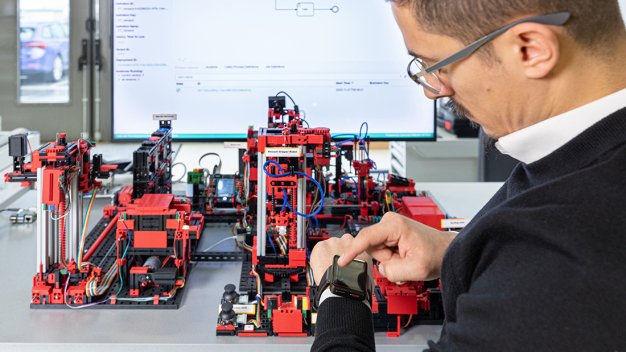
An AI detects disruptions and errors. By linking with a workflow model, the employee receives action recommendations directly on their smart watch. © Fraunhofer IPA/Photo: Rainer Bez
Intelligent algorithms detect errors and wear phenomena, and the smart watch informs the machine operator how to fix the disruptions: A research team from Fraunhofer IPA has developed a method, together with industry partners, on how artificial intelligence can be integrated into maintenance.
This is how it often works in industry today: An error occurs unnoticed on a machine. It then produces scrap until the quality defect is noticed by a vigilant employee, who stops the machine. Then the big guessing game begins. Why did the error occur? How can it be fixed? Settings on the machine are changed in a completely unsystematic way, and additional products are produced as tests — until eventually the quality is restored. Lucky is the one who has an experienced colleague who knows the problem and immediately knows how to fix it.
However, such specialists are unfortunately rare. Soon, artificial intelligence (AI) could replace them. A research team led by Jonas Krauß from the Process Innovation Project Group at the Fraunhofer Institute for Production Technology and Automation IPA has developed a method, together with the companies Maincor Rohrsysteme and Maxsyma, on how AI can be integrated into maintenance.
Algorithm detects faulty weld seams
Maincor Rohrsysteme, based in Knetzgau in Lower Franconia, produces, among other things, plastic-coated aluminum pipes for underfloor heating. Faulty weld seams can occur, as well as deviations in the thickness of the plastic coating. Both previously meant scrap and led to machine downtime until the error was found and fixed.
The research team led by Krauß developed a demonstrator in which ultrasonic welding is monitored with a camera and AI. An intelligent algorithm analyzes the camera images and detects faulty weld seams immediately as they occur. To train the AI, scientists from the Fraunhofer IPA provided it with photos of good and faulty weld seams until it recognized a pattern. However, because there were not enough images of faulty weld seams, the research team had to generate some artificially to better support the learning process of their AI model.
The sonotrode of the ultrasonic welding device is a wear part. Wear increases resistance and thus power consumption. The researchers around Krauß attached current clamps to the cable. Another algorithm analyzes the measurement data. The diameter of the finished pipes is measured with an X-ray device. Deviations upward indicate, for example, that the pressure in the extruder applying the plastic coating is too high. A too small diameter indicates too little pressure.
Smart watch provides action recommendations
“As soon as the AI detects a poor weld seam, registers increased current consumption of the sonotrode, or notices deviations in diameter, a corresponding message appears on the smart watch of the responsible machine operator,” explains Krauß. “It is connected with a recommended action so that the disruption can be fixed as quickly as possible and without unsystematic trial and error, or a new sonotrode can be procured in time.” The action recommendations are based on so-called workflow models, which the research team previously developed together with process experts. They depict the steps of work to be performed, which the AI recommends. This predictive maintenance not only improves specific maintenance tasks but also production planning and control. Because if it is known in advance when a sonotrode will be replaced, order processing and procurement can be organized accordingly.
The company Maxsyma, a software firm from Floss in the Upper Palatinate, will now integrate the newly developed functions and software libraries into their existing application “iot2flow” and adapt it so that it is also useful for companies from other industries. Meanwhile, Maincor expects that the finished tool, after its rollout across manufacturing, could reduce machine downtime by about 15 to 20 percent and decrease scrap rates by around 0.5 percent. Additionally, they anticipate falling costs for maintenance and repairs, as well as efficiency gains through optimized production planning and control.

Fraunhofer-Institut für Produktionstechnik und Automatisierung IPA
Nobelstraße 12
70569 Stuttgart
Germany
Phone: +49 711 970 1667
email: joerg-dieter.walz@ipa.fraunhofer.de
Internet: http://www.ipa.fraunhofer.de