



- Translated with AI
Philippe Biard
How a 50 CHF investment and a few minutes can save you thousands of problems
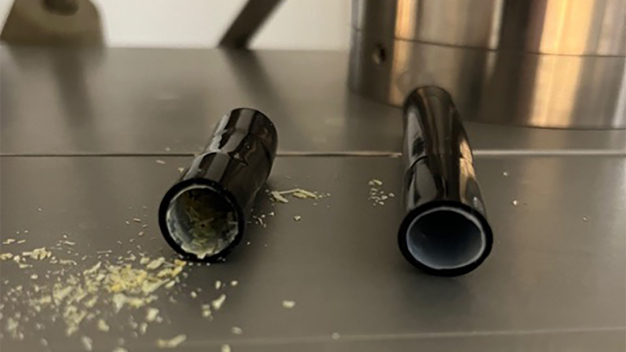
Example image of a heavily soiled/defective hose: This hose was located very hidden beneath an installed insulator and was therefore not replaced for several years. Here you can clearly see how the inner material is peeling away.
In the world of particle measurement, seemingly minor components often determine the quality of results. While expensive instruments are regularly maintained and calibrated, one critical element is often overlooked: the Bev-A-Line tubing. Yet this simple consumable can have a decisive impact on the reliability of entire measurement series.
An Underestimated Risk in the System
Bev-A-Line tubing is widely used in particle counting systems due to its chemical resistance and flexibility. However, like any material, it is subject to aging and contamination over time. During operation, fine particles, aerosols, and environmental residues gradually deposit on the inner walls. Over time, microscopic buildup forms, affecting flow behavior and particle transport efficiency.
The result: measurement data becomes distorted. Particles may adhere to the tubing, be delayed in transport, or fail to reach the detector altogether. This is particularly critical in applications with stringent cleanliness requirements, such as the pharmaceutical, semiconductor, and food industries.
Why Annual Replacement Makes Sense
Regular replacement—at least once per year—ensures consistent and reproducible measurement conditions. Even if no external damage is visible, internal deposits may already be compromising measurement quality.
A new tube ensures:
– A defined, clean inner surface
– Optimal flow characteristics
– Reduced risk of particle loss due to adhesion
– Reproducible and compliant measurement results
Cost Savings Through Prevention
The cost of a new Bev-A-Line tube is typically very low. Replacement takes only a few minutes and can easily be integrated into existing maintenance routines.
In contrast, the potential costs of not replacing the tubing include:
– Particle retention
– Incorrect measurements leading to poor decisions
– Repeated measurements and loss of time
– Production delays or batch release issues
– Extensive root cause investigations for unexplained deviations
A neglected tube can quickly lead to costs in the four- to five-digit range—not to mention the reputational risks in regulated environments. There can be a phenomenon of particle accumulation in degraded tubes, followed by clump release, which can create optical pollution in the particle counter and a malfunction with significant repair costs.
Best Practice: Make Tube Replacement a Standard
Integrating tube replacement into an annual maintenance plan is a simple yet highly effective quality assurance measure. Ideally, replacements should be documented and combined with other routine checks.
Additionally, it is recommended to:
– Perform regular visual inspections of tubing
– Document service life and operating conditions
– Consider shorter replacement intervals for critical applications
Conclusion
The Bev-A-Line tube may seem insignificant, but its role in reliable particle measurement is substantial. An investment of around 50 CHF and a few minutes of work can help prevent measurement errors, unnecessary costs, and complex troubleshooting.
Those who act proactively not only safeguard data quality but also improve overall process efficiency.
Aérométrik AG
4313 Möhlin
Switzerland