
- Technical cleanliness
- Translated with AI
Gerhard Koblenzer
High Purity requires technical cleanliness throughout the entire process chain
Just cleaning was yesterday
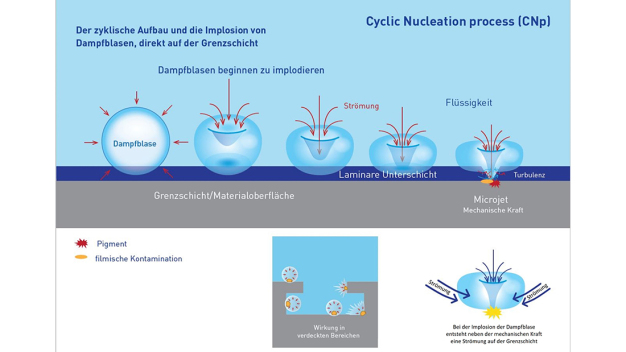
The CNp Technology: A Game-Changer in High Purity Processes: Last year, LPW obtained the European patents for the CNp process (Cyclic Nucleation), which has been in use and internally developed for years, following international rights. CNp acts directly on the boundary layer of a component, even in hard-to-reach internal contours (such as 3D implants or fine capillaries and lumens). Through targeted pressure fluctuations within the liquid-specific vapor pressure curve, the formation of vapor bubbles, the cleaning effects of gentle cavitation, and effective media exchange, contaminants are dissolved and, if necessary, residual contamination carried along is safely removed. With the ultrasound-CNp combination as a process enhancer, LPW also tackles the most challenging tasks in fields such as medical technology or high vacuum technology.
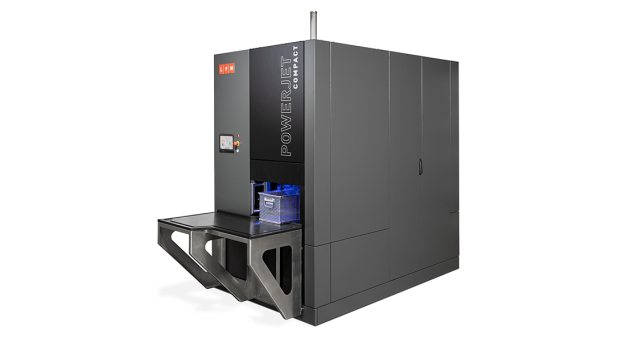
New CNp System: Small Powerhouse for Highest High Purity New to the LPW portfolio is the space-saving standard chamber system PowerJet compact CNp. The two-stage system with integrated steam intermediate rinse occupies just under 4 m² and features, in addition to ultrasonic and Cyclic Nucleation (CNp) cleaning processes, the necessary drying for higher requirements. This can be implemented in the form of hot air as well as infrared vacuum drying. Furthermore, the new system is equipped with a treatment chamber embedded within the two pre-treatment tanks, suitable for goods up to a batch size of 600 x 400 x 300 mm and weights up to 150 kg. The sandwich construction supports cleaning and rinsing processes as well as drying through a higher temperature level. The recirculation system features integrated full-flow filtration with a filter area of over 4 m² and filter units up to 0.5 µm. Currently, the small powerhouse is available in two versions. More info: www.lpw-cleaning.de.
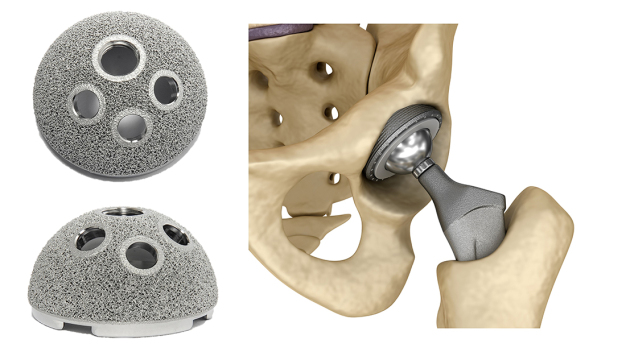
1. New products in medical technology, such as additively manufactured implants, pose new challenges for cleaning equipment manufacturers. Additionally, there are regulatory requirements (in Europe, the Medical Device Regulation) that must be addressed. (Photo: LPW)
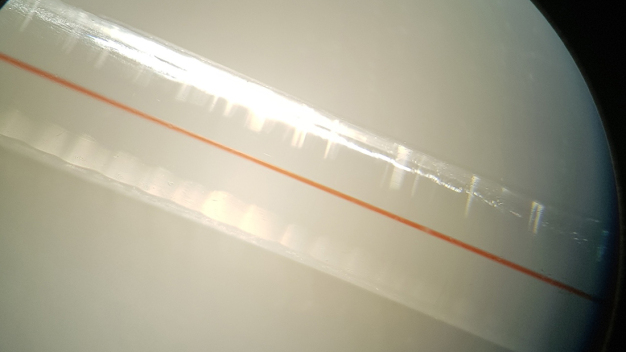
2. Capillary structures, such as in fine channels and tubes, are subject to the highest cleanliness standards depending on their intended use. Due to their aspect ratio (the ratio of inner diameter to length), these components make the use of most known cleaning methods impossible and also challenge the rinsing and drying processes. Here is a 300 mm long glass capillary with an inner diameter of approximately 50 µm. (Photo: LPW)
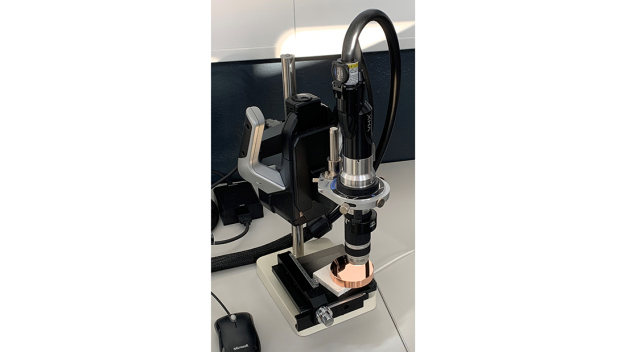
3. In laser and high vacuum technology, cleaning is confronted with delicate and highly precise processed surfaces – such as mirrors, for example. (Photo: LPW)
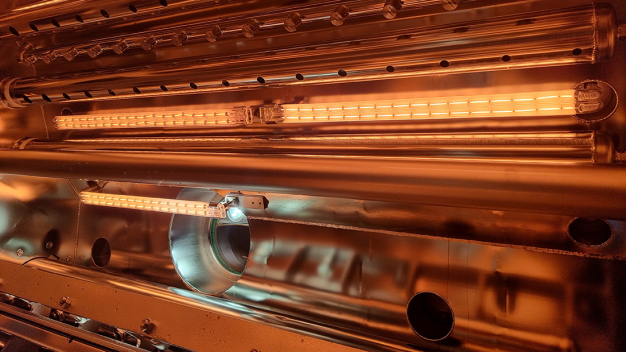
4. The influences of drying on the degree of technical cleanliness are often underestimated. For example, energy-efficient recirculating air drying tends to concentrate the finest organic and inorganic contaminants, which can lead to recontamination of the components. Therefore, LPW uses environment-decoupled infrared systems. (Photo: LPW)
The entire manufacturing industry is undergoing technological change. And this worldwide. Changed mobility concepts, digitalization, and the production of completely new products are leading to higher demands on technical cleanliness. Cleaning alone is no longer sufficient. Highly clean environments and finely coordinated subprocesses throughout the entire process chain have become just as relevant as the appropriate cleaning technology itself. This demands new procedures, ways of thinking, and an expanded understanding among plant manufacturers and their customers.
Technical cleanliness is therefore no longer achieved solely through the cleaning process. That was yesterday. In modern high purity tasks, it is about composing a holistic process symphony and clarifying, for example, how the pre-process affects the cleanability of a component, how the cleaning process presents itself with its immediate internal parameters, and how the subsequent process with its quality-influencing factors should be designed when transporting the clean component to its actual point of use.
In detail, each industry has its own special effects: for example, in the manufacture of analytical devices, in medical, high vacuum, or sensor technology, as well as in the automotive sector (e-mobility and fuel cells), increasing requirements for technical cleanliness are emerging regarding film-like, pigment-like, biological, toxic, and atomic contamination levels in daily production. In additive manufacturing – that is, the production of 3D-printed components with complex geometries or capillary structures – the defined level of purity on hard-to-reach surfaces is becoming increasingly important. Besides these product-related factors, there is also the demand for traceability/validation across the entire process chain.
Experience and Research
LPW Cleaning Systems GmbH has established itself worldwide in recent years as a partner for customized plant solutions in the high purity segment. The systems are used in many high-tech fields and meet the highest cleanliness requirements. Furthermore, the specialists in Riederich are actively involved in research and conduct comprehensive experimental series and contract cleaning, even under cleanroom conditions, with users from various industries in the company's own test and service center. The most important trends and process learnings from experience and research in fine and ultra-fine cleaning can be summarized as follows:
Basically:
– Pre-processes must be assessed regarding their positive and negative influences on the level of technical cleanliness. The focus is on handling operations, the auxiliary and operating materials used, or environmental and ambient parameters.
– The more stable a pre-process is concerning its resulting net contamination, the more efficiently and safely the required cleanliness standards can be implemented.
– Unplanned changes, such as switching auxiliary or operating materials or tools, geometric changes to components, or unplanned waiting times, negatively influence cleaning, potentially leading to failure.
These basics apply to every cleaning process to varying degrees. With the new high purity tasks, additional features come into play:
– Film-like, pigment-like, or biological, toxic, or atomic contaminations "hide" in the laminar boundary layer, directly on the component surface.
– In conjunction with complex, possibly capillary geometries or tightly packed arrangements of the cleaning items, many established cleaning processes and media (liquid or gas-assisted) are only limitedly suitable or not at all.
– Then, influences from environmental conditions (keyword cross-contamination), the risk of contamination from the cleaning system itself, and the use of unsuitable media must be considered.
– The subsequent process after the "cleaning" quality gate also carries its own risks. There is a temporal and spatial gap between achieving the required cleanliness level and the point where it is needed. Damage or contamination due to improper handling, unsuitable packaging, or unfavorable environmental parameters, or aging/alteration effects from prolonged storage and waiting times, can ruin the painstakingly achieved result on the way to actual use.
High Purity from Mini to XXXL
That’s the theory and hot list of high purity. Adapted to daily plant operation, these projects from LPW’s portfolio accurately reflect practice.
AM manufacturing: For an American manufacturer of medical devices and implants, additively manufactured hip prostheses were to be freed from powder residues after 3D printing. The manufacturing process results in an open-pore geometric shape, initially contaminated with powder residues. In subsequent steps, contamination can occur in the internal geometry, for example through mechanical post-processing. Thus, two cleaning processes are required: the first after printing, the second immediately after the final processing before packaging. LPW designed a fully automated double-chamber system of the PowerJet type – with ultrasound-CNp combination in both chambers and appropriate powder residue separation.
Components of high vacuum technology: In this area, the focus is mainly on sensitive components for semiconductor production that exhibit organic film and molecular-atomic contamination. The actual cleaning process is integrated into essential quality gates within the manufacturing process. One such gate involves wet cleaning before the cleanroom (usually ISO 5), preceded by bake-out in a high vacuum oven to achieve final organic cleanliness requirements. LPW has been supplying complex high purity systems for final wet cleaning before the ISO-5 cleanroom to Europe, Asia, and North America for many years. In the EU, direct and indirect ASML suppliers, such as Trumpf Semiconductor division, are among the users. In the USA, customers include Applied Materials. Recently, the first XXXL-Grade1 system was delivered to the long-standing partner VAT Malaysia. For these tasks – the final wet cleaning to remove film contamination before bake-out in the cleanroom – custom-designed fully automated multi-chamber systems with multi-frequency ultrasound-CNp combinations in all chambers, ultra-pure water rinses, and adapted (recontamination-free) vacuum IR drying were built.
Responsibilities of Equipment Manufacturers
New requirements cannot be met with old thinking and procedures. Therefore, the LPW team has focused on these new challenges since 2008 and, based on intensive analyses and evaluations of megatrends across various industries, has undergone a profound transformation, including its products, which remains agile to this day. In addition to restructuring internal workflows and processes, training and further education of staff is a major focus. Furthermore, all cleaning systems have been completely overhauled and further developed, and lists of prohibited materials have been created. Modifications to rinsing and drying processes have been implemented, along with adjustments to all handling and automation systems. Digital process monitoring has been improved and is currently undergoing an intensive R&D process together with external specialists.
Most recently, the application engineering division was established as a completely new business unit, which, alongside new service offerings (e.g., training, application planning and support, process simulation, efficiency optimization in energy and quality, and cleanroom-based contract cleaning), also coordinates R&D activities. All these technical solutions, processes, and procedures are developed at LPW in close collaboration with customers through intensive co-engineering, tested, and continuously challenged. Sometimes a challenge for both sides, but absolutely necessary if the new tasks and requirements are to be successfully met.
LPW Reinigungssysteme GmbH
Industriestraße 19
72585 Riederich
Germany
Phone: +49 7123 38040
email: info@lpw-cleaning.de
Internet: http://www.lpw-cleaning.de