




- Translated with AI
High-performance micromodules and innovative lattice technology in red diode lasers
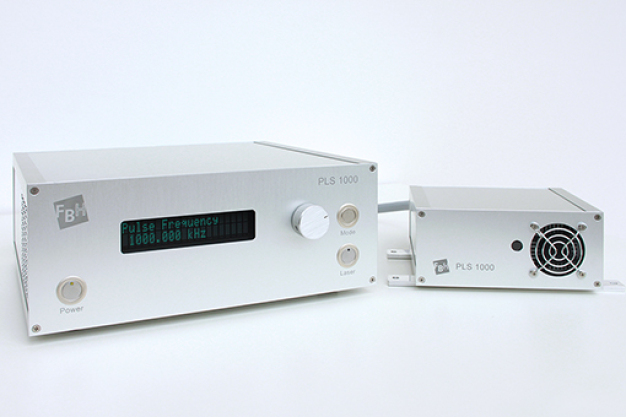
Pulse Laser System_PLS_1000
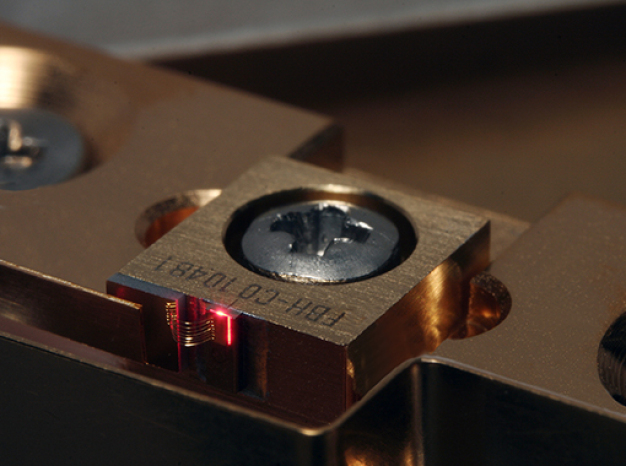
Red-emitting diode laser
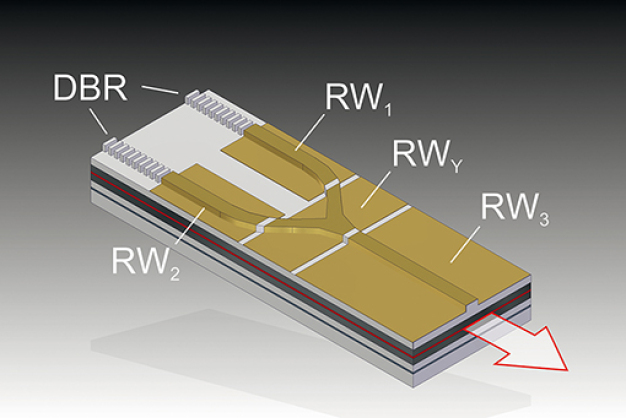
2-Wavelength_Diode_Lasers
The FBH presents various miniaturized laser beam sources as well as diode lasers for the red spectral range at the Laser World of Photonics trade fair, utilizing a novel grating technology for wavelength selection.
With compact, hybrid-integrated diode laser modules, the Ferdinand-Braun-Institut, Leibniz Institute for High-Frequency Technology (FBH), enables a wide range of applications. The flexible "all-rounders" can be optimized according to requirements, from material analysis, sensing or display technology to material processing.
Custom-made, flexible picosecond light pulse source PLS 1000
With the PLS 1000, the FBH introduces a highly efficient pulsed laser source based on self-developed optical and electronic semiconductor components. The laser system delivers ultrashort light pulses of less than 10 picoseconds and offers freely selectable repetition frequencies from Hertz to the megahertz range. The peak pulse power exceeds 20 watts. Thanks to these features, the compact laser system is ideal for applications in material processing – especially in conjunction with fiber-reinforced materials – for biomedical investigations based on fluorescence spectroscopy, and for mobile LIDAR systems for close-range applications. The innovative system is equipped with semiconductor components for a wavelength of 1064 nanometers (nm), but can be flexibly adapted to other wavelengths. It consists of a mode-locked laser with a repetition rate of about 4 gigahertz, an innovative pulse picker concept, and an amplifier. Electronic control, utilizing gallium nitride transistors developed at the FBH, makes the system even faster. This ensures stable and user-friendly operation. The PLS 1000 can be operated both manually and computer-controlled, with flexible selection from single pulses to multiple successive pulses (burst mode).
Novel grating technology for red-emitting diode lasers
Spectral stabilized diode lasers in the wavelength range of 630 nm to 680 nm are of great interest for material analysis and length measurement technology. Gas lasers such as helium-neon (HeNe) and krypton lasers have been available for many years and have established many measurement methods in the red spectral range. Newly developed diode lasers in this spectral range can replace such gas lasers and enable more compact measurement equipment. The radiation of these monolithic diode lasers with integrated gratings for wavelength stabilization can be flexibly tuned to specific wavelengths and easily modulated in terms of power and wavelength. Furthermore, significant improvements are expected in established measurement methods, and new ones become possible. The key technological step was integrating surface Bragg reflectors into red-emitting diode lasers. The process already established at the FBH for the near-infrared spectral range uses higher-order surface gratings based on standard i-line stepper lithography and conventional reactive ion etching at low temperatures. This gives the FBH a flexible process for realizing spectrally stabilized red-emitting diode lasers, suitable for high-volume manufacturing as well.
Applications of this grating technology include replacing HeNe lasers with diode lasers in laser metrology. Line widths below 1 MHz at an optical output power of 14 mW have been demonstrated – corresponding to a coherence length of more than 100 meters, which is sufficient for many applications.
The grating technology also benefits spectroscopic applications in sensing, which the FBH has been working on for several years. Raman spectroscopy allows precise analysis of many substances. When a sample is illuminated with monochromatic laser light, it is scattered differently depending on the substance. These spectrally shifted signatures are as unique as a fingerprint for each molecule. However, Raman signals are often overwhelmed by a fluorescence signal that is several orders of magnitude stronger. Here, the Shifted Excitation Raman Difference Spectroscopy (SERDS) provides a solution. By exciting the sample with light at two closely spaced wavelengths, the spectral position of the Raman lines shifts – whereas the fluorescence signal varies little. A simple subtraction of the two Raman spectra separates the Raman signals from the background noise. This functionality can now be implemented on a single laser chip with the new grating technology. The wavelengths are around 671 nm and only 0.5 nm apart. Applications of SERDS are particularly relevant where a lot of noise, such as fluorescence, occurs. This includes especially biological samples like meat, fruit, leaves, or even medical diagnostics of skin.
Trade fair booth at "Laser World of Photonics"
This and other developments will be presented by the Ferdinand-Braun-Institut at the world’s leading trade fair Laser World of Photonics, Hall C1 Stand 312, from May 13 to 16, 2013, in Munich, as well as at the associated CLEO Europe conference.
Ferdinand-Braun-Institut gGmbH
12489 Berlin
Germany



