



- Filter
- Translated with AI
Sébastien Jouas
HEPA filter with PTFE membrane
Design, performance features, and energy efficiency in cleanroom ventilation systems
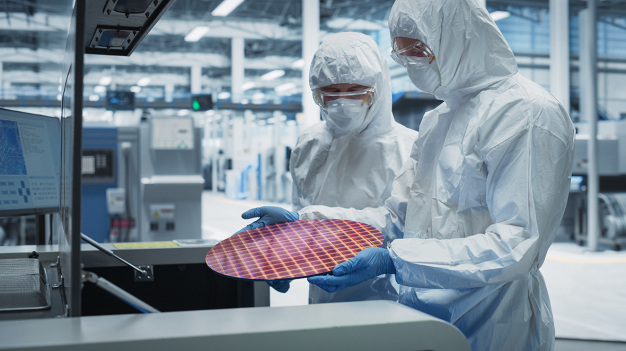
Semiconductor manufacturing in cleanroom environments
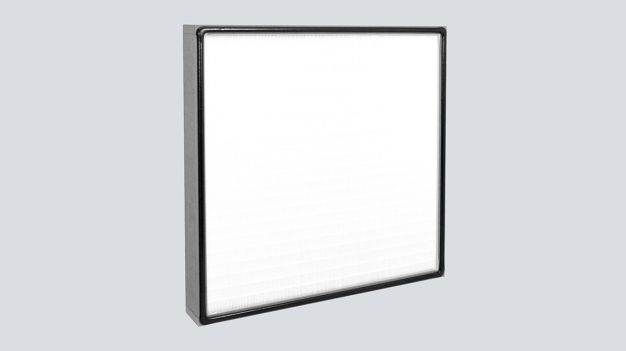
Figure 1: Nanoclass Square EF ©MANN+HUMMEL
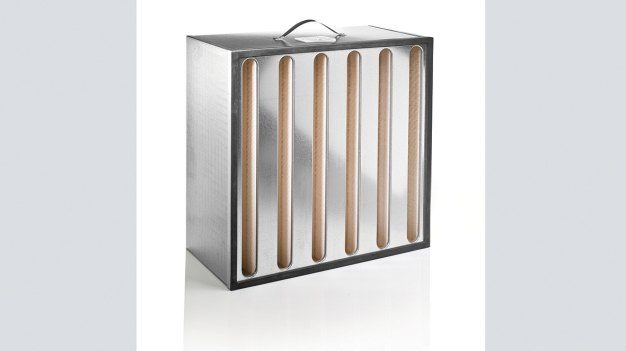
Figure 2: Nanoclass Cube N EF ©MANN+HUMMEL
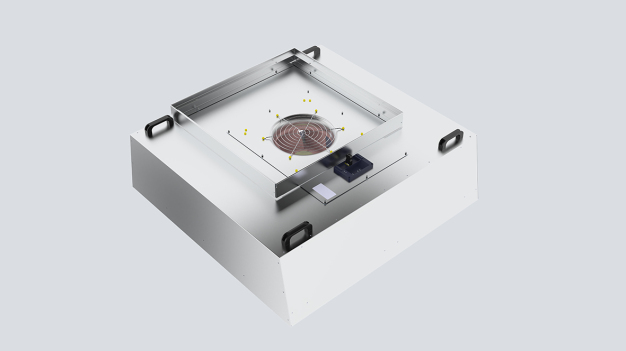
Nanoclass FFU_EF©MANN+HUMMEL

Nanoclass FFU_Vogel Perspective©MANN+HUMMEL

Cleanroom workstations©Shutterstock-Gorodenkoff
In light of stricter environmental regulations and ambitious decarbonization goals, the energy consumption of buildings and processes is increasingly coming into focus. Cleanroom air treatment systems offer significant potential for savings. HEPA filters, as key components of these systems, are often regarded as standardized consumables. However, the introduction of filter media made from expanded polytetrafluoroethylene (ePTFE) challenges this view – not only regarding air technical performance but also in terms of chemical resistance, lifespan, and overall costs over the entire lifecycle.
The energy consumption of HEPA filters is often underestimated. Ventilation and air treatment systems can account for a significant portion of the total electricity consumption of pharmaceutical or microelectronics production buildings. Depending on the system, this share can be 50% or more. Within these systems, HEPA filters present the greatest flow resistance. Their differential pressure directly influences the power consumption of fans, regardless of whether they are FFUs (Fan Filter Units) in filter ceilings or air handling units (AHUs) for primary air treatment.
For HEPA filters used in cleanrooms, two main configurations are fundamentally distinguishable, which differ significantly in their differential pressure behavior: cleanroom technology panels, integrated into filter ceilings, FFUs (Fan Filter Units), isolators, and RABS (Restricted Access Barrier Systems), and HEPA box filters used in air handling units (AHUs).
|
Cleanroom Technology Panels with Glass Fiber Medium |
HEPA Box Filter with Glass Fiber Medium |
|
Depth 66 to 70 mm, designed for moderate volumetric flows. The initial differential pressure of H14 glass fiber filters ranges between 90 and 130 Pa depending on manufacturer and size. The Nanoclass Square EF from MANN+HUMMEL reaches about 90 Pa and is among the lowest pressure-loss solutions in this segment. Typical applications: filter ceilings, FFUs (Fan Filter Units), and pharmaceutical isolators. |
Depth 292 mm, designed for high volumetric flows. The initial differential pressure of H14 glass fiber filters varies depending on nominal flow rate and available filter area between 250 and 375 Pa. The Nanoclass Cube N EF from MANN+HUMMEL starts with an initial pressure drop of 250 Pa. Typical applications: air handling units (AHUs) and systems for primary air treatment. |
In both cases, the differential pressure of a HEPA filter represents a constant load on the associated fan. Summed over the entire filter inventory of a system, which can range from a few dozen to several hundred filters, this flow resistance leads to significant annual energy consumption. Additionally, the pressure loss increases progressively during operation.
The ePTFE membrane: operating principle and structural features
Expanded polytetrafluoroethylene (ePTFE) is produced by extrusion and biaxial stretching of a fluorinated polymer. This results in a microporous membrane with fibers in the micrometer range. Thanks to this structure with a higher density of fine fibers, the H14 class filter can be achieved with significantly less filter material than conventional glass fiber media.
PTFE filters are typically constructed as a three-layer sandwich: two support layers made of fleece, polyester, or polypropylene enclose the active ePTFE membrane. While the support layers provide necessary mechanical stability, the ePTFE membrane performs the actual filtration.
Glass fiber media operate based on a combined filtration principle: at the beginning of their service life, particles penetrate deep into the fiber structure, resulting in depth filtration. Dendritic structures gradually fill the interspaces between fibers. Only afterward does surface filtration increasingly establish itself.
This two-stage mechanism leads to a nonlinear increase in differential pressure, which accelerates notably toward the end of the filter’s service life.
In contrast, ePTFE media operate predominantly on the principle of surface filtration from the outset. Particles deposit on the upstream side of the membrane without penetrating deeply into the filter structure. This typically results in a more uniform and predictable increase in differential pressure, which can be directly used for maintenance planning and the optimization of total operating costs (Total Cost of Ownership, TCO).
Comparison of energy balance: key figures and practical values
With the same filtration efficiency of class H14, the initial pressure drop of a PTFE medium is about 50% lower than that of a comparable glass fiber medium. This ratio applies to both panels and 292-mm filters used in air handling units (AHUs).
In cleanroom panels, the initial differential pressure values of glass fiber media, depending on manufacturer and size (66 to 70 mm height), range between 90 and 130 Pa. The Nanoclass Square EF from MANN+HUMMEL achieves about 90 Pa. Comparable PTFE media are around 55 Pa, roughly half of this pressure loss.
For 292-mm filters used in air handling units (AHUs), the absolute differential pressure depends on factors such as nominal flow rate and available filter area. The ratio between glass fiber and PTFE media remains comparable: the pressure loss of PTFE media is typically about half that of corresponding glass fiber media.
__________
Important note on differential pressure data
The values for differential pressure depend on the nominal flow rate, available filter area, and face velocity. Therefore, comparisons between glass fiber and PTFE media should always be made at the same flow rate and filter size. For a reliable assessment, it is necessary to refer to the performance curves provided by each manufacturer for the relevant filter types.
__________
At constant flow rate and within the normal operating range of FFUs or AHU fans, reducing the differential pressure in the filter system directly results in lower fan energy consumption. However, the actual energy savings depend on several factors, especially the operating point, fan characteristic curve, overall system efficiency, and control strategy.
Over the lifespan of a system—which is typically 15 to 20 years for FFUs and often even longer for air handling units—the accumulated energy savings can significantly exceed the higher purchase price of a PTFE filter. This price is generally about two to three times that of a comparable glass fiber filter. Consequently, investing in PTFE filters can be economically justified over the entire operational life of the system despite higher initial costs.
|
Performance comparison of glass fiber and ePTFE media |
||
|
Performance criterion |
Glass fiber medium |
PTFE medium (ePTFE) |
|
Initial pressure drop H14 Panel filter (66-70 mm height, FFUs / isolators) |
90-130 Pa depending on manufacturer and size (e.g., Nanoclass Square EF from MANN+HUMMEL: 90 Pa) |
Up to about 50% lower differential pressure, depending on size, flow rate, and filter design |
|
Initial pressure drop H14 – HEPA box filter (292 mm, AHUs)
|
Varies depending on nominal flow rate, filter area, and face velocity. |
Up to approximately 50% lower differential pressure, depending on size and flow rate; energy savings depend on fan operating point. |
|
Particle separation mechanism
|
Technical depth filtration; nonlinear pressure increase with acceleration towards the end of service life. |
Slip flow effect of nanofibers; linear and predictable pressure increase over the entire service life. |
|
Composition of filter medium
|
95-97% borosilicate glass fibers (SiO₂) + 3-5% acrylate binder. Some manufacturers offer boron-reduced glass fiber media. |
Active ePTFE membrane without organic binders. |
|
Chemical resistance to oxidizing agents (H₂O₂)
|
Good; SiO₂ chemically inert. Acrylate binder may be a critical factor in long-term exposure.
|
Excellent; very high chemical inertness, without organic binders. |
|
H₂O₂ compatibility (untreated filter medium)
|
Excellent – validated by Camfil (2020) and Battelle (50 VHP cycles without degradation)
|
Excellent – chemically inert C-F bonds. |
|
Purchase costs
|
Reference value |
2 to 3 times higher, offset by lower total operating costs (TCO) |
Chemical resistance in environments with intensive decontamination processes
Borosilicate glass fibers are chemically inert to hydrogen peroxide. The contained silicon dioxide (SiO₂) does not react with H₂O₂ under typical pharmaceutical decontamination conditions. This property was confirmed by the Battelle study, which found no material degradation after 50 VHP cycles (vaporized hydrogen peroxide). This aspect is particularly noteworthy because there is still a misconception in the industry that glass fiber media are susceptible to repeated H₂O₂ decontamination cycles.
However, the glass fiber medium does not consist solely of glass fibers. An organic acrylate binder, making up about 3 to 5% of the composition, holds the fibers together. This binder could theoretically be a critical factor in long-term and repeated exposure to oxidative media, especially in aseptic filling isolators with frequent VHP decontamination cycles.
In the case of Nanoclass Square Pro membrane filters, the active ePTFE membrane is free of organic binders. The media structure with its stable C-F bonds imparts the ePTFE membrane with an exceptionally high chemical inertness, making it one of the most chemically resistant technical polymers.
In pharmaceutical isolators with VHP injection through the supply plenum before the HEPA filter, where vaporized hydrogen peroxide passes through the HEPA filter before entering the chamber, the adsorption behavior of the filter medium becomes a critical operational parameter. Glass fiber media can adsorb a significant portion of H₂O₂ during the gassing phase. The subsequent gradual desorption during the venting phase can extend the time needed to reach the prescribed residual concentration limit (usually < 1 ppm v/v). This can directly impact production throughput. Due to its hydrophobic and non-hygroscopic properties, the ePTFE medium exhibits lower VHP adsorption. In configurations with plenum injection, this behavior can help optimize venting cycles.
This advantage is specific to plenum injection: in direct chamber injection, filters are only minimally exposed to VHP, making this difference negligible.
TCO analysis (Total Cost of Ownership) and practical recommendations
The evaluation of choosing between glass fiber and ePTFE media should not be reduced to the comparison of purchase price per unit. A TCO analysis over the entire system lifecycle should consider the following factors:
- The power consumption of fans, which is significantly influenced by the differential pressure of the filter system; the advantage of PTFE must be assessed at constant flow, considering the fan’s operating point and control strategy.
- Filter service life and replacement intervals: the linear growth of differential pressure with PTFE allows for optimized maintenance intervals and prevents premature filter changes due to a sharp increase in loading at the end of life.
- Qualification and requalification costs (IQ/OQ): in an existing system qualified with glass fiber filters, switching to PTFE may require requalification. These costs should be included in the analysis.
- Chemical resistance: the absence of organic binders in PTFE offers a theoretical long-term advantage in intensive VHP applications, although further quantitative data are needed to substantiate this.
__________
Practical recommendations:
1) For new build projects (Greenfield projects)
ePTFE media should be considered already in the planning phase, both for filters in filter ceilings (FFU, 66-70 mm) and for AHU filters (292 mm). Eliminating additional requalification costs and realizing immediate energy savings over the system’s lifespan can positively impact return on investment. For filters exposed to VHP cycles, EPDM or gel knife seals should be specified instead of silicone seals.
2) For existing qualified systems (Brownfield projects)
Consider switching to PTFE during the next planned renewal or requalification. Calculate the annual energy savings of the installed filter system to determine the payback period. Priority should be given to checking the seal type (replace silicone seals with EPDM or gel knife seals), regardless of the filter medium choice.
__________
Conclusion
The HEPA filter medium made from ePTFE represents a significant technological advancement in three complementary dimensions:
Firstly, a differential pressure that can be up to approximately twice as low depending on flow rate, design, and filter configuration compared to a comparable glass fiber filter; secondly, better predictability of loading due to predominantly surface-based filtration; thirdly, a structural chemical inertness attributable to the absence of organic binders in the active membrane.
The choice between glass fiber and ePTFE media cannot be made universally. It should be evaluated individually for each system, considering the desired performance level, energy profile, decontamination process, qualification requirements, and the economic planning horizon of the operator.
Footnotes
1 Zhang W., Deng S., Wang Y., Lin Z. - Dust Loading Performance of the PTFE HEPA Media and its Comparison with the Glass Fibre HEPA Media - Aerosol and Air Quality Research, 18: 1921-1931, 2018. DOI: 10.4209/aaqr.2017.11.0481
2 Zhang et al., AAQR 2018 (peer reviewed) - Camfil Technical Bulletin (compatibility H2O2) - HI-Q Environmental Products (media composition) – Battelle Memorial Institute (VHP cycles) – MANN+HUMMEL Air Filtration data (Nanoclass range).
3 Comecer - VHP decontamination in isolators, 2020 - Camfil, Technical Bulletin: Effects of Decontamination Agents on HEPA Filters, 2020.
4 Battelle Memorial Institute - Decontamination and Reuse of Filtering Facepiece Respirators - 2020.
References:
- Zhang W., Deng S., Wang Y., Lin Z. - Dust Loading Performance of the PTFE HEPA Media and its Comparison with the Glass Fibre HEPA Media - Aerosol and Air Quality Research, 18: 1921-1931, 2018.
- Technical Bulletin: Effects of Decontamination Agents on HEPA Filters - Camfil, 2020.
- Comecer – Decontamination with VPHP in isolators: ideas and reflections on optimising cycle times - 2020.
- Battelle Memorial Institute - Decontamination and Reuse of Filtering Facepiece Respirators - 2020.
- Schmidt O. et al. – Modern PTFE Membrane Based HEPA/ULPA Filters for Improved Energy Savings and Risk Reduction - ICCCS, 50 Years 50 Articles.
- Bozenhardt A., Bozenhardt H. - Isolator Decontamination: Key Considerations – Pharmaceutical Online, 2018.

MANN+HUMMEL Life Sciences & Environment Germany GmbH
Eichenhofer Weg 14-16
45549 Spockhövel
Germany
Phone: +49 2339 12800
Fax: +49 2339 12828
email: info.de-sh@mann-hummel.com
Internet: https://airfiltration.mann-hummel.com/