


- Transport
- Translated with AI
Hazardous substances in laboratories & cleanrooms: How proper storage works
© KAISER+KRAFT
© KAISER+KRAFT
Safety is of the utmost priority in every laboratory and everywhere where hazardous substances are handled. There are important points to consider right from storage: What chemicals are stored where? What spill protection is required? And how do employees behave in the event of a leak?
Storage of hazardous substances: rules and regulations
The regulations for storing hazardous substances in Germany are, among others, governed by the Ordinance on Industrial Safety and Health (BetrSichV), the Water Resources Act (WHG), and the Occupational Safety Act (ArbSchG). They provide clear instructions on how flammable and water-hazardous liquids must be stored and transported in compliance with regulations by a company. This includes, among other things, the requirement to secure liquids classified as hazardous substances with a catch basin to prevent leaks. All legal rules aim to ensure the safety of employees and protect the environment in every situation.
Implementing safety requirements practically
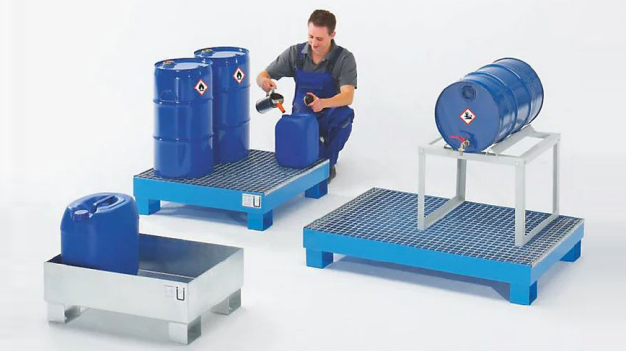
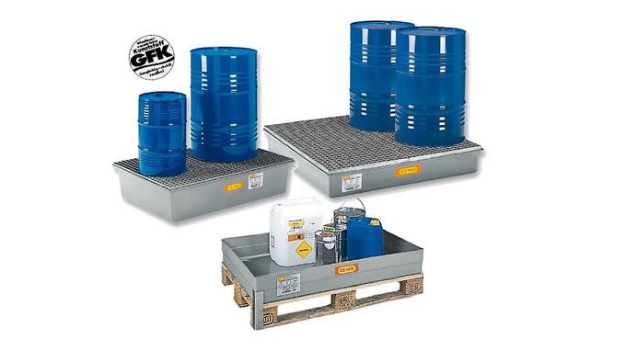
Which spill basin is the right choice in practice depends on the type of liquids stored. The legislator also provides clear regulations here to guarantee maximum safety. A spill basin must be able to hold the contents of the largest container stored and at least 10% of the total stored volume. The corrosion resistance of the material of the basin must also be considered. Flammable and water-hazardous liquids may be stored in steel basins. Polyethylene basins are only suitable for water-hazardous liquids, acids, and alkalis. The use of polyethylene for flammable substances is not permitted. A wide selection of spill basins for storing hazardous substances can be found at KAISER+KRAFT.
Flammable liquids are stored in safety cabinets classified according to DIN EN 14470-1. They can be placed directly in the workrooms and provide fire and explosion protection, effective storage, and reduction of internal transport routes. Exceptions apply to substances with a ignition temperature below 100 °C. Safety cabinets are also usually equipped with technical ventilation.
Environmental and chemical cabinets are the proper storage location for water-hazardous liquids, such as non-flammable chemicals and toxins. These cabinets are often already equipped with a tested spill basin. When stored inside cabinets, particular attention must be paid to the materials of the containers to withstand the contents' demands. For example, substances containing chlorinated hydrocarbons must not be stored in aluminum containers, while strong alkalis are safely stored in polypropylene bottles rather than glass bottles. If hazardous substances emit fumes or gases, the chemical cabinet must be effectively ventilated.
How companies protect their employees when working with hazardous substances
Every employee must have access to high-quality protective equipment at all times. Gloves, eye protection, and safety shoes are standard equipment when working with hazardous substances. Depending on the chemicals stored, respiratory masks and possibly full-body protective suits are also used. The company ensures that all hazardous substances are always properly labeled. This way, everyone involved always knows what liquid they are dealing with and how to react in an emergency.
Reacting correctly: What to do if a leak occurs?
If a leak is detected in the storage container, immediate action is required. Absorbent cloths are an effective and easy-to-handle method for quickly removing spilled, hazardous liquids. They have a high absorption capacity and are available in various versions. Absorbent cloths for oil and gasoline only absorb these liquids and no water. Special absorbent cloths for chemicals are intended for wiping acids, alkalis, and alcohols. The third option is universal absorbent cloths, suitable for any liquid.
In the case of a larger leak in the spill basin, a liquid vacuum cleaner is the best choice to quickly and thoroughly eliminate the emergency. Pouring out or siphoning can quickly lead to secondary leaks and create additional risks.
Ensuring safety
Thorough employee training and the proper selection of high-quality storage aids make workplaces like laboratories safe for people and the environment. Paying close attention to legal requirements and suitable materials from the outset can significantly reduce the risk of damage of any kind.
KAISER+KRAFT GmbH
70191 Stuttgart
Germany