

- Translated with AI
Hannover Institute for Technology HITec
Laying of the foundation stone for interdisciplinary research building
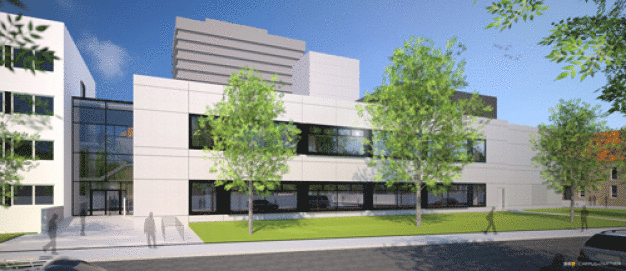
Image credit: Carpus+Partner AG
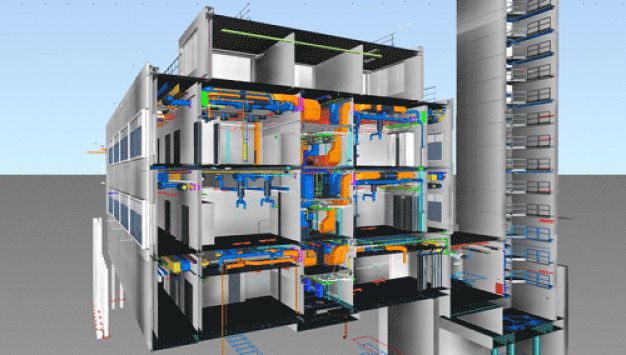
Image credit: Carpus+Partner AG
In Hanover, the state of Lower Saxony, represented by the State Building Management Hanover, is constructing a new research center that, for the first time in the European research landscape, combines basic research, applied research, and technology development in the fields of quantum physics and geodesy under one roof. On January 27, 2015, the foundation stone was laid for the Hanover Institute for Technology HITec – planned and realized by the Aachen engineering and architecture firm Carpus+Partner AG.
To further improve the conditions in quantum and space-time research at the Hanover site and to solidify its international top level, the highly modern Hanover Institute for Technology – short HITec – is being established at Leibniz University. The client is the state of Lower Saxony, represented by the State Building Management Hanover. With the official laying of the foundation stone on January 27, 2015, construction work for the research center, planned and now realized by Carpus+Partner, has begun. The forward-looking infrastructure will – for the first time in Europe – interdisciplinally unite basic research, applied research, and technology development under one roof. Up to 120 scientists will work here together in the fields of quantum physics, solid-state physics, geodesy, laser development, and space technology.
The building will house future physics laboratories where optical instruments are developed, manufactured, and tested, as well as some of the most powerful research facilities worldwide: for example, a highly specialized fiber drawing system for space equipment in a cleanroom of class 7 spanning three floors, or a so-called atom fountain, where the trajectories of atoms are precisely measured. Additionally, experiments under microgravity or with attractive forces similar to those on the Moon can be conducted in the "Einstein Elevator" free-fall simulator. The scale and type of this facility are unique worldwide.
The planning was accordingly demanding. "From the beginning, the focus was on the consistent separation of the highly sensitive complex optical systems from the numerous disturbance impulses," explains Albert Borucki, the responsible project manager at Carpus+Partner. Therefore, the architects planned a fully decoupled "technology backpack" for the compressor, ventilation, and cooling systems, separate from the laboratory section. The tower housing the Einstein Elevator is also completely separated from the rest of the building with a separation joint. This approach results in laboratories with vibration levels far below the human perception threshold of 100 micrometers per second, specifically around three micrometers per second, according to the relevant vibration criteria VC-E.
"The laboratories, test environments, and the large equipment planned for the institute do not exist in this quality and integration at any German or international research institutions," says Prof. Dr. Wolfgang Ertmer, Chairman of QUEST Leibniz Research School and Vice President of the German Research Foundation DFG. "At HITec, fundamental questions of physics are investigated in interdisciplinary cooperation with geodesy and engineering sciences. Alongside the highly important questions of basic research, HITec stands not only for our outstanding national and international physics but also for an interdisciplinary research and teaching approach," says Prof. Dr. Volker Epping, President of Leibniz University.
Carpus+Partner AG
52074 Aachen
Germany