
- Company
- Translated with AI
Growing Semiconductor Industry
Air Liquide Electronics opens new office in Dresden
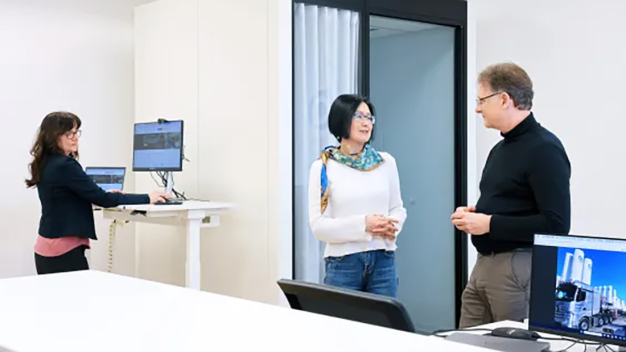
The Saxon specialist for industrial gases Air Liquide Electronics has been able to expand its customer portfolio in recent months. To coordinate upcoming large projects in the semiconductor industry more effectively, a new office was opened near Dresden Airport. Managing Director Wolfgang Steiner explains more about the background, work, and tasks of the new location in an interview.
Since when has the office at Dresden Airport existed?
Steiner: We secured the airport office due to its perfect location already over a year ago. Currently, three to four colleagues are working here. As the targeted new large projects begin, we will work more and more from here. During peak times, up to 25 experts will be employed in the office.
Why was the airport office established?
Steiner: Essentially, there are two reasons. Firstly, we lacked the spatial capacity at the Ottendorf-Okrilla site for a larger number of new colleagues. Instead of expanding the facilities there, we decided on a new office directly in Dresden. This way, the office is also close to our customers and projects. All construction sites are easily accessible from here, for example by bicycle. Our planners and engineers can quickly check the status of things during the process. Secondly, many foreign colleagues will be working here weekly or monthly, depending on the required expertise, and proximity to the airport is naturally ideal for mobility.
"Planners and engineers," that sounds exciting. What tasks is the local team responsible for?
Steiner: The colleagues at the airport are primarily project developers. Their task is to plan the facilities and countless kilometers of gas pipelines together with the customers, which supply a semiconductor factory with the necessary high-purity gases. These include, for example, oxygen or nitrogen. These gases will be produced directly on-site at the customer’s location using our air separation units. Operating such units requires a range of resources such as electricity, cooling water, or natural gas. This also needs to be planned together with the customers.
Many elements of the future air separation units will be assembled worldwide at different Air Liquide locations. The team at the airport will coordinate the individual parts and the construction of each plant. During operation, the experts will then handle analytics. This means they monitor gas production and ensure that the products continuously meet the required purity standards.
What expertise do your specialists need to have on-site for these tasks?
Steiner: We have people with extensive project experience in the airport team, as well as experts in air separation, analysis equipment, and specialists for gas purification. Additionally, there will be experts for approval procedures, safety, and on-site construction supervision.
Will the new office also collaborate with other Air Liquide locations and departments?
Steiner: Yes, the airport team works with Air Liquide locations worldwide. Besides our planning offices in Europe, such as in Germany, France, and Poland, this also includes branches and manufacturing sites in Japan, China, India, and the United Arab Emirates. The European and Asian branches play a central role in designing and manufacturing the parts for the planned air separation units. Overall, employees from many different nations will work together on our future projects, coordinated through the new office.
AIR LIQUIDE Deutschland GmbH
40476 Düsseldorf
Germany