



- New building
- Translated with AI
Groundbreaking ceremony for the medicine of the future
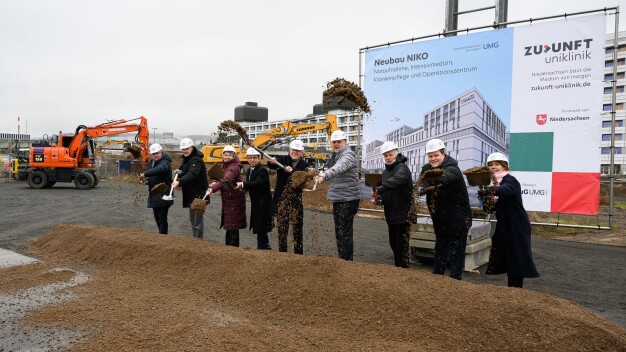
Groundbreaking ceremony for the new construction Phase 1 of the University Medical Center Göttingen (UMG): (from left) Burkhard Landré, Managing Director of the umbrella organization for construction projects at Niedersachsen University Medicine (DBHN), Christian Kilz, Managing Director of the UMG Construction Company, Petra Broistedt, Mayor of Göttingen, Falko Mohrs, Lower Saxony Minister for Science and Culture, Stephan Weil, Lower Saxony Minister President, Prof. Dr. Wolfgang Brück, Spokesperson of the Executive Board and Board of Research and Teaching of UMG, Prof. Dr. Lorenz Trümper, Board of Hospital Care at UMG, Jens Finke, Board of Business Management and Administration at UMG, Helle Dokken, Director of Nursing at UMG. (Photo: UMG)
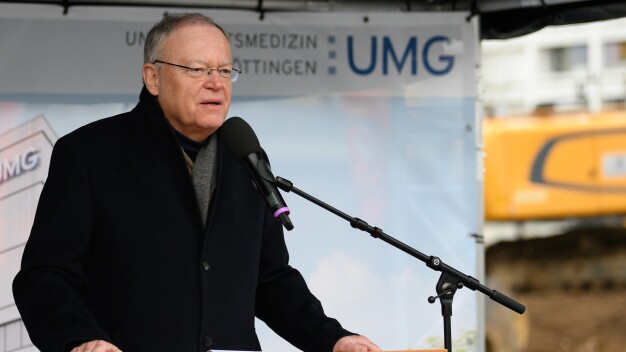
"With this groundbreaking ceremony, we send a strong signal for the future of University Medicine Göttingen," says Lower Saxony's Prime Minister Stephan Weil in his speech at the symbolic groundbreaking for the new construction phase 1 of University Medicine Göttingen (UMG). (Photo: UMG)
Lower Saxon Prime Minister Stephan Weil and Lower Saxon Minister for Science and Culture Falko Mohrs deliver speeches at the symbolic groundbreaking ceremony of Göttingen University Medical Center (UMG). Construction activities begin in January 2025. The first phase of the new building marks the start of the structural modernization of UMG's healthcare services.
The new building of Göttingen University Medical Center (UMG) is taking shape: With the symbolic groundbreaking for Construction Phase 1 on December 3, 2024, the start of construction activities in the coming years has been given. In January 2025, work will commence on the construction site in front of Bed House 1 of the university medical center. This marks the beginning of the complete structural modernization of UMG's healthcare services.
After the welcome speech by the spokesperson of the Executive Board and the Board for Research and Teaching at UMG, Prof. Dr. Wolfgang Brück, Lower Saxon Prime Minister Stephan Weil and Lower Saxon Minister for Science and Culture Falko Mohrs delivered their speeches. Subsequently, the groundbreaking ceremony took place together with UMG's Nursing Director, Helle Dokken, Göttingen's Mayor, Petra Broistedt, the Managing Director of the construction company UMG, Christian Kilz, and the Managing Director of the umbrella organization for university medical construction in Lower Saxony (DBHN), Burkhard Landré.
“Here at Göttingen University Medical Center and at the sister project at Hannover Medical School, the largest construction sites in Lower Saxony are currently emerging. With this groundbreaking, we send a strong signal for the future of Göttingen University Medical Center. I am confident that UMG will strengthen its position as a leading location for high-performance and innovative medicine in Lower Saxony. With the new building of the university medical center, we are creating healthcare of the highest quality and innovative ways to realize it for all residents of Lower Saxony. I wish all involved a successful and smooth construction phase. Rest assured, the state government remains closely supportive,” says Stephan Weil, Lower Saxon Prime Minister.
“The new hospital building emerging here will become the new heart of healthcare in Southern Lower Saxony and beyond. With its focus on neuromedicine, including a supra-regional Stroke Unit, cardiology, and oncology potential, it is an indispensable part of the German hospital landscape. At the same time, UMG, as a very significant employer, plays an outstanding role and shapes the future of healthcare through its innovative medical-university training. We are creating future-oriented structural facilities for this,” says Falko Mohrs, Lower Saxon Minister for Science and Culture.
“Today marks a milestone in the structural development of UMG. Long planned, now construction is finally underway for a forward-looking medicine that offers patients in our region and beyond excellent healthcare at university top-level. Our sincere thanks go to the state of Lower Saxony, especially to the Prime Minister himself, for establishing functional structures for the new university clinics here at UMG and also in Hannover,” says Prof. Dr. Wolfgang Brück, spokesperson of the Executive Board and Board for Research and Teaching at UMG.
The new building will house a large part of healthcare services. Covering a gross floor area of approximately 112,000 square meters—almost the size of 17 football fields—it will provide space for 624 beds (including 204 intensive care beds) and 31 operating theaters (including six outpatient surgeries). The net usable area, excluding spaces such as entrance areas, technical rooms, corridors, or stairwells, is about 51,000 square meters. The construction costs for Phase 1 amount to approximately 833 million euros, including a risk buffer, financed from the state's special fund. Completion of construction is planned for 2029, with clinical commissioning by 2030.
Many central areas of healthcare are located in NIKO – the new name for Construction Phase 1, chosen from the creative suggestions of the future users of the building. NIKO stands for Emergency Department, Intensive Medicine, Nursing, Operating Center – the medical focuses considered in Phase 1. Alongside the Central Emergency Department (ZNA) with admission stations, the intensive care units with Intensive Care Unit (ICU) and Intermediate Care (IMC) stations, as well as standard care wards, will be housed here. The building will also include the central operating theater and rooms for outpatient surgeries. Nearby, advanced imaging diagnostics with state-of-the-art MRI and CT scanners, as well as sterilization services (medical device reprocessing unit), will be located. Additionally, most outpatient clinics (ambulances of various clinics) will move into the new spaces in NIKO. Two helicopter landing pads are available on the roof for simultaneous takeoff and landing.
A focus of the new construction is on the use of modern, forward-looking technologies and a high degree of digitalization. The goal is a university medical center where core processes close to and distant from patients are fully digitalized. This is based on a comprehensive digital infrastructure, such as a space management system. This allows checking which examination rooms are available, which room can be used for meetings, and which workspace in the office is free. This aims to accelerate processes and manage resources more efficiently.
Another digital feature is tracking—monitoring medical devices, aids, or beds—which will significantly ease daily work. Items can be digitally tracked and quickly located within the system. Furthermore, for logistics and supply processes across different functional areas, an autonomous transport system (FTS) will be established, which operates automatically and contactlessly. This relieves hospital staff from transporting medicines, sterilized instruments, food, or waste, allowing them to focus on the core task of reliable patient care.
In the future, it will also be possible for patients to register for their appointments via app from home. This can significantly reduce waiting times during admission at the university medical center. For inpatient admissions, these processes will soon be implemented and professionalized in the main building of UMG.
Sustainability is also a major focus of the new construction. Among other measures, increased thermal insulation, CO2-reduced concrete, and green roofs will positively impact the climate balance during both construction and ongoing operation. The strategic goal is to operate a climate-friendly university medical center. A second sustainability component is energy supply, which also positively influences the climate balance. Specific measures include the use of heat pumps, a geothermal system for heating, and large-scale photovoltaic systems. Additionally, systems for heat recovery in various technical areas and a district heating supply for peak loads are planned.
The planned building structure also considers the well-being and health of patients and staff. To ensure sufficient daylight in interior rooms and operating areas, four green light wells are planned.
Universitätsmedizin Göttingen
37075 Göttingen
Germany