

- Buildings & Rooms
- Translated with AI
Getting smaller, finer, purer
GS Swiss PCB invests in three new cleanrooms for circuit boards
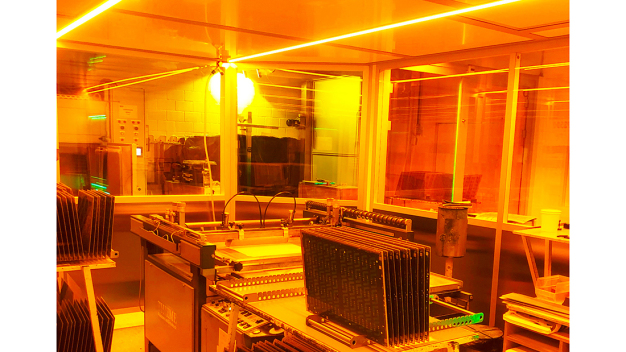
Cleanroom with yellow light for the final photosensitive process.
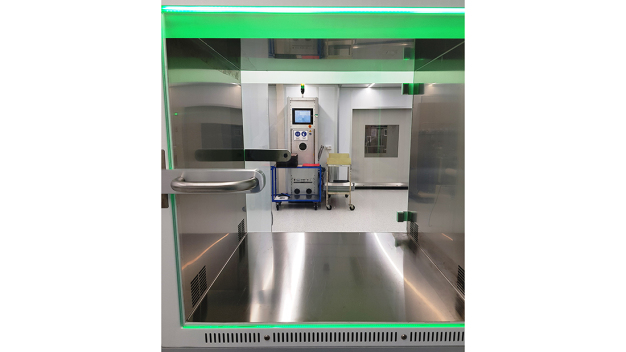
View through the material lock into the multilayer production.
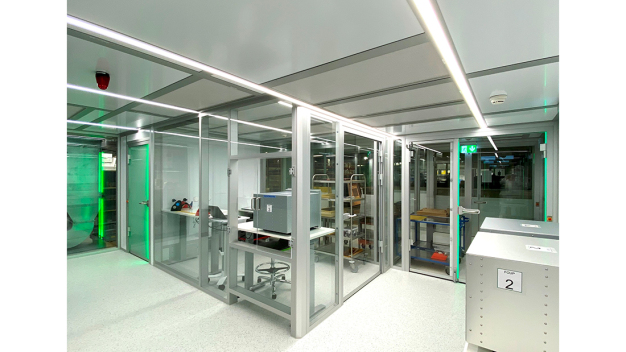
Fully glazed ISO5 cleanroom CleanCell4.0® for the new sputtering system.
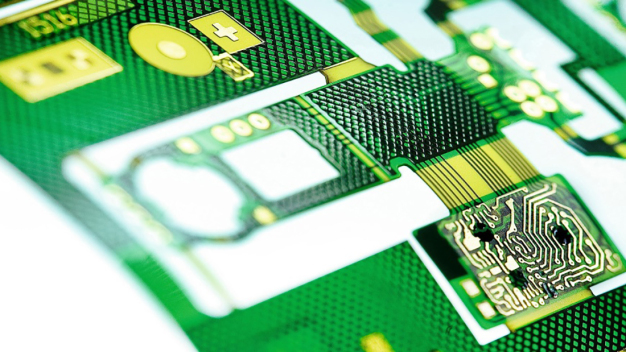
Flexible circuit board for use in hearing aids.
Swiss GS Swiss PCB produces printed circuit boards for medical technology and electronics, made from ultra-thin base materials of only 12 μm. To produce even finer and more precise structures in the future, the high-tech company has invested in three CleanCell4.0® cleanrooms. The new cleanroom facilities were installed without dismantling the existing production lines, allowing production to continue during the renovation.
Smallest components, barely visible to the naked eye, have led to rapid advances in electronics in recent years, enabling increasingly powerful devices. Printed circuit boards ensure the functionality of cell phones, computers, cars, and airplanes. In medical technology, such as hearing aids, these tiny components enable high functionality of the technology in the smallest space.
GS Swiss PCB specializes in the production of miniaturized printed circuit boards and competes in this fiercely contested market with 170 employees against strong Asian competition. The Swiss high-tech company achieves this by guaranteeing very high reliability of sensitive products and through customized manufacturing with short delivery times.
Three new cleanrooms for controlled processes
To enable the development of sensitive components into even smaller structures, GS Swiss PCB has invested in three new cleanrooms for various process steps. Edgar Camenzind is Deputy Production Manager and explains the importance of cleanroom technology for manufacturing quality: “The critical processes in the production of our highly integrated printed circuit boards take place in cleanrooms. Every speck of dust is our enemy and leads to scrap in production. We must produce completely controlled and without any contamination. This is only possible with cleanroom technology. In the future, we want to further improve our fine structures and have therefore set up three new cleanrooms for different process steps.”
The three new systems at GS Swiss PCB were planned, manufactured, and installed by their long-standing cleanroom partner SCHILLING ENGINEERING. A major challenge was the tight spatial conditions, which required precisely adapted solutions. To minimize production downtime, part of the cleanroom installation was carried out without dismantling the existing production lines.
Sputtering in confined spaces
The development steps in printed circuit board production are highly specialized and divided into different areas. Newly introduced at GS Swiss PCB is their own sputtering system, where the carrier film is coated. The film serves as the base material for all subsequent processing steps. For the sputtering process, a 40 m² cleanroom system of ISO cleanroom classes 5 and 6 was installed. Materials are brought into the cleanroom via a 1.50-meter wide material transfer chamber with a double swing door for forklifts. At the request of the Swiss company, cleanroom walls, doors, and pass-throughs are fully glazed to allow unobstructed visibility from outside into the workspace. A particular challenge was the extremely tight space for the ceiling plenums of the cleanroom. Filter units and ventilation ducts were carefully arranged by the engineers from Schilling Engineering precisely between the building’s existing piping to make the best possible use of the limited space.
Multilayer production during cleanroom construction
In another process step, multi-layer rigid, rigid-flexible, and flexible printed circuit boards are produced. The ultra-thin carrier films are bonded and pressed in multiple layers. The newly installed 130 m² cleanroom meets the conditions of ISO cleanroom classes 7 and 8.
The multilayer production was not halted during the cleanroom construction but was shifted to night shifts to avoid significant production losses. The installation of the cleanroom system was carried out without removing existing machines, conveyor belts, and connections of the production line from the room. The cleanroom walls were installed in front of the existing walls and windows of the building.
Edgar Camenzind is responsible for multilayer production. The deputy production manager recalls the challenging construction period: “Setting up the cleanrooms was quite a challenge. For us and also for the Schilling Engineering team. We continued full production during the renovation. For multilayer manufacturing and the final photosensitive process, the cleanroom systems were essentially built around the production line. That required a lot of flexibility and organization from all of us.”
Yellow light for photosensitive production
In the final process step, coating is applied to the printed circuit boards and multilayers. Here too, production must not be contaminated by particles due to the tight tolerances in micrometer-precise processing. An additional 95 m² of cleanroom space ensures safety in the final processing. Under ISO Class 5 conditions, materials are printed, exposed, developed, and packed. Certain areas are separated by cleanroom curtains. 25 high-performance filters installed directly over the processes and a high air exchange rate of > 95/h guarantee contamination-free production of fine structures.
Since UV light must not reach the sensitive materials during coating, a special yellow light illumination was installed, and the windows and glass doors of the cleanroom were coated with yellow film. Another special feature are wall modules made of stainless steel, which facilitate the increased cleaning requirements of photosensitive production.
Good coordination and short distances
After several months of planning and construction in various phases, all three cleanrooms at GS Swiss PCB have been put into operation. A total of 277 m² of ceiling modules with LED light strips and 58 filter fan units were installed. The modular design of the CleanCell4.0 cleanroom system allows for future expansion of the cleanroom facilities. The cleanrooms are equipped with the intelligent control and monitoring system CRControl® including monitoring. The cleanroom-compatible setup of personnel sluices and the final qualification were also handled by Schilling Engineering. Edgar Camenzind is pleased that he can now fully focus on the demanding production of multilayers: “The cleanroom project went very well. It was actually several projects with different requirements. Good coordination with the cleanroom company was extremely important. We always had direct access to Ute Schilling, who coordinated the overall project. Short communication channels, always reachable—definitely a big advantage.”
The deputy production manager is pleased with the smooth operation of the cleanrooms and especially with the fact that the secure production of customer-specific printed circuit boards ensures the functionality of modern hearing aids and thus contributes to a better quality of life.

Schilling Engineering GmbH
Industriestraße 26
79793 Wutöschingen
Germany
Phone: +49 7746 927890
email: info@schillingengineering.de
Internet: http://www.schillingengineering.de