


- Trade fair
- Translated with AI
Fraunhofer IPA presents exhibits on energy and sustainability
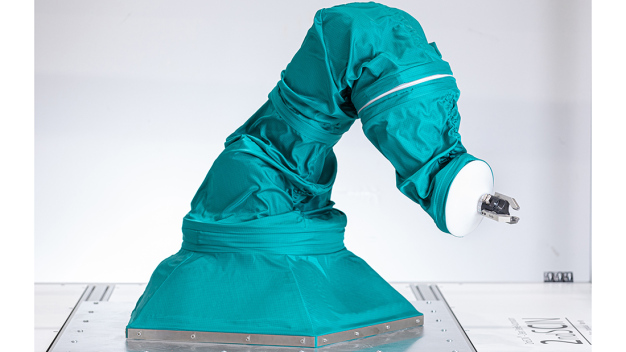
The protective enclosure 2ndSCIN® makes robots and other dynamic automation components ready for ultra-clean production. © Fraunhofer IPA/Photo: Rainer Bez
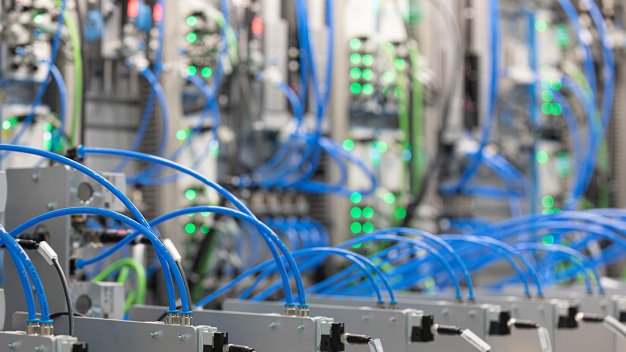
This demonstrator is used by Fraunhofer IPA, the University of Stuttgart, and sensor manufacturer Sick to train an intelligent algorithm that detects leaks in compressed air systems. © Fraunhofer IPA/Photo: Rainer Bez
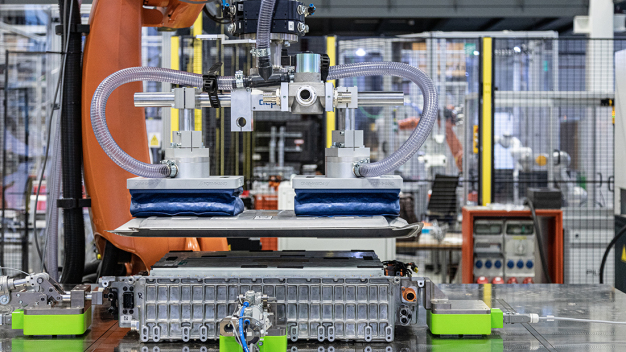
This robot cell can perform all the necessary work steps required for the disassembly of decommissioned battery systems. © Fraunhofer IPA/Photo: Rainer Bez
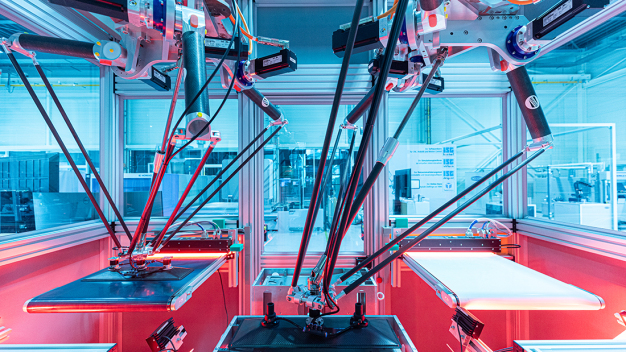
Fraunhofer IPA and Campus Schwarzwald have developed a robot cell in which two delta robots quickly alternate stacking bipolar plates and membrane electrode units for fuel cell stacks. © Fraunhofer IPA / Photo: Rainer Bez
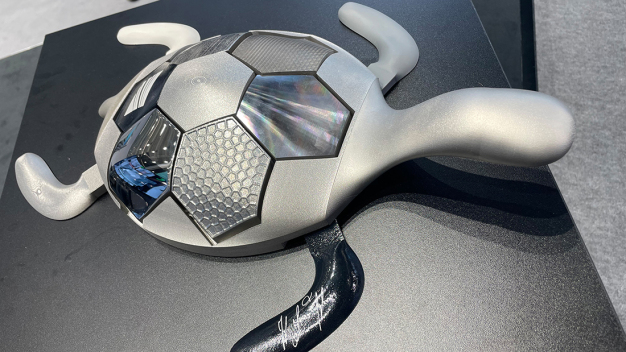
The shell of this turtle demonstrates various ways to improve the rough and porous surfaces of additively manufactured components. © Fraunhofer IFF
"Energizing a Sustainable Industry" is the motto of this year's Hannover Messe. The topics of energy and sustainability are also a comprehensive research focus of the Fraunhofer IPA. Insights into ongoing and completed research projects are presented by the institute from April 22 to 26, 2024, at two exhibition stands.
Among the main themes of the fair, the Fraunhofer Institute for Production Technology and Automation IPA conducts numerous research and transfer projects. Several departments are engaged with energy efficiency, hydrogen technology, or battery cell production. All share the question of how resource use in production can be made more efficient and waste avoided. This includes, for example, the Department of Industrial Energy Systems, which offers solutions for customized energy systems. The focus is on optimizing energy efficiency, reducing CO2 emissions, and maximizing supply security.
From April 22 to 26, 2024, researchers from several departments will present their results and provide insights into ongoing research projects at two different exhibition stands:
– Baden-Württemberg International in Hall 12, Stand D15
– Fraunhofer-Gesellschaft in Hall 2, Stand B24
Direct Current for Industry
The solar cells on the roof and the battery storage in the yard have one thing in common: they both supply direct current. So why not operate the entire factory with direct current? This saves energy and resources. The savings in infrastructure, logistics systems, and manufacturing robots range between eight and twenty percent. The often oversized rectifiers of individual machines are eliminated, and braking energy can be fed into the DC network. A research team led by Isabella Bianchini from the Department of Industrial Energy Systems at Fraunhofer IPA has developed a system concept, together with partners from science and industry, that enables the introduction of DC networks in factories. Insights into practical applications are provided at the Baden-Württemberg International booth: Hall 12, Stand D15.
Transparency of Corporate CO2 Consumption
Consistent climate protection requires a holistic approach across the entire value chain. In the completed research project "Climate Solutions for Industries" (CS4I), a team led by Christian Schneider from the Department of Industrial Energy Systems at Fraunhofer IPA, together with industry partners, developed an app that can determine the so-called "True Carbon Footprint" of a product across company boundaries. Processes upstream and downstream of production can account for up to 70 percent of total CO2 emissions in some cases. CS4I addressed various aspects from raw material procurement, investment decisions, to delivery, so that companies can consider sustainability and economic efficiency simultaneously. A digital twin of machines and systems serves as the decision basis. A prototype of the open platform concept developed by CS4I is shown by scientists at Hall 12, Stand D15.
Artificial Intelligence Detects Leaks in Compressed Air Systems
The most expensive energy is that which is wasted: estimates suggest that about one-third of the compressed air produced by a company escapes unused through tiny holes and leaks. The costs of this waste can quickly amount to tens of thousands of euros per year. Detecting leaks was previously labor-intensive. Now, Fraunhofer IPA, the University of Stuttgart, and sensor manufacturer Sick have developed an automated detection system. The core is a flow sensor that continuously records mass flow, pressure, and temperature profiles. An intelligent algorithm analyzes these curves in real time and recognizes characteristic signatures indicating leaks. The current status of this joint development is demonstrated by a prototype at the Baden-Württemberg International booth: Hall 12, Stand D15.
Productive, Pure, and Sustainable: Innovations for Battery Cells
Even more important than compressed air for production is the battery cell for electric vehicles. It should be compact, as powerful as possible, and above all, safe. This places high demands on manufacturing. Researchers from the Center for Digitized Battery Cell Production at Fraunhofer IPA show what future production could look like. Their goal is to establish and fully digitize the entire manufacturing chain of lithium-ion batteries on a laboratory scale. The focus is on stabilizing and increasing productivity while considering strict economic and ecological conditions.
An absolutely clean environment and very low humidity are essential for battery cell production. A mobile cleanroom tent, DryCleanCAPE®, developed by a team led by Udo Gommel and Frank Bürger, allows for cost-effective, quick, and flexible creation of a clean and dry production environment, achieving air purity levels similar to high-quality conventional cleanrooms. DryCleanCAPE® consists of two different enclosures, providing dryness and particle and chemical-free conditions independently through separate air treatment units. Visitors can see what DryCleanCAPE® looks like and how it works at Hall 12, Stand D15.
But not only is the efficient production of battery cells under clean conditions becoming increasingly important; recycling of used battery systems is also critical. If all announcements are fulfilled, nearly 50 million electric vehicles could be on the roads worldwide by 2030. Their batteries contain valuable raw materials such as nickel, cobalt, manganese, and lithium, which can be reused. The research project "Industrial Dismantling of Battery Modules and Electric Motors" (DeMoBat) has developed a robotic cell equipped with various tools capable of performing all necessary dismantling steps and suitable for many battery types. More about the DeMoBat project can be learned by visitors at Hall 12, Stand D15.
Industrial Mass Production of Electrolyzers and Fuel Cells
Alongside batteries, hydrogen is considered a promising energy carrier that is clean and versatile. Hydrogen is particularly interesting for industry and heavy-duty transport. To replace currently emission-intensive processes with hydrogen technologies, extensive research along the entire value chain is still needed—from the production of electrolyzers and fuel cells.
Both electrolyzers and fuel cells are currently often manufactured in so-called manual production, involving a lot of manual labor. "If fuel cells are to replace combustion engines in heavy-duty transport, they must be produced in industrial mass production, largely automated, and cost-effective," says Erwin Groß from the Department of Corporate Strategy and Development at Fraunhofer IPA. A research team from Fraunhofer IPA and the Center for Digitalization, Leadership, and Sustainability Schwarzwald (Campus Schwarzwald) has now succeeded in this. The "H2FastCell" project has developed a robotic cell where two robots rapidly stack bipolar plates and membrane electrode assemblies alternately for fuel cell stacks.
In a similar robotic cell, electrolyzers could also be mass-produced in the future, as they also consist of multiple layers—two electrodes and a proton exchange membrane (PEM) in the middle—and are stacked. The "Industrialization of PEM Electrolyzer Production" (PEP.IN) project aims to automate not only this so-called stacking process but the entire production line by spring 2025—covering all downstream processes up to end-of-line testing. Insights into the PEP.IN and H2FastCell research projects are available at the Baden-Württemberg International booth: Hall 12, Stand D15.
The Entire Hydrogen Value Chain Comes into Focus
The research project "Transformable, Energy-Flexible, and Networked H2 Industry Research Platform" (WAVE-H2) by the University of Stuttgart goes even further. It considers a comprehensive industrial energy system with a focus on hydrogen utilization. Over the coming years, a hydrogen industry research platform will be built on the university campus in Stuttgart and adjacent to the Schwarzwald campus in Freudenstadt, with a total budget of around 36 million euros. It will integrate various technological options for the production, distribution, storage, and consumption of hydrogen within a connected industrial energy system, enabling systematic development and testing of innovative production and energy technologies. The industrial-scale research platform will be built and operated at full scale, allowing companies to retrofit and test their processes. More about WAVE-H2 can be learned by visitors at Hall 12, Stand D15.
Lossless Coating for Surface Refinement of Additively Manufactured Parts
Additive manufacturing processes have long become part of industrial reality. They offer high flexibility and enable new products and solutions across many industries. However, the surface of additively manufactured parts generally exhibits porosity or roughness, requiring post-processing. A display from the Fraunhofer Production Alliance addresses this issue. It shows various ways to improve the surface properties of additively manufactured parts. Fraunhofer IPA presents the technology of lossless coating as a method for automated decoration and coating of additively manufactured plastic parts. This combines expertise from additive production by Oliver Refle and coating technology by Oliver Tiedje. Optimized process control in additive manufacturing, combined with targeted post-treatment to smooth the surface, forms the basis for subsequent coating without paint mist—using coating systems specifically tailored to the surface properties of additively manufactured plastic parts. This makes high-quality surface finishes economically feasible even for personalized parts. The exhibit can be seen at the Fraunhofer-Gesellschaft joint stand: Hall 2, Stand B24.
2ndSCIN® – a Custom Suit for Robots
"The key technologies of tomorrow only advance with purity technology. It is decisive: from battery production to biotechnology," says Udo Gommel, head of the Reinst- and Microproduction Department at Fraunhofer IPA. To meet these requirements, Gommel and his team developed the protective enclosure 2ndSCIN®. It makes dynamic automation components, such as robots, ready for ultra-clean production. 2ndSCIN® consists of a permeable, movable textile. Depending on the application, two or more layers can be stacked. The layers are separated by spacers. In each gap, air can be sucked in or exhausted. This allows particles from the environment or automation components to be removed. The supply of special gases into the system's gaps enables sterilization, for example, for life science applications—both of the enclosed automation component and of the suit itself. The textile layers are also equipped with sensors that continuously measure parameters such as particle concentration, chemical contamination, pressure, or humidity. AI-based algorithms analyze this sensor data to enable predictive maintenance and assess the current cleanliness status. The protective enclosure can be replaced in about an hour and can be reused after decontamination. 2ndSCIN® can be seen at the Fraunhofer-Gesellschaft joint stand: Hall 2, Stand B24.
Lectures and Panel Discussions: The Framework Program of Hannover Messe
Even outside the two exhibition stands, guests will meet at the Fraunhofer IPA during the framework program of Hannover Messe. On Tuesday, April 23, the "Industrial Transformation Stage" in Hall 3 will host the all-day event "Industrial AI," providing insights into joint research projects on artificial intelligence, presented by Fraunhofer IPA together with renowned industry partners in use cases.
One day later, on Wednesday, April 24, Professor Thomas Bauernhansl, director of Fraunhofer IPA, will participate in a panel discussion titled "Biointelligent Value Creation in Mechanical and Plant Engineering" at the TechTransfer Conference Stage in Hall 2, Stand B02, starting at 10:50 a.m. He will present the results of a new international benchmark study on biointelligence, together with representatives from the University of Hohenheim, the German Mechanical Engineering Industry Association (VDMA), and Festo.

Fraunhofer-Institut für Produktionstechnik und Automatisierung IPA
Nobelstraße 12
70569 Stuttgart
Germany
Phone: +49 711 970 1667
email: joerg-dieter.walz@ipa.fraunhofer.de
Internet: http://www.ipa.fraunhofer.de