

- R+D & Community of Interest
- Translated with AI
Fraunhofer IPA presents disinfection robot »DeKonBot«
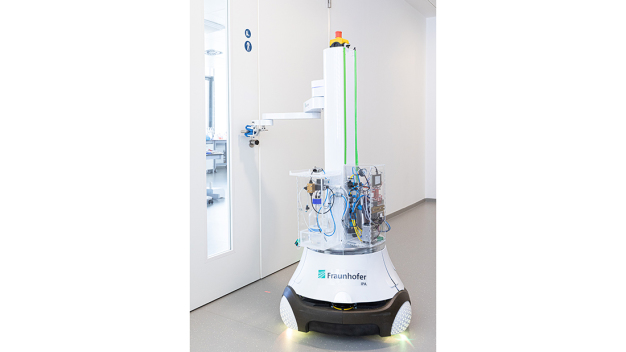
The mobile cleaning and disinfection robot DeKonBot autonomously travels to critical objects such as door handles and disinfects them. (© Fraunhofer IPA, Rainer Bez)
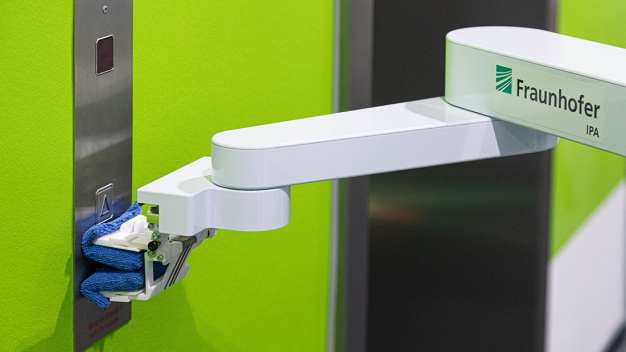
Using its flexible cleaning tool, DeKonBot can perform wiping disinfection of various objects, e.g., elevator buttons. (© Fraunhofer IPA, Rainer Bez)
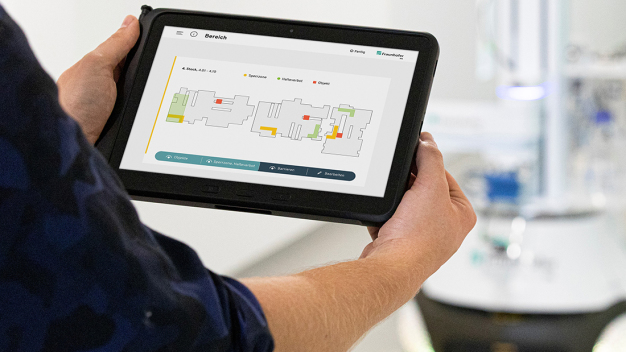
The operating environment is learned via an intuitively operable graphical user interface. (© Fraunhofer IPA, Rainer Bez)
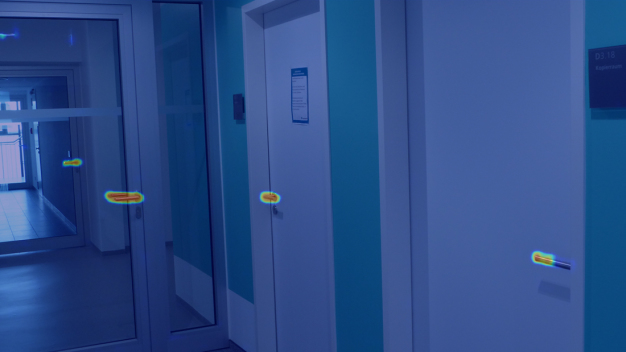
Methods of machine learning enable the detection of objects to be cleaned in the room, here exemplified by door handles in a corridor. (© Fraunhofer IPA)
To contain the spread of the coronavirus, the Stuttgart research institute quickly developed a prototype of a mobile cleaning and disinfection robot. It autonomously travels to potentially contaminated objects such as door handles, thoroughly disinfects them, and does so in a resource-efficient and time-efficient manner.
The new prototype of the mobile disinfection robot "DeKonBot" is an automation solution that independently cleans and disinfects potentially contaminated areas such as door handles, light switches, or elevator buttons. Compared to manual cleaning, the use of the robot reduces the infection risk for cleaning staff and ensures that the cleaning is performed reliably and traceably. By continuously deploying the robot even during the night, cleaning can be performed more frequently than in manual operation.
Targeted and Safe Disinfection
Compared to available robot solutions on the market, DeKonBot differs in several ways. Firstly, it cleans relevant surfaces directly and specifically, and does not spray disinfectants broadly throughout the room like various other robots. This not only saves disinfectant and time by limiting the area to be cleaned to the essentials but also prevents hazards such as slipping on wet surfaces or inhaling potentially harmful substances. Secondly, DeKonBot can be safely used around people. Disinfection robots that, for example, use UV rays to kill viruses require a human-free environment for safety reasons.
For DeKonBot to work effectively, it is initially trained in its new environment with the help of a tablet that is easy to operate even without robotics expertise. In the first step, the operating personnel guide the robot through the environment, during which it autonomously creates a map of its deployment area. Additionally, the user "shows" the robot the objects to be cleaned and the cleaning movements to be performed: for this purpose, the user guides the robot arm with the disinfection tool to the door handle and moves the tool as required for cleaning. The robot records the path and can repeat it independently thereafter.
The recognition of objects to be cleaned is currently still done using so-called "tags," small black-and-white signs. The robot positions itself relative to these. In the future, tags will no longer be needed. Instead, new methods developed at the Fraunhofer IPA will be used, which enable automatic recognition of these objects in camera data. Additionally, a new 3D sensor developed within the project better detects the objects to be cleaned and their position in space than available sensors — for example, even if it is a metallic, reflective surface. Based on these recognition functions, the robot can automatically plan and execute cleaning movements in the final development stage.
Joint Rapid Development
The prototype is the result of a collaborative IPA development involving the departments of robot and assistance systems, laboratory automation, bioproduction technology, and cleaning and microproduction. DeKonBot received funding from the Fraunhofer-Gesellschaft's internal program "Anti-Corona," which supports comprehensive research and innovation activities to combat the pandemic.
The development of the service robot progressed rapidly. A first feasibility study was conducted as early as April of this year, using a simple spray tool for disinfection. "Only four months later, we were able to put the robot with its new wiping disinfection tool into operation — despite the restrictions imposed by the COVID-19 pandemic on our Fraunhofer staff," explains Dr. Birgit Graf, group leader for household and assistance robotics and responsible for the development of DeKonBot.
The development of the prototype benefited from extensive preliminary work by the institute in mobile service and cleaning robotics. For example, the mobile platform of the assistance robot Care-O-bot® 4, which is already marketed by an spin-off of the institute as a series product, is used. Existing software modules for navigation, 3D object recognition, and manipulation were further developed for specific applications. Currently, initial long-term tests of the robot are being conducted in the office rooms of the Fraunhofer IPA. Subsequently, employees of a cleaning company will test the robot in an external building. By the end of the project in February 2021, the robot will be further optimized based on these tests. Measurements of microbial contamination in disinfected areas will serve to verify the added value of the robot.
Furthermore, the research project "Mobile Disinfection" (MobDi), which started in October of this year and is also funded by the Fraunhofer-Gesellschaft, will build on and further develop the technologies of DeKonBot. Specifically, new disinfection methods and tools, as well as more complex recognition and planning methods, are to be developed within the one-year project period to enable even more targeted cleaning and disinfection.
Focus on Series Readiness
Although DeKonBot has not yet reached its full functionality, the researchers at the Fraunhofer IPA have already developed a concept for a later series product. "Together with interested companies, we want to bring the service robot into practical use and thereby contribute to the restart of public life even in times of COVID-19," states Graf about the next goals. Several cleaning companies, which were actively involved in the development of the robot, have already expressed their interest in deploying the DeKonBot.

Fraunhofer-Institut für Produktionstechnik und Automatisierung IPA
Nobelstraße 12
70569 Stuttgart
Germany
Phone: +49 711 970 1667
email: joerg-dieter.walz@ipa.fraunhofer.de
Internet: http://www.ipa.fraunhofer.de