




- R+D & Community of Interest
- Translated with AI
Fraunhofer IPA and HLRS initiate collaboration
Computing power for the highest demands
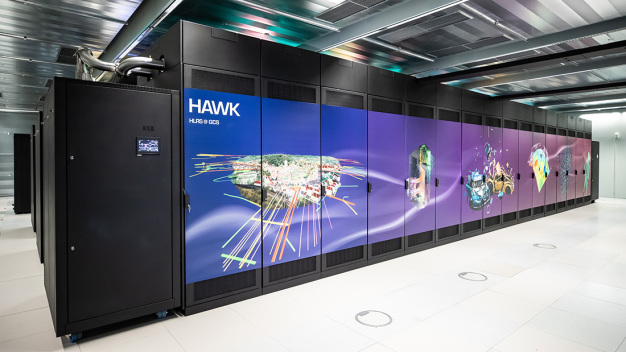
The Fraunhofer IPA can now use the computing power of the supercomputer "Hawk" for its project work. (© HLRS)
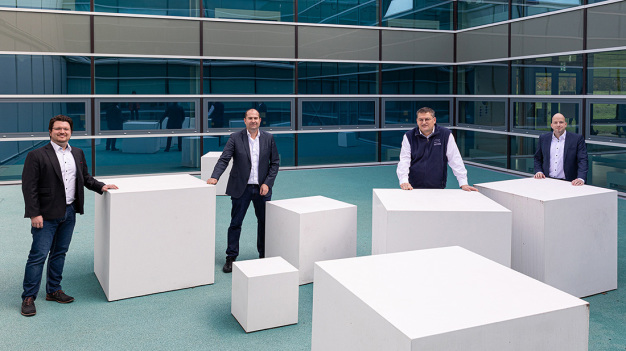
02- Cooperation Partners In November 2020, the cooperation between both institutions was sealed (from left to right): Raoul Schönhof, Head of Fachthemen Machine Learning at Fraunhofer IPA, Bastian Koller, Managing Director of HLRS, Professor Michael Resch, Director of HLRS, and Professor Marco Huber, Department Head at Fraunhofer IPA. (© Fraunhofer IPA)
Whether for simulations, data-intensive calculations as a basis for machine learning methods, or for learning robots: Fraunhofer IPA is now collaborating with the High-Performance Computing Center Stuttgart (HLRS). The research institute can thus access enormous computing power and realize new projects and applications.
At the beginning of this year, the newly commissioned supercomputer "Hawk" made quite a splash. With it, HLRS currently offers the University of Stuttgart one of the most powerful computers in Germany. Its up to 26 petaflops — one petaflop equals a quadrillion calculations per second — are now benefiting the staff of Fraunhofer IPA for their projects. Because in November of this year, the research institute and HLRS launched their cooperation. The already longstanding proximity in Stuttgart's Nobel Street can now also bear fruit in terms of content.
Of strategic importance
"This partnership is of outstanding importance for Fraunhofer IPA," explains Professor Marco Huber, head of the Center for Cyber Cognitive Intelligence and the Department of Image and Signal Processing at Fraunhofer IPA. "In increasingly many industrial and research projects, data processing is a success factor. I think, for example, of learning procedures based on large data sets or the verification of neural networks for safety-critical applications such as autonomous driving or human-robot collaboration," adds Huber. He sees the institute's ability to access the relevant high-performance computers project-related as a great added value.
HLRS also explicitly welcomes this partnership, as it offers its services, hardware, and software to both science and industry, especially to small and medium-sized enterprises. Fraunhofer IPA, with its applied research, can bridge the gap between the two. "The partnership with the neighboring Fraunhofer IPA opens up several opportunities for HLRS: on the one hand, it supports our goal to further expand and improve the overall solution of high-performance computing, high-performance data analytics (HPDA), and artificial intelligence for our users. On the other hand, we can jointly explore the field of quantum computing more efficiently," says Bastian Koller, managing director of HLRS. Furthermore, the partnership will test new applications involving high-performance computing and other related technologies in the context of industrial research.
Logical step
The IPA scientist and specialist in machine learning, Raoul Schönhof, initiated and implemented the cooperation. "I am very pleased about the collaboration," says Schönhof. "Because even today, we work extensively with complex simulations to, for example, teach robots new skills virtually and without disrupting ongoing production operations. These simulations, which can be expanded to encompass entire factories, can now be carried out at a completely new level," he summarizes.

Fraunhofer-Institut für Produktionstechnik und Automatisierung IPA
Nobelstraße 12
70569 Stuttgart
Germany
Phone: +49 711 970 1667
email: joerg-dieter.walz@ipa.fraunhofer.de
Internet: http://www.ipa.fraunhofer.de



