

- R+D & Community of Interest
- Translated with AI
Fraunhofer builds for the location – lightweight – efficient – economical – communicative
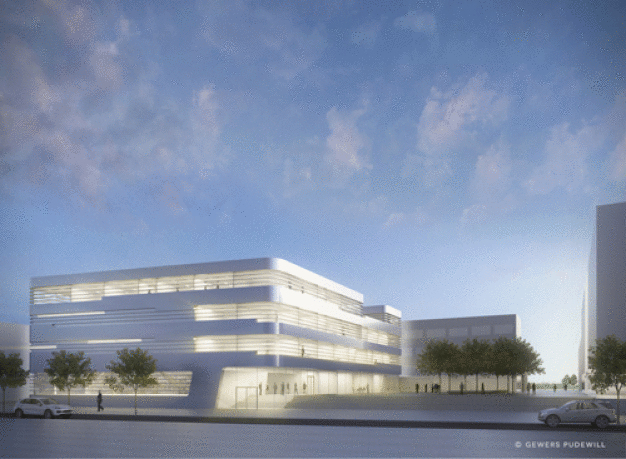
The planned building U for lightweight construction technologies at Fraunhofer IPA. (Source: © Gewers & Pudewill GmbH)
On the grounds of Birkhof in Stuttgart-Vaihingen, opposite the Fraunhofer Institute Center, construction work is beginning on Building U. Starting in 2021, processing technologies for lightweight construction will be developed there. The groundbreaking ceremony is on May 20, 2019.
With the groundbreaking, the official work on the construction site begins: the State Secretary in the Ministry of Economics, Labor and Housing Baden-Württemberg, Katrin Schütz, will symbolically open the construction site together with the institute directors of Fraunhofer IPA, Professors Fritz Klocke and Thomas Bauernhansl, as representatives of the state government.
In the now emerging Building U, Fraunhofer IPA will research from 2021 for and with industry – especially small and medium-sized enterprises – processes that sustainably reduce energy and material consumption in production. The developed lightweight machine components require less material and have a lower weight, thus saving energy during operation. The newly developed processes for the efficient processing of lightweight materials such as CFRP, aluminum, or multi-material mixes also make the use of these lightweight materials cost-effective and economical.
Functions and requirements of the building
For all these tasks, researchers need production machines such as high-performance CNC machines, which are partly designed together with companies and have corresponding industrial dimensions. Typical sizes and weights are 40–50 square meters of floor space for a milling machine with a machine weight of around 12 tons. These machines and systems often have a height of 3 meters.
The research operation and long-term use of the building mean that there cannot be a fixed equipment of the laboratory with machines. Instead, the machine inventory is oriented towards the needs of the companies and the state of the art. Therefore, flexible placement of machines is necessary.
Machines must be able to be lifted over already installed machines with a crane. The hall must be accessible with heavy equipment and have a corresponding ceiling height. The floor must also be suitable for the high machine weights and movements.
Adhesive and welding machines for connection technology for lightweight materials are to be housed in special laboratories that guarantee high air cleanliness. For assembly of components, especially fine assembly, climate-controlled rooms are needed, which are decoupled from the more polluted hall.
For simulations, analyses, designs, reports, etc., which take place at computer workstations, sufficient office space is needed. Transferring results to a broad professional audience particularly requires meeting rooms as well as a seminar room that also enables the conduct of larger conferences.
Short distances
The design by Gewers & Pudewill Architects from Berlin consolidates all these functions into a building approximately 37 meters wide and 55 meters long on a 5,700-square-meter footprint. The compact organization of the building allows short distances from the offices to the technical area, enabling intensive exchange between office workstations and the machine hall on the one hand, and IPA researchers, developers from the project group, and companies on the other.

Fraunhofer-Institut für Produktionstechnik und Automatisierung IPA
Nobelstraße 12
70569 Stuttgart
Germany
Phone: +49 711 970 1667
email: joerg-dieter.walz@ipa.fraunhofer.de
Internet: http://www.ipa.fraunhofer.de