



- Translated with AI
For body scanner and material testing
New imaging method for terahertz radiation relies on micro-mirrors
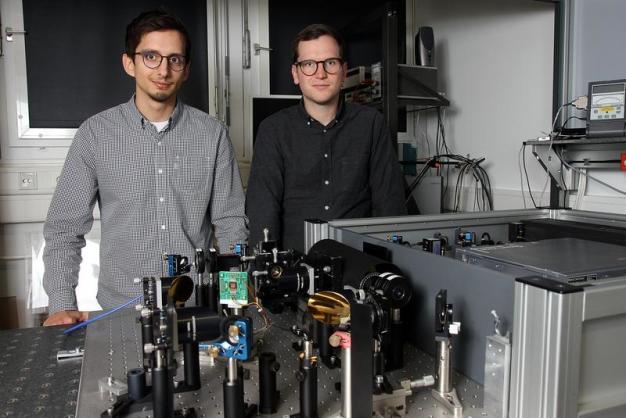
The team around Jan Kappa (re.) and Dominik Sokoluk has developed this new module. (Photo: Koziel/TUK)
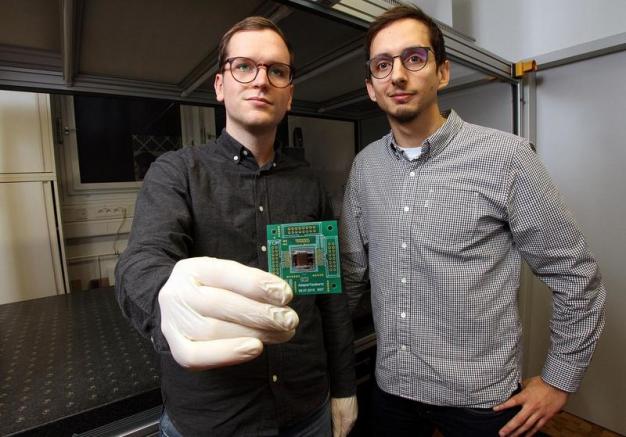
The researchers are working to optimize their micro-mirror modulator for material analysis. (Photo: Koziel/TUK)
Terahertz waves are used in airport body scanners: They are electromagnetic waves in the spectrum between microwaves and infrared radiation. "They penetrate materials such as paper, wood, and ceramics and are non-ionizing and harmless to humans," says Jan Kappa from the working group for Metamaterials and Terahertz Technology in the Department of Electrical Engineering and Information Technology at the Technical University of Kaiserslautern (TUK).
However, it is still associated with enormous technical effort and time to examine and identify objects contactlessly using imaging terahertz spectroscopy. A first component that could enable such a technique in the future has been developed by researchers at TUK. With their electromechanically controllable micro-mirror modulator, it should soon be possible to examine objects using fast imaging terahertz spectroscopy.
Terahertz waves lie in the electromagnetic spectrum between microwaves and infrared radiation. "They penetrate materials such as paper, wood, and ceramics and are non-ionizing and harmless to humans," says Jan Kappa from the working group for Metamaterials and Terahertz Technology in the Department of Electrical Engineering and Information Technology at the Technical University of Kaiserslautern (TUK).
However, it is still associated with enormous technical effort and time to examine and identify objects contactlessly using imaging terahertz spectroscopy. A first component that could enable such a technique in the future has been developed by researchers at TUK. With their micro-mirror modulator, they can spatially selectively alter terahertz radiation — similar to how light beams are controlled by an adjustable aperture in a camera. The technology works as follows: a source emits terahertz radiation, which hits the modulator. "Thanks to its micro-mirrors, it now switches a specific pattern that is imprinted into the radiation," explains Kappa about the process. The pattern then hits the object to be examined. Part of the radiation is absorbed, part continues on and is focused onto a detector. Through multiple passes and different switched patterns, the image can eventually be reconstructed. "This method involves indirect imaging," continues Kappa. "We know the switched pattern and the corresponding output signal. Algorithms can reconstruct the image of the object from these data."
With this method, the researchers are able to cover a very broad frequency spectrum. "In addition to spatial information about the object, we also collect spectral information for each individual pixel," explains Kappa. "This was previously only possible to a limited extent because comparable methods could only influence terahertz waves within a very narrow spectral range."
The novel micro-mirror system allows the spectral properties of objects to be examined within the shortest possible time. "Potentially, this can be used to identify chemical substances based on spectral fingerprints in the terahertz spectral range without scanning the objects for minutes," says Professor Dr. Marco Rahm, head of the department, about the technology.
On campus, the researchers produced their micro-mirror modulator themselves in the cleanroom of the NanoStructuring Center. In the coming months, they will mainly work on optimizing the modulators for material analysis. The technology is particularly interesting for food monitoring, where contaminants from manufacturing and packaging can have health consequences. It is also suitable for non-destructive material testing in the automotive or aerospace industries, for example to look beneath a paint layer. Additionally, the method can be used in the pharmaceutical industry and medical technology.
The researchers already presented their technology at the beginning of the year in the renowned journal Scientific Reports. In September, Jan Kappa received second place for the Best Student Paper Award at the International Conference on Infrared, Millimeter, and Terahertz Waves (IRMMW-THz) 2019 in Paris.
The team around Jan Kappa, Dominik Sokoluk, Corey Shemelya, and Professor Dr. Marco Rahm collaborated closely with Steffen Klingel and Professor Dr. Egbert Oesterschulze from the Chair of Physics and Technology of Nanostructures at TUK. The team led by Dr. Sandra Wolff from the NanoStructuring Center was also involved in the development. The research work is part of the State Research Center for Optics and Material Sciences (OPTIMAS).
The study "Electrically Reconfigurable Micromirror Array for Direct Spatial Terahertz Modulation of Terahertz Waves over a Bandwidth Wider Than 1 THz" was published in the journal Scientific Reports. DOI: 10.1038/s41598-019-39152-y
Questions answered by:
Jan Kappa
Chair of Theoretical Electrical Engineering
Working Group for Metamaterials and Terahertz Technology
Tel.: 0631 205-5334
Email: kappa@eit.uni-kl.de
Technische Universität Kaiserslautern
67663 Kaiserslautern
Germany