




- R+D & Community of Interest
- Translated with AI
Flexible proximity sensor makes surfaces intelligent
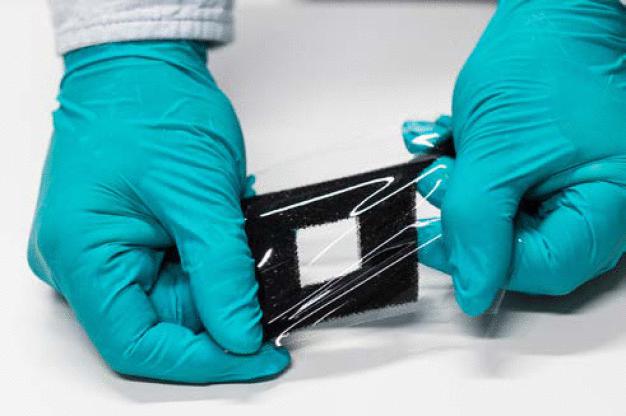
With its elastic design, the proximity sensor can be flexibly attached to large surfaces. (Source: Fraunhofer IPA, Photo: Rainer Bez)
The Fraunhofer IPA has developed a proximity sensor based on silicone and carbon nanotubes (CNT) that detects objects and determines their position. Using the materials and printing process, the sensor is highly flexible, cost-effective, and suitable for large surfaces. Industry and research partners can now implement and further develop this innovation.
At first glance, the proximity sensor doesn't seem particularly spectacular: a thin, elastic silicone layer with black square areas printed on it. What looks like paint are actually countless microscopically small carbon nanotubes that can locate people or objects. "The proximity sensor detects anything that is electrically conductive. When an object approaches, the electric field changes," explains IPA scientist Florian Bodny. However, this is only visible when connected to evaluation electronics. When a hand or a metallic object is held over it, the lamp lights up. Not only is the object detected, but its position is also determined if the surface consists of multiple sensor elements.
High Flexibility and Low Manufacturing Costs
For their sensor, the IPA scientists used a combination of silicone and CNT. The structure is built up in layers. A layer of silicone is followed by a layer of silicone-CNT mixture. Both materials are elastic, flexible, and highly environmentally stable. This allows the sensor to be attached to large surfaces. The experts chose screen printing as the manufacturing process. Bodny confirms that this method is quick and does not require elaborate preparations. Furthermore, it is possible to print large areas and produce sensors in large quantities. "The sensor is easy to attach, extremely versatile, and inexpensive in terms of material costs," says Bodny.
In a series of experiments, the IPA team analyzed which parameters are crucial for detection accuracy. They found that the concentration of the active material has the greatest influence. Second is the layer thickness, followed by the sensor's surface area. "To detect an object at an 8-millimeter distance, for example, three printing layers, a concentration of 1.5 mass percent, and a surface area of 36 cm² are necessary," explains Bodny.
Seeking Partners for Implementation
The proximity sensor is suitable for a variety of applications. It could be used as artificial skin on robots. "Service robots, for example, can stretch out their hand when they recognize a person," Bodny explains. There are also many possibilities in the "Smart Home" sector, such as for lamps or doors that open or close when a person stands in front of them. Due to its elasticity, the sensor is also suitable for accident prevention, for example on work and protective clothing. The scientists are also considering using it in medical technology for exoskeletons. "The sensor is now available. We are still looking for industry and research partners who want to test and further develop it," Bodny states.
The proximity sensor is an example of printed electronics. Applications in this field are generally used to make surfaces intelligent. In the era of Industry 4.0, where objects are equipped with intelligence and communicate as cyber-physical systems, such sensors are becoming increasingly important. Surfaces with proximity sensors serve as human-machine interfaces (Human-Machine Interface).

Fraunhofer-Institut für Produktionstechnik und Automatisierung IPA
Nobelstraße 12
70569 Stuttgart
Germany
Phone: +49 711 970 1667
email: joerg-dieter.walz@ipa.fraunhofer.de
Internet: http://www.ipa.fraunhofer.de