

- Translated with AI
Flexibility, quality, and speed in laboratory construction thanks to modular construction
New laboratory construction in modular design at the Max Planck Institute for Marine Microbiology in Bremen
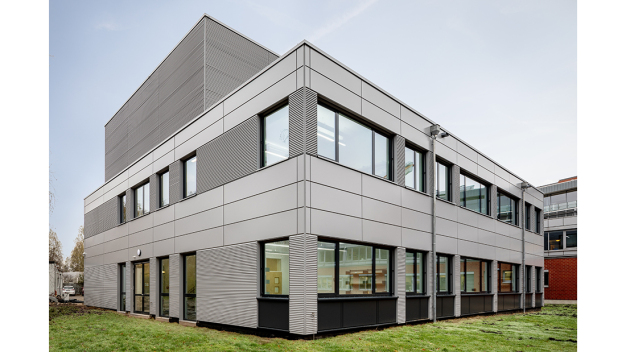
Exterior view of the new laboratory building at the Max Planck Institute in Bremen (Cadolto Modular Construction GmbH)
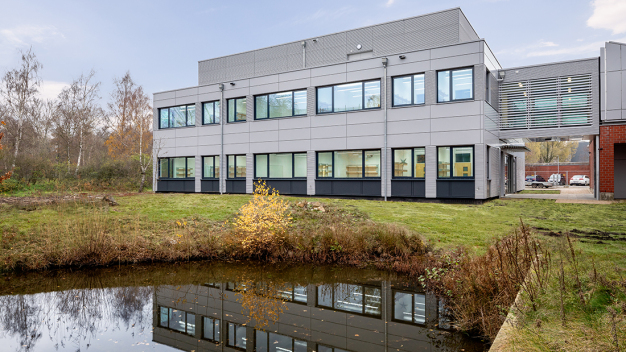
Exterior view of the new laboratory building with the glass transition as an extension to the existing Max Planck Institute in Bremen (Cadolto Modulbau GmbH)
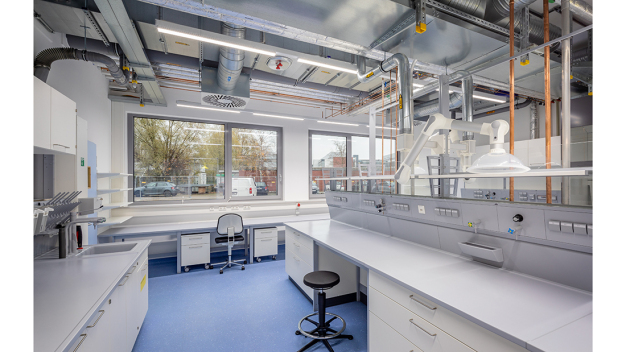
Labor jobs at the new laboratory construction at the Max Planck Institute in Bremen (Cadolto Modular Construction GmbH)
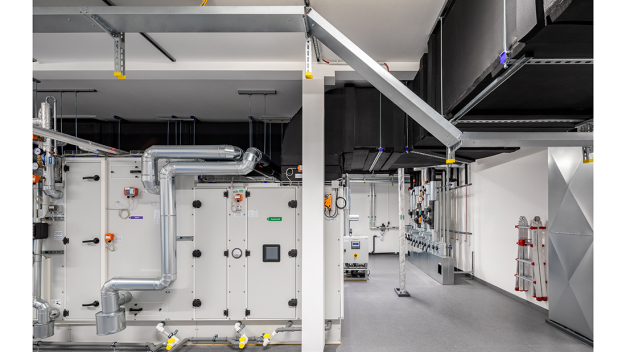
Technical center of the new laboratory building of the Max Planck Institute (Cadolto Modular Construction GmbH)
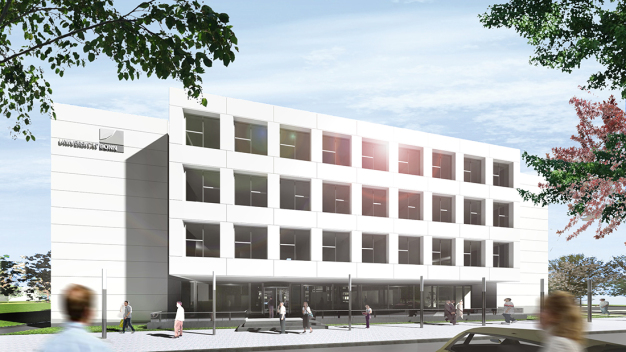
Rendering of the front view of the laboratory rotation building at the University of Bonn (Bergstermann + Dutczak Architects)
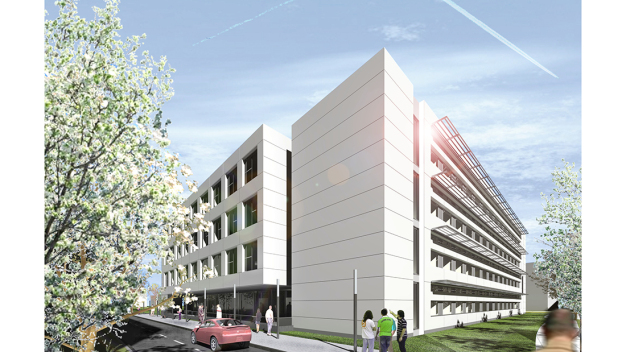
Rendering of the side view of the laboratory rotation buildings at the University of Bonn (Bergstermann + Dutczak Architects)
The Max Planck Institute in Bremen expanded its existing building with a new laboratory in modular construction. Cadolto quickly realized a new laboratory wing tailored to the institute's needs, totaling 1,400 m². Consisting of 29 modules equipped with state-of-the-art laboratory technology, the new building serves as an extension to the existing Max Planck Institute building. After commissioning, it supports microbiologists, molecular biologists, and biochemists in advancing science and researching marine microorganisms.
The new laboratory meets biosafety level 2 and is equipped with a climate cell that provides heating and cooling functions. This allows the room temperature to be adjusted quickly to suit different research activities. The laboratory spaces were also fitted with seawater-resistant and solvent-resistant work surfaces. The connection of technical laboratory gases and supply media was integrated into the existing infrastructure at the Max Planck Institute.
In addition to the laboratories, the new building houses office spaces and communal areas. The acoustic panels mounted on the ceilings are not only visually striking but also enable a quiet working environment through their sound-absorbing function. Furthermore, the building was connected to the existing institute building via a skywalk, a glass corridor.
Speed as a Key Success Factor in the Construction of Laboratory Buildings
An important goal in laboratory research is the timely start of new research projects. However, this often requires new spaces or extensive renovations of existing facilities.
During the tendering process for a research project, it is also essential for the respective institute to secure the commitment of relevant professors and specialists. This is achieved, among other things, by establishing high-quality workplaces within a short period. For these reasons, rapid construction is a crucial decision criterion in laboratory building projects. Cadolto responds to these challenges by enabling the planning and construction of a new laboratory building within a few months, maintaining the highest quality standards.
The modules for the new laboratory at the Max Planck Institute were produced in weather-independent conditions in the factory halls with a high degree of prefabrication and transported to the construction site by truck within a few days for assembly. Due to the short on-site construction time, noise and emissions were kept minimal, allowing the operation in surrounding areas of the institute to continue almost undisturbed.
Especially during the COVID-19 pandemic, speed in medical infrastructure was also demanded: thanks to modular construction, the new laboratory for the Max Planck Institute was erected quickly. It provides additional alternative spaces during the pandemic and thus makes an important contribution to protecting the institute's staff.
Labor Rotation Building at the University of Bonn: High Flexibility Thanks to Modular Construction
The challenge in laboratory construction today: the life cycles of laboratory uses are continuously shortening, and the requirements for building flexibility are increasing. Additionally, spaces must adapt to both simple and complex conditions. Laboratory concepts must not only be functional but also provide maximum safety and a pleasant working atmosphere.
Cadolto's modular construction method offers versatile and future-proof solutions for these challenges: the design of the laboratory modules is based on a support structure, making it easier to move and remove walls, thereby enabling high flexibility in room layout.
Furthermore, the modular construction meets all quality and safety standards for laboratories, just like conventional construction, and offers the advantage that individual areas or entire buildings can be reconfigured or relocated.
The realization of the laboratory complex in the form of a rotation building at the University of Bonn demonstrates the enormous flexibility of modular construction: in summer 2020, Cadolto received the order to plan and realize the project.
In the coming years, extensive renovation work is planned for several buildings at the University of Bonn. These renovations will involve multiple usage cycles. To ensure smooth ongoing operations, a rotation building with a gross floor area of approximately 15,100 m² is being constructed on the campus grounds. The modular construction will serve as a temporary building for various institutes during renovations and will be equipped with laboratories, meeting rooms, workspaces, and offices for several hundred university members.
The renovation of surrounding buildings will be carried out gradually, requiring consideration of multiple usage cycles with different requirements for each faculty. Special importance is given to the laboratory areas, which are designed to be adaptable and multifunctional for various disciplines.
To ensure that the university's different areas can continue working smoothly during renovations, the planning of the modules for the rotation building takes into account existing requirements and conditions. The modules are designed and produced so that, during different usage cycles, the necessary utility services can be connected immediately without major renovations.
The supply system for the new laboratory building will be self-sufficient. The technical gas supply will be managed via separate gas storage. An intermediate voltage system will be installed for electrical supply, which will also power other institutes in the future. The safety levels of the laboratories will vary during the rotation within the usage cycles. For example, the conversion from a chemical laboratory to a radionuclide laboratory, where radioactive materials are handled, will be carried out on-site.
The laboratories will be equipped with the latest laboratory technology, meeting the newest technical standards, ensuring a comfortable and high-quality working environment for each usage cycle. Additionally, the basement will house NMR devices and raster electron microscopes. Working with these devices requires minimal vibrations. Due to the surrounding highway, special attention is paid during building planning to external vibrations. Both the conventional building component and the modules are designed to be decoupled from the environment so that external vibrations do not enter the interior of the building.
In terms of exterior appearance, a modern look is prioritized in the facade design. The rotation building will feature an attractive facade made of metal cassette panels with a light-colored coating. Light bands will be installed at the windows of the workspaces to reflect sunlight toward the ceiling, creating natural interior lighting.
Implementing Individual Requirements for a Laboratory: Cadolto's Laboratory Concepts and the Sample Module
With its modular laboratory types, Cadolto can quickly provide concrete sample plans. The building structures are predefined as a basis for further planning but can be modified in any direction. The grid widths of 3,600 mm for the laboratory modules are based on common furnishings and the recommendations of BG RCI and DIN EN 14056. Naturally, the laboratory concepts can be expanded and multiplied at will. They are stackable up to five stories, with a braced core even higher, and can also be realized with a technical floor.
In facade design, individual wishes can also be implemented within the framework of the laboratory concepts. Through anodizing of the aluminum facade, various color concepts can be realized according to customer requirements, allowing laboratory buildings to be designed to match their surroundings.
To make the laboratory concept tangible during plant visits, Cadolto has built a sample laboratory module in its sample park that combines all requirements of a modern laboratory: highest quality, the latest technology, precisely fitting rooms that can be flexibly expanded in the future. In short, the sample laboratory module is tailored to the laboratory worlds of the future and the digitalization of laboratory work. Equipped with numerous monitors, it allows control and monitoring of operations directly from the workstation, and an integrated meeting area facilitates communication. The two-module sample laboratory has a gross floor area of approximately 100 m².
Cadolto Modulbau GmbH
90556 Cadolzburg
Germany