
- Translated with AI
Fascination Space - Wedding in the Cleanroom
Fascination Space - Marriage in the Cleanroom
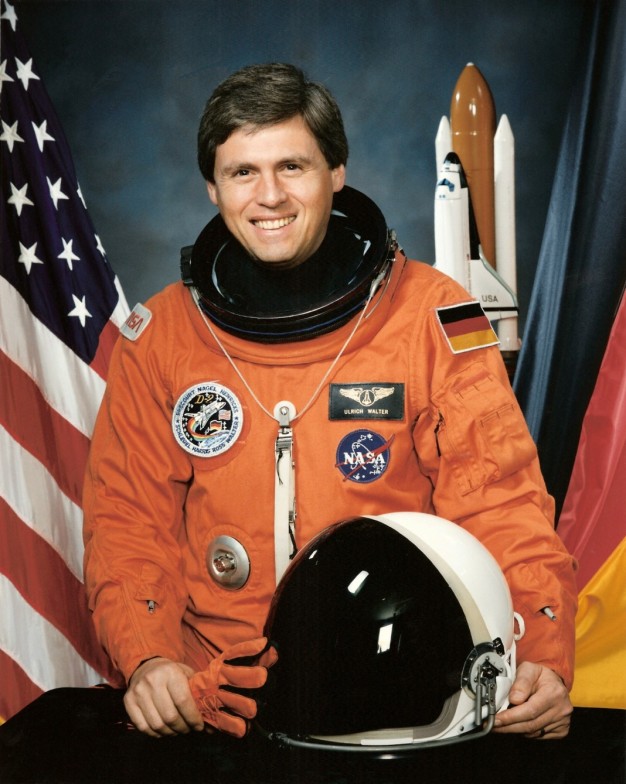
Astronaut Prof. Dr. Ulrich Walter is the Keynote Speaker at the Cleanzone Congress
He has seen the Earth from space; today, he is sending the next generation into space: Dr. Ulrich Walter, astronaut and professor of aerospace technology, is the keynote speaker at the Cleanzone Congress in Frankfurt am Main. The new knowledge platform is launching parallel to Cleanzone, the international trade fair for cleanroom technology, on October 24 and 25, 2012.
In his keynote "Clean Room, Clean Space – Cleanroom Technology in Space Missions" on the first day of the congress, Prof. Dr. Walter discusses work in space, marrying in cleanrooms, and the vital importance of cleanliness in laboratories: "Purity is the key to success in space. This applies both to scientific results and to survival on the space station," says the experienced astronaut. In 1993, he flew to space as a payload specialist on the D2 mission. Today, he conducts research and teaches at TU Munich and builds satellites for current space projects.
Marrying and Spy Protection in the Cleanroom: Interview with Prof. Dr. Ulrich Walter
You are speaking as the keynote speaker at the Cleanzone Congress. What is your topic in Frankfurt?
Cleanroom technology plays a central role in manned and unmanned spaceflight. Everything in space must be 100% clean; otherwise, lives and missions are at risk. Therefore, I will talk about the specific applications of cleanrooms in spaceflight, their special requirements—and of course, about the fascination of space itself.
In which areas does cleanroom technology impact spaceflight?
Basically in all areas, because the space station is simply one large cleanroom. From the smallest screw to the complete interior, all components must be at least particle-free, if not sterile. Depending on the different requirements, we work in cleanrooms of various classes. The highest demands are in optics. For example, even with the Hubble Space Telescope, lenses and housings had to be kept particle-free during manufacturing, assembly, and operation due to the high resolution, which was a significant challenge given the telescope's size.
In research, cleanrooms serve a second very important function: access control. Not only is it precisely monitored and documented who enters the lab, but access permissions are also extremely restrictive. This prevents unauthorized persons from gaining access to secret information. Thus, cleanrooms are also a tool for espionage protection.
What role did cleanroom technology play when you worked as a scientific astronaut on the D2 mission in space in 1993?
I was responsible as a research astronaut for the payload, that is, the then-space laboratory Spacelab in the shuttle's payload bay. Probably, I spent more time in cleanrooms during the preparation years than outside, because the experimental equipment and the Spacelab itself, which we had to train on, were built and stored in cleanrooms before the mission. The Spacelab was located at EADS Astrium in Bremen, which many still know under the name DASA. The experimental equipment installed in the Spacelab was built and tested at various international research facilities. I usually trained with them on site. Before launch, all experimental equipment was brought to Bremen and "married" or integrated with the space laboratory there. Important: Throughout this entire process— from construction, testing, and transportation to integration— individual components had to be kept under cleanroom conditions at all times.
What special requirements must cleanrooms meet today for practical applications in spaceflight?
Today’s research laboratory in space is the International Space Station (ISS). It will be operational for at least until 2020, over 20 years. During this time, dust will not be swept, nor will the instruments or racks be cleaned. The atmosphere in the ISS must be so clean that cleaning is unnecessary. Since astronauts, like all humans, exhale moisture and organic compounds into the ISS, there is a risk of mold growth. Therefore, space stations must not only be dust-free but also sterile. If this is not guaranteed, they would become unusable after a short time.
How does the cleanroom in space differ from that on Earth?
The cleanrooms used in spaceflight do not differ significantly from those in other industries—except perhaps in two aspects: First, the space station is a closed system. This means that, unlike on Earth, it cannot be continuously supplied with new filtered fresh air. Accordingly, the materials used in the ISS must neither outgas nor develop odors in any form. This would make working for astronauts unbearable. Therefore, on the ISS, for example, there are significantly more metal surfaces than plastic ones. Second, satellites up to ten meters long must be fully assembled and tested in cleanrooms on Earth, standing upright. The required ceiling height poses a certain challenge here.
What is the biggest challenge for humans working in space?
One of the biggest problems astronauts face is psychological stress. They work for months in a completely sterile, highly technical environment, in a confined space, without plants or variety. This causes stress. Therefore, space travelers are selected not only based on training, knowledge, and physical fitness but also according to their personal traits and psychological stability.
How is hygiene maintained in the shuttle?
Since the entire space station—from sleeping to working areas—is a cleanroom system, everything is extremely well-organized and perfected: from the sterilized, individually packed clothing to the pre-cooked, vacuum-sealed food. Some areas are easier to control than others. Handling water is dangerous because free-floating splashes must not reach the electronics of instruments and racks. Even everyday activities like shaving pose a challenge. For this, special electric shavers have been developed that vacuum up the stubble directly.
You work at TU Munich in research and build satellites with your students. What cleanroom classes do you use?
Since we build satellites without sensitive optical instruments, we use a cleanroom class ISO 6.
How has the role of cleanrooms changed since your spaceflight in 1993?
I have been in contact with cleanroom technology for 25 years, but the principle has changed little. Innovations are more in the details. For example, today, there is a more consistent focus on increased internal pressure in laboratories to prevent external contamination, as well as on avoiding electrostatic discharges on electronic components through humidity control, conductive flooring materials, and direct grounding.
What challenges will cleanroom technology face in the future?
Today’s cleanrooms are already so advanced that we can work perfectly within them. Of course, there are always possibilities for optimization—especially regarding comfort. Because when astronauts have to work for months in a confined space without greenery or fresh air, even the smallest improvement is valuable.
What are the most urgent tasks in spaceflight?
The biggest challenge currently is optimizing resource management in closed-loop processes on a space station. This makes sense because everything consumed in space must be brought from Earth. The questions are: How can I regenerate the used air more effectively? Or: How can I convert wastewater, including toilet waste, into drinking water more efficiently? Innovations are needed here.
Speaking of innovations: many space technologies are transferred to other industries. How does this apply to cleanroom technology?
In this area, spaceflight is more of an end-user than a driver. We use existing technology and only need to make minor adjustments. However, there are some areas where the requirements are so high that we can challenge the industry—especially in the construction of space telescopes and large cleanrooms.
On your TU Munich website, you warn about your degree program: "But beware: based on experience, you should not expect offers only from aerospace!" Where do you see particularly great opportunities for your graduates?
It is true that more than half of our graduates do not work in aerospace. Only about 20 percent go into aviation, and the same number stay in spaceflight. The reason is quite simple: aerospace is a cross-sectional technology par excellence. It involves all the technologies and methods that define modern devices today: mechatronics, embedded systems, software, state-of-the-art measurement technology, hyperspectral sensors, optical instruments, hardware-in-the-loop, project management, systems engineering, and of course, cleanroom technology. People with this spectrum are highly sought after in all industries and receive very good offers, for example from automotive manufacturers. In southern Bavaria, many go to BMW and Audi, where a lot of work is already done in cleanrooms during development and research.
One last question: When will we fly to Mars?
In November 2046. The date is fixed because only every 15 years does an optimal launch window open, when Mars and Earth are particularly favorably aligned. The necessary technologies are already available in principle, and we could start now. However, the mission would be simply too expensive and uncertain because not all these technologies have been tested yet. 2031 would be too soon, as we need to go to the Moon first to test them there. But in 2046, it will be time: after launching in April/May 2046 and a 200-day journey, we will reach the red planet in November 2046. Promise.
Cleanzone – Trade Fair and Congress
The Cleanzone trade congress in Frankfurt is a new industry and cross-border knowledge platform for cleanroom technology, providing users and manufacturers with scientifically based and independent knowledge from international experts. Speakers include Koos Agricola (ICCCS International Confederation of Contamination Control Societies), Dr. Udo Gommel (Fraunhofer IPA), Conor Murray (3dimension Cleanroom and Chairman of the Irish Cleanroom Society), Joachim Ludwig (Colandis), Gabriele Schmeer-Lioe (Institute for Textile and Process Engineering Denkendorf), and Florian Dittel (Dittel Engineering).
The congress takes place simultaneously with Cleanzone. The new trade fair targets all companies and industries already using or planning to use cleanrooms. Visitors include decision-makers from chemistry, medicine, pharmaceuticals, food, nanotechnology, optics and laser technology, microelectronics, automotive, and aerospace. Exhibitors include manufacturers of cleanroom systems and technology, construction components, and consumables, such as BSR, CAS Clean-Air-Service, Colandis, Decontam, Dycem, Hydroflex, Kimberly-Clark, PPS Pfennig, Weiss, and WISAG.

Cleanzone
Messe Frankfurt Exhibition GmbH
Ludwig-Erhard-Anlage 1
60327 Frankfurt am Main
Germany
Phone: +49 69 75756290
Fax: +49 69 757596290
email: anja.diete@messefrankfurt.com
Internet: https://cleanzone.messefrankfurt.com