



- Translated with AI
Eye-Tracking Laboratory: Recording and analyzing eye movements helps improve learning behavior
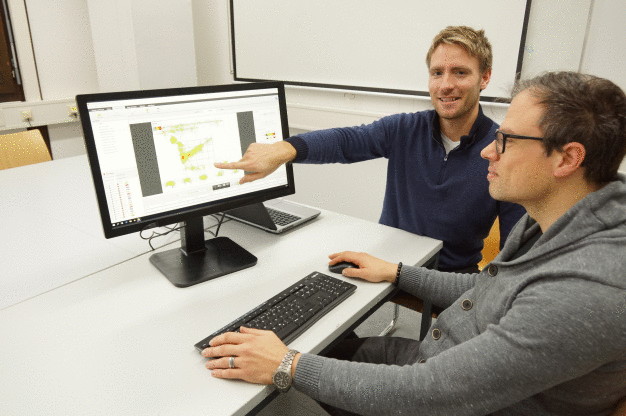
Junior Professor Dr. Pascal Klein (left) researches learning behavior using eye-tracking technology. Next to him in the picture is Sebastian Becker, a doctoral student in the Physics Didactics working group. (Photo: Yvonne Müller)
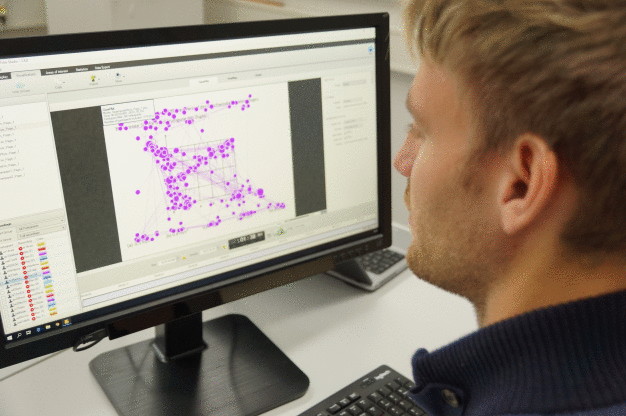
With eye-tracking technology, it is possible to record and analyze eye movements in order to draw conclusions about learning behavior. (Photo: Yvonne Müller)
What happens when reading word problems and viewing physics diagrams? This is the focus of the team led by Junior Professor Dr. Pascal Klein in the group of Professor Jochen Kuhn from the Physics Didactics department at the Technical University of Kaiserslautern (TUK). They use eye-tracking, a technique that records and analyzes eye movements on screens. To investigate reading and learning behaviors, the Physics department at TUK has recently established its own eye-tracking laboratory, the eyePL (eyePhysics Lab). The Klein team has already demonstrated in initial studies that eye movement patterns can provide insights into physical understanding.
When reading a physics problem, the eyes move back and forth between text and diagram. Where is the focus? Perhaps on the axis label in a coordinate system or on the curve shown in the diagram? Do the eyes also jump back to the text and linger there for a few seconds? Can we draw conclusions about learning behavior from this? "Yes, we can," says Junior Professor Dr. Pascal Klein, who researches digital techniques for physics studies and physics education in schools at TUK. "In the past, such analysis was not possible. With eye-tracking technology, we are able to precisely analyze eye behavior when working with texts and diagrams."
Not much equipment is needed for this investigation: a screen and an eye tracker that records gaze directions in real-time. It is mounted directly below the display and sends its data to a laptop placed beside the screen.
At the eye-tracking laboratory, the eyePL (eyePhysics Lab) on the TU Kaiserslautern campus, there are currently six such workstations. The Klein team aims to investigate, for example, how physics students read texts and grasp their content. "We observe where they pause, whether they jump between text and diagram, or re-read certain parts," the researcher explains as examples.
In studies, Klein has already examined what conclusions can be drawn about learning behavior from the so-called gaze paths. "When working with diagrams, these paths reveal which strategies students use to solve problems. We can also determine whether strategies they have learned previously are applied correctly or incorrectly," the physicist continues. Additionally, the technique allows him to infer other insights, such as how confident students are when solving tasks.
In a recently published study, involving colleagues from the German Center for Artificial Intelligence, Klein's team investigated how physical concepts (specifically the divergence of vector fields) are best visualized to maximize learning success. "We showed students two different representations of divergence, one as differential calculus and the other as integral calculus," he summarizes the experimental setup briefly. "To illustrate and describe physical relationships, textbooks and courses often use only one form of representation. However, we found that content is best conveyed when students are familiar with both forms. This underscores the important role of different perspectives in acquiring physical knowledge."
But Klein's focus is not only on university learning but also on school instruction. "We bring our technology into schools to observe how students handle physics problems." Thanks to the technology, results are available shortly afterward. It quickly becomes clear whether students have understood the learning content. "In this way, it is possible, for example, to diagnose differences between successful problem solvers and less successful ones and to promote individual learning behaviors," Klein explains. For these studies, the physicist also collaborates with groups from other countries to analyze international differences in learning physical concepts.
The technology is also used in teacher training and professional development at TU Kaiserslautern, for example, as part of the project "U.EDU: Unified Education – Media Education along the Teacher Education Chain," which is funded by the Federal and State Governments' joint "Quality Offensive for Teacher Education" from resources of the Federal Ministry of Education and Research. The establishment of the eye-tracking lab was financially supported by TU Nachwuchsring.
Klein conducts his research under the guidance of Professor Dr. Jochen Kuhn, a didactician of physics who has been studying innovative teaching and learning formats for university, school, and teacher education for nearly ten years. He uses digital media of today and tomorrow in his work.
The study was published in the renowned journal "Physical Review Physics Education Research": "Instruction-based clinical eye-tracking study on the visual interpretation of divergence: How do students look at vector field plots?" P. Klein, J. Viiri, S. Mozaffari, A. Dengel, and J. Kuhn: DOI: https://doi.org/10.1103/PhysRevPhysEducRes.14.010116
Technische Universität Kaiserslautern
67663 Kaiserslautern
Germany