


- Know How, Institute
- Translated with AI
Barbara Halstenberg
Experience spaces before they are built
New IEQ Lab at TU Berlin’s Hermann Rietschel Institute combines a climate chamber and virtual reality to investigate how energy efficiency, health and comfort can be brought together in buildings
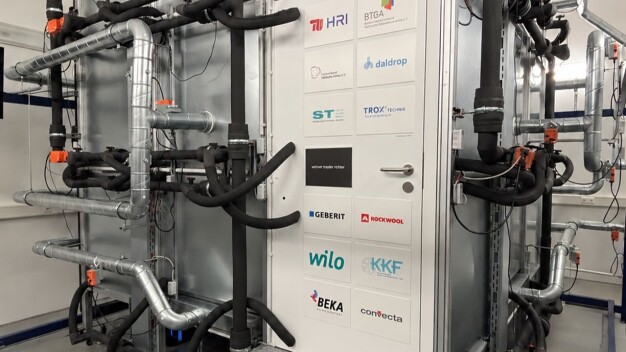
Exterior view of the new IEQ lab of the Hermann Rietschel Institute (HRI) at TU Berlin.
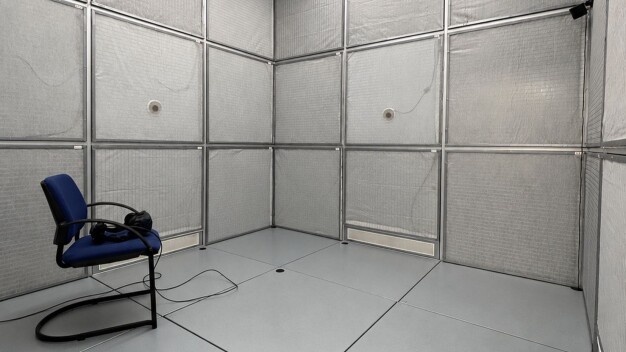
Interior view of the new IEQ lab: 54 individually controllable surface modules on the walls and ceiling can be heated or cooled. Electric heating textiles and water-based capillary tube mats enable rapid temperature changes.
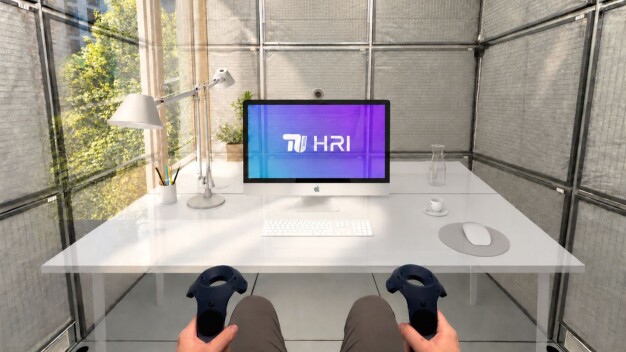
The laboratory’s distinctive feature lies in the close coupling of virtual reality and physically generated spatial conditions. For example, through a VR headset, test subjects see an office with specific windows, lighting conditions, or spatial geometries.
How warm should a room be, how much light do we need, and when do we perceive the air as pleasant? In the new IEQ Lab at the Hermann-Rietschel Institute (HRI) of TU Berlin, such questions can be investigated under precisely controlled yet realistic conditions. To this end, the laboratory combines a highly flexible climate chamber with virtual reality. Temperature, air, light and the visual design of a room can be deliberately modified and combined with one another. This enables researchers to investigate how different conditions affect health, well-being and performance – and how buildings can be designed in the future to be comfortable, healthy and energy-efficient at the same time.
Virtual rooms, real climate
The laboratory’s special feature is the close integration of virtual reality and real room conditions. Using VR goggles, test subjects might see, for example, an office with specific windows, lighting conditions or room geometries. At the same time, the climate chamber generates the corresponding thermal conditions. If a test subject opens a window in virtual reality, for example, they immediately feel the resulting draught – coming from exactly the direction in which it appears in the virtual room.
For this purpose, 54 individually controllable surface modules in the walls and ceiling can be heated or cooled. Electrical heating textiles and water-based capillary tube mats enable rapid temperature changes. Within just 30 seconds, surface temperatures can change by up to five kelvins. A powerful air-conditioning system also allows the precise adjustment of air temperature, humidity and airflow. Different ventilation modes, such as mixing and displacement ventilation, can also be replicated.
At the same time, numerous sensors record, among other things, air and operative temperature, humidity, CO₂ concentration and illuminance. This makes it possible to investigate thermal, visual and air-hygiene-related influences both individually and in combination, and to link them to the test subjects’ perceptions.
“The IEQ Lab’s great advantage is that we can investigate indoor spaces under precisely controlled, realistic conditions. Thermal, visual and acoustic conditions, as well as air quality, can be deliberately and reproducibly modified – and combined with a wide range of virtual room concepts. This is only possible to a limited extent in field studies. It allows us to systematically investigate how different room concepts affect people while also determining how energy efficiency can be optimised,” says Lukas Schmitt.
When is a room really good?
The laboratory is part of a more fundamental research approach pursued by the EnOB: GEnEff project (Innovative Assessment of Building Energy Efficiency). Until now, a building’s energy efficiency has been measured primarily by how much energy it requires during operation. The comfort and indoor environmental quality that this energy use actually provides for people, on the other hand, have only been taken into account to a limited extent. The research team at HRI has therefore developed an approach that combines both aspects. The so-called GEnEff indicator relates the probability that users will accept the indoor climate to the specific energy demand required to achieve it. Energy efficiency is thus no longer assessed solely on the basis of consumption, but also according to the actual benefit achieved for the people in the building.
A survey conducted in two sustainably certified office buildings already demonstrated the importance of this perspective. The researchers found discrepancies of up to 50 percent between documented certification values and users’ actual perceptions – particularly with regard to indoor air quality and the opportunities to influence the indoor climate themselves.
Temperature also changes the perception of air
The new approach has already been tested in a study with test subjects in the IEQ Lab. The researchers combined different operative temperatures between 20 and 28 degrees Celsius with different illuminance levels, while air quality and acoustics were kept constant.
The results show how closely the individual factors of indoor environmental quality are interconnected. For example, the test subjects perceived warm rooms as having poorer air quality – regardless of the actual CO₂ concentration. In the study, thermal comfort had the greatest influence on the overall assessment of the room, accounting for 33 percent. This was followed by perceived indoor air quality at 26 percent, visual comfort at 23 percent and acoustics at 18 percent.
A subsequent field study at 16 workplaces and residences confirmed that the findings obtained in the laboratory can also be applied to real buildings. The comfort function developed in the IEQ Lab correctly predicted the assessment of indoor environmental quality in 81 percent of the cases studied.
Saving energy without compromising indoor environmental quality
With the IEQ Lab, TU Berlin now has a research infrastructure that enables the interaction between people, buildings and energy consumption to be investigated in considerably greater detail. In the future, additional factors influencing indoor environmental quality can be integrated, and different building concepts can be tested under laboratory conditions.
The research is particularly relevant in view of climate change and the increasing demands for building energy efficiency. A building with the lowest possible energy demand is not necessarily a good building. What matters is achieving high indoor environmental quality with as little energy as possible. The methods developed in the project could therefore also become relevant in the long term for certification procedures, standards and guidelines. The aim is to design buildings in which energy savings do not come at the expense of users’ health, comfort and satisfaction.
Beyond the GEnEff project, the IEQ Lab will also be used for research and development projects and in university teaching. It thus creates new opportunities to develop the buildings of the future from the perspective of the people who spend their everyday lives in them.
The IEQ Lab was established as part of the “EnOB: GEnEff” research project, which was funded by the Federal Ministry for Economic Affairs and Energy (BMWE). In addition to the Hermann-Rietschel Institute at TU Berlin, the project involved the Department of Building Services Planning and Engineering at Berlin University of the Arts, headed by Prof. Dr Christoph Nytsch-Geusen.

Technische Universität Berlin - Hermann-Rietschel-Institut
Marchstrasse 4
10587 Berlin
Germany
Phone: 030 314 24180
email: valeria.hofer@tu-berlin.de
Internet: https://hermann-rietschel-institut.de/