


- Translated with AI
Excellent conditions for excellent research
PBR completes laser laboratory for Hochschule Mittweida
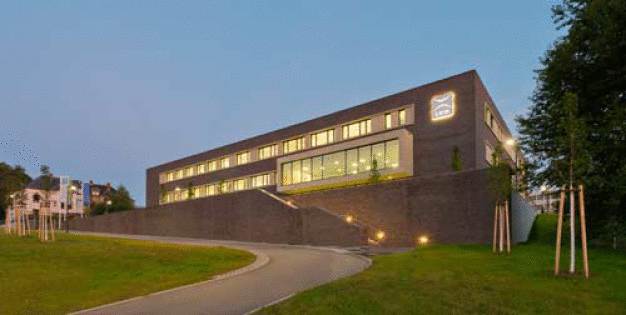
The glass cube protruding from the building's facade, made of light-colored concrete masonry units, serves as an eye-catcher and additionally emphasizes the main entrance. (Image rights: Michael Miltzow)
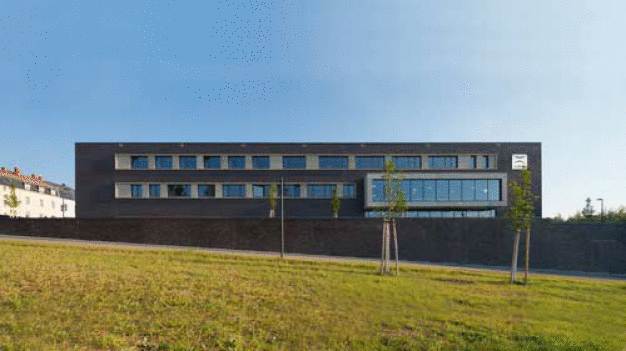
The entrance area of the laser institute is clearly marked by the single-story building entrance along the north side. (Image rights: Michael Miltzow)
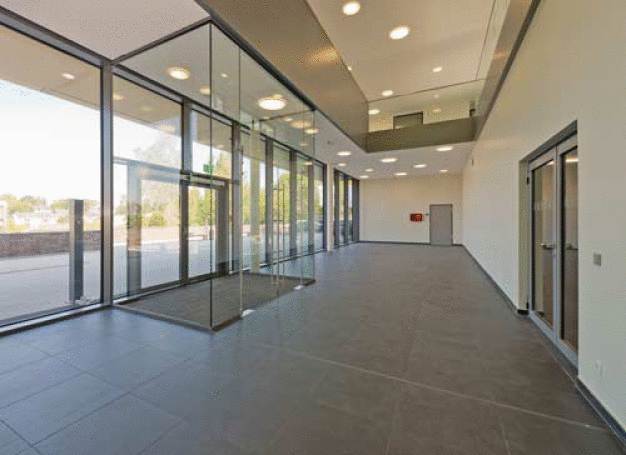
Visitors and employees enter through the main entrance into the spacious and welcoming foyer, from which the logically structured corridor system allows for easy orientation. (Image rights: Michael Miltzow)
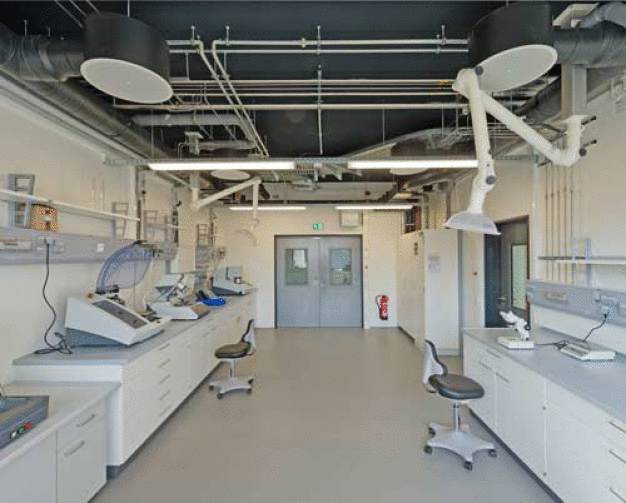
On the ground floor in a central location, an area with five laboratories has been established for research on laser macro processes, laser nano- and micro-processes. (Image rights: Michael Miltzow)
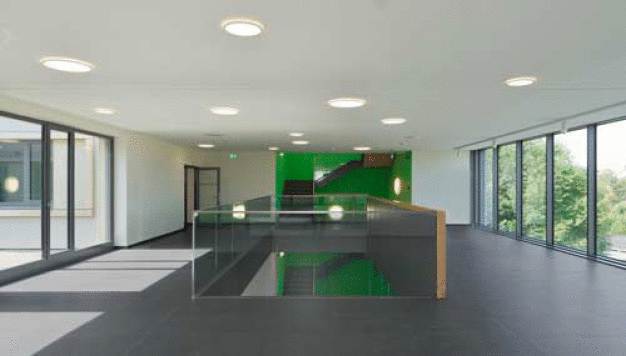
The vertical access is provided by four stairwells, located at the building corners. (Image rights: Michael Miltzow)
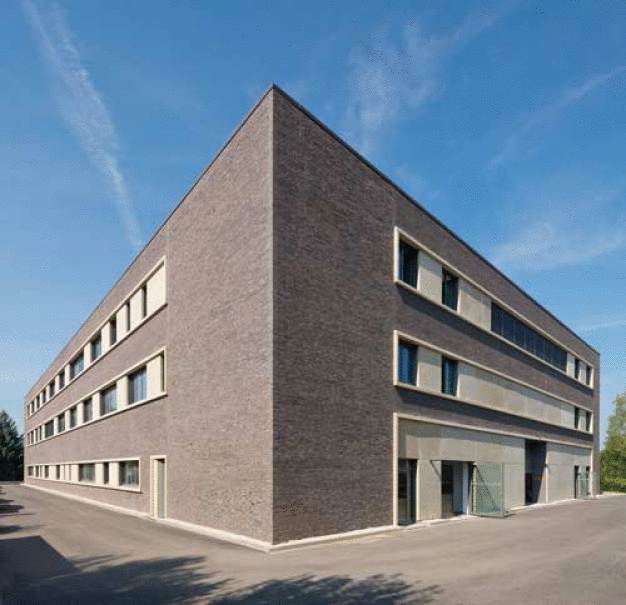
Anthracite-colored window surrounds, consisting of window openings and blind elements made of prefabricated concrete parts, divide the research institute within the floors. (Image rights: Michael Miltzow)
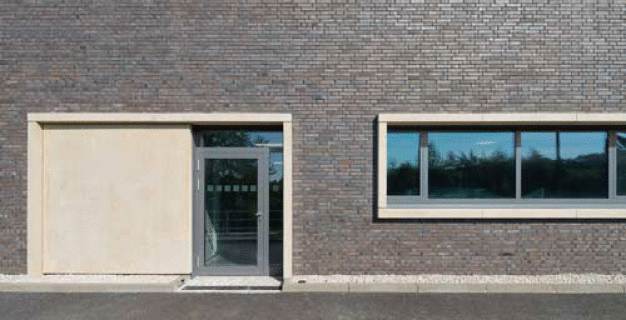
The facade makes a reference to the frequently occurring motif of the brick facade in the immediate surroundings. (Image rights: Michael Miltzow)
On the 151st year of its existence, the Mittweida University of Applied Sciences, with its new research institute, receives a beacon that is both confirmation and challenge. With the new institute building, the university can offer ideal conditions for research in its excellence area in the future and thus further increase its international visibility. In September 2016, the building, for which the architecture was designed by the pbr Planning Office Rohling AG, was handed over to Mittweida University of Applied Sciences. In addition to architectural planning, pbr also provided fire protection planning. The client is the Free State of Saxony, represented by the Saxon Real Estate and Construction Management State Enterprise, Chemnitz Branch. With the start of the semester in October 2016, the approximately 60 scientific staff of the institute began their work in the new research building.
Leading research facility in the field of laser technology
With internationally recognized research results, the "Laser Institute of Mittweida University of Applied Sciences" (LHM) is one of the leading research institutions in the field of laser technology in Germany. The focus is on application-oriented research and development in the areas of laser microprocessing, laser pulse deposition, laser macroprocessing, and photonics. Due to its over 40-year success story, the federal government, on the recommendation of the Science Council, decided to participate in financing the new construction of the institute as part of research infrastructure funding. Thus, Mittweida University of Applied Sciences is one of three universities of applied sciences in Germany included in the research and science funding program.
Campus of the university completed
The three-story institute building is located in the southern part of the university campus, above the newly constructed Center for Media and Social Work (ZMS). Through a compact design and external appearance, the architects from pbr succeeded in establishing a connection between the new building and the ZMS, and in optimally completing the university campus in the center of Mittweida. The campus extends northward. At the center is the redesigned Technikum Square, while the LFZ, together with the sports hall, forms the southern boundary of the campus.
Architectural interplay of clinker and glass
With the facade of the new research building, the architects established a reference to two essential components of the surroundings: On one hand, it interprets the motif of the clinker facade, which appears frequently in the city and immediate environment. On the other hand, the new building corresponds with the facade design of the ZMS. The entrance area of the Laser Institute is clearly marked by the single-story building body along the north side. The glazed front allows for diverse views in and out and ensures a high level of daylight throughout the ground floor. On the first floor, this glass front takes on a sculptural form in the exterior and interior spaces. The protruding glass cube made of light-colored concrete masonry forms a visual highlight and additionally emphasizes the main entrance. Anthracite-colored window frames, consisting of window openings and blind elements made of prefabricated concrete parts, segment the research institute within the floors. To the south, east, and west, these are equipped with external shading integrated into the exterior cladding.
Unique quality of stay through transparency
Visitors and staff enter the spacious and communicative foyer through the main entrance, from which the logically structured corridor system allows easy orientation. In the area of the main entrance, there is a light-flooded atrium. This not only illuminates the circulation routes but also the foyer extensively. In terms of transparency and visual communication, the research institute thus offers a very special quality of stay. The vertical access is provided by four stairwells arranged at the building corners. An elevator ensures barrier-free access to all levels.
Short routes for optimal workflows
The new building's structure is primarily determined by functional aspects, so that on the ground floor, a central area of about 520 m² with five laboratories for research on laser macro processes, nano- and micro-lasers is created. This area has high load capacities, so vibration-free and economical arrangements on the upper floor could not be guaranteed. On the first floor, in addition to laser systems, there are five air-conditioned laboratories for laser metrology, ultra-short pulse material processing of organic thin-film systems, and laboratories for developing laser components. To enable staff to have short routes, experimental workplaces and workshops for electrical engineering and precision mechanics are attached to the laboratories. Additionally, workspaces were established in the north and west to facilitate optimal connections and communication with the research areas. The second floor mainly contains offices and technical building equipment, along with some laboratories and workshop areas. The arrangement of technical spaces ensures short and efficient routing of services to the respective functional units.
Effective and economical operation
A key design principle for the architects from pbr was the effective and economical operation of the laser institute. Besides selecting suitable materials and building components, this is particularly reflected in the consistent implementation of the compact building mass. With a shell-to-volume ratio of 0.3 relative to the gross volume of 26,900 m³, the new building is well below the benchmark values for university buildings. Another advantage of this concentration is the short accessibility of all rooms and the resulting communication opportunities among the various functional areas. Furthermore, costly circulation areas could be minimized. The heating system is a geothermal-assisted gas heating system with controlled ventilation and heat recovery.
pbr Planungsbüro Rohling AG
07745 Jena
Germany