



- Translated with AI
Endress+Hauser iTHERM TrustSens
This year, the iTHERM TrustSens won the Hermes Award at Hannover Messe and the AMA Innovation Award at Sensor+Test 2018. Its development incorporated the expertise of Endress+Hauser Wetzer, the Innovative Sensor Technology IST AG, which is part of the Endress+Hauser Group, and the Technical University of Ilmenau. There, Dr. Marc Schalles, head of the Temperature Measurement Working Group, developed the functional principle of the TrustSens.
Mr. Schalles, your project team succeeded in integrating a Curie-temperature-based fixed point calibration into a thermometer. How did you come up with this idea?
Marc Schalles: Thermometers are always calibrated directly or with the help of comparison thermometers in a traceable chain at fixed points. These are temperatures at which pure substances undergo a phase change; they melt, solidify, or have their triple point. For calibration, fixed point cells containing the respective substance are used. Here at TU Ilmenau, we started about 25 years ago to miniaturize such cells and integrate them into thermometers for inline calibration. However, there were disadvantages: with a fixed point made of metal, you need to maintain the melt. Additionally, heat is exchanged during each phase change – thus, the sensor measures the phase change temperature, not the process temperature. I therefore looked for alternative solutions and found them. This sparked the idea that allowed us to develop an industrial thermometer in this project collaboration, which incorporates the Curie-temperature-based calibration.
And then you arrived at the Curie temperature. What makes it so practical for calibration?
Schalles: At the Curie temperature, a phase change occurs analogous to classical fixed point materials. It is the material-specific temperature above which ferromagnetic or ferroelectric materials lose their properties. During the phase transition at the Curie temperature, such materials remain in the solid phase in both polarized and unpolarized states, making them very suitable for integration into a thermometer. Moreover, the phase transition can be electrically detected and reproduced very well. The colleagues from Endress+Hauser analyzed, together with plant operators, at what temperature such a phase change should occur to be usable in the processes of the food and life sciences industries. Then we looked for suitable materials in this range – selecting and handling them involves a lot of know-how, similar to classical fixed point cells.
What were the challenges in implementing the iTHERM TrustSens into a product?
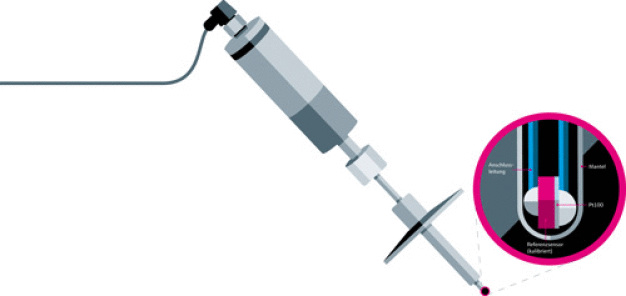
Schalles: The biggest challenge was the limited space available. The smallest TrustSens measuring inserts have an outer diameter of three millimeters. Within this, the actual temperature sensor, the reference sensor with the special material, and the electrical measurement methods for detecting the phase change had to be integrated. Due to its technological expertise, Endress+Hauser developed the sensor and thermometer design to achieve long-term stable phase changes. The know-how of the sensor specialist IST, which is part of the Endress+Hauser Group, also contributed significantly to this.
How reliable is this new form of calibration compared to traditional calibrations, such as using calibration wheels?
Schalles: Comparison calibrations with calibration wheels are part of stationary calibration procedures. You place the thermometer to be tested and the comparison thermometer into a setup and wait for thermal equilibrium, so that both thermometers stabilize at the same temperature for calibration. In contrast, the iTHERM TrustSens is calibrated dynamically. Through the appropriate design of the iTHERM TrustSens, we ensure that temperature changes caused by the process medium are equally detected by the reference sensor and the process sensor. We thermally dimensioned the thermometer and optimized the heat transfer processes inside it for this purpose.
Was the development of the sensor something special for you?
Schalles: Definitely. I found it remarkable that Endress+Hauser gave a lot of freedom in developing a self-calibrating process thermometer – especially since the research was open-ended. The company demonstrated that it understands its customers' processes. I find it impressive how such an innovation culture is lived. As a result, it was not just about the pure idea – for me, this is a great example of successful development and a fruitful partnership between research and industry.
Endress+Hauser AG
4153 Reinach BL 1
Switzerland



