

- Translated with AI
End the noise in hygiene manufacturing facilities
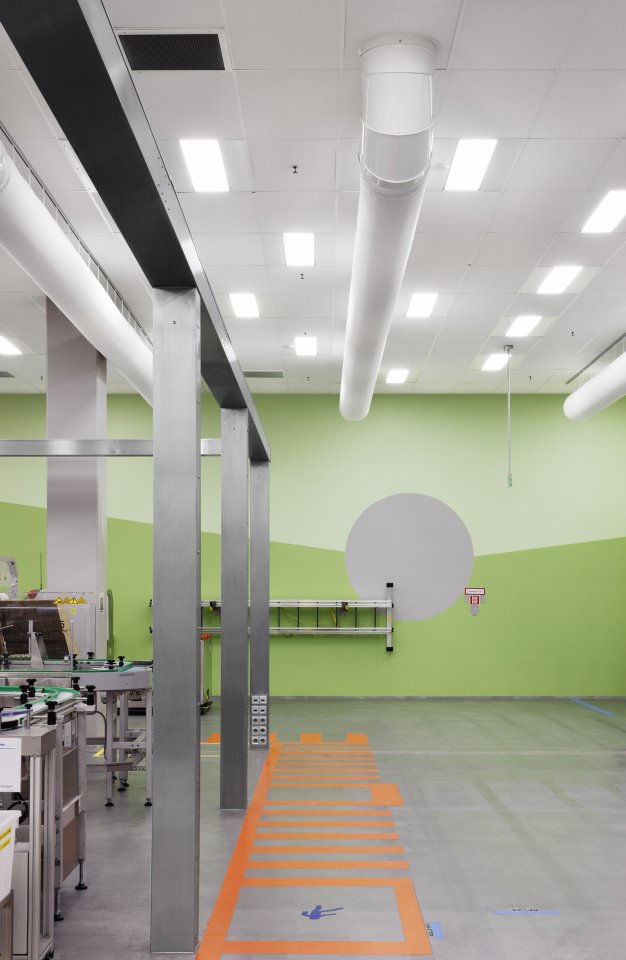
End the noise in hygiene manufacturing plants
Efficient sound absorbers on ceilings and walls reduce the noise level by up to 10 dB. Such measures can halve the perceived noise levels in the room. Hearing protectors are usually unnecessary as a result. Of course, this also applies to hygienic areas!
Equipping industrial halls with special hygienic sound absorbers of the highest sound absorption class is generally a worthwhile investment. We often hear this from our clients, with whom we have maintained close relationships worldwide for decades. These include, for example, Roche, Bayer, Sanofi-Aventis, AstraZeneca, Merck, but also companies like Nestlé and Coca-Cola. It has been proven many times that in a good acoustic environment, staff work more efficiently and feel more comfortable. Improving acoustics not only directly affects product quality but can even increase productivity. Additionally, sick leave and the risk of accidents at work are significantly reduced.
Noise is a problem
In many production facilities, noise is one of the unresolved problems because it causes discomfort and stress. The effects on the people on site are negative. In many countries, employers are required to implement noise protection measures. These include technical, organizational, or personal measures. Generally, technical solutions are preferred because they are usually more effective and comprehensive. For example, it is much more effective to reduce machine noise directly at its source of emission than to protect affected persons through organizational measures or even equip them with hearing protection on a personnel level. (see TRLV Noise, p. 75ff)
Sound absorption is the solution
Production halls usually have a large footprint and a high raw ceiling. Hard surfaces on walls, floors, and ceilings reflect the incoming sound. The noise source combined with the reverberant room creates an extremely high sound pressure level, which must be reduced. Here, sound absorbers with the highest possible sound absorption are recommended. A hygiene acoustic ceiling supplemented with hygiene wall absorbers can reduce the sound pressure level by up to 10 dB(A). In areas where a fully suspended acoustic ceiling is not feasible for practical or technical reasons, hygiene baffle solutions in combination with wall absorbers are preferable. It is ideal to include room acoustics considerations already during the planning of new spaces.
Good acoustics promote performance and image
Studies have shown that a good acoustic environment at the workplace can reduce sick leave and turnover rates. Furthermore, a quieter working environment increases the long-term productivity of employees. Good working conditions, in turn, strengthen high employee satisfaction and thus the long-term positioning of a brand. A pleasant environment also leaves a positive impression on visitors touring the facility. Thanks to optimal working conditions, such a company is an attractive employer.
All requirements must be met
In addition to excellent acoustic properties, materials used often need to meet other highly demanding requirements: cleanroom classifications according to GMP or DIN 14644-1, as well as cleanability, disinfectability, or inhibition of biological growth are just as crucial as demountability or possible corrosion protection.
The choice of an acoustic ceiling must ensure that it precisely meets the requirements necessary for its intended use. With the Ecophon Hygiene system family, we have developed various systems over the past decades that are specifically suitable for your production. With our experience, you also gain the security you need for such a project. The durability and reliability of Ecophon Hygiene systems ensure the continuity of production as well as product quality.
___________________________________________
75% of all reported occupational injuries are due to high noise levels
According to the British health and safety organization Health & Safety Executive (HSE), 75% of all occupational injuries reported in industry concern hearing. Those exposed to high noise levels (equivalent sound level during eight hours) for whole workdays risk hearing damage and tinnitus. The risk increases markedly at 80 dB(A), and personal hearing protection is required at 85 dB(A).
HSE studies have shown that the equivalent sound levels in industry can reach 95 dB(A), which corresponds to doubling the perceived loudness.
___________________________________________
Technical rules for noise and vibration occupational safety regulation (TRLV Noise) from March 2010, Part 3 – Measures to reduce noise
4.3.2 Reflection sound and sound level reduction with distance from the sound source
- The state of the art is considered to be met if the sound level reduction per doubling of distance in the range of 0.75 m to 6 m in octave bands with center frequencies from 500 Hz to 4000 Hz is at least 4 dB.
4.3.3 Average sound absorption coefficient
- The state of the art is considered to be met if the average sound absorption coefficient α in octave bands with center frequencies from 500 Hz to 4000 Hz is at least 0.3.
Ecophon Deutschland
23556 Lübeck
Germany