
- Service
- Translated with AI
Dipl. Ing. (FH) Reimund Rieger
Electrostatic Charging and Air Ionization in the Cleanroom
Particle-free through air ionization

Faust01
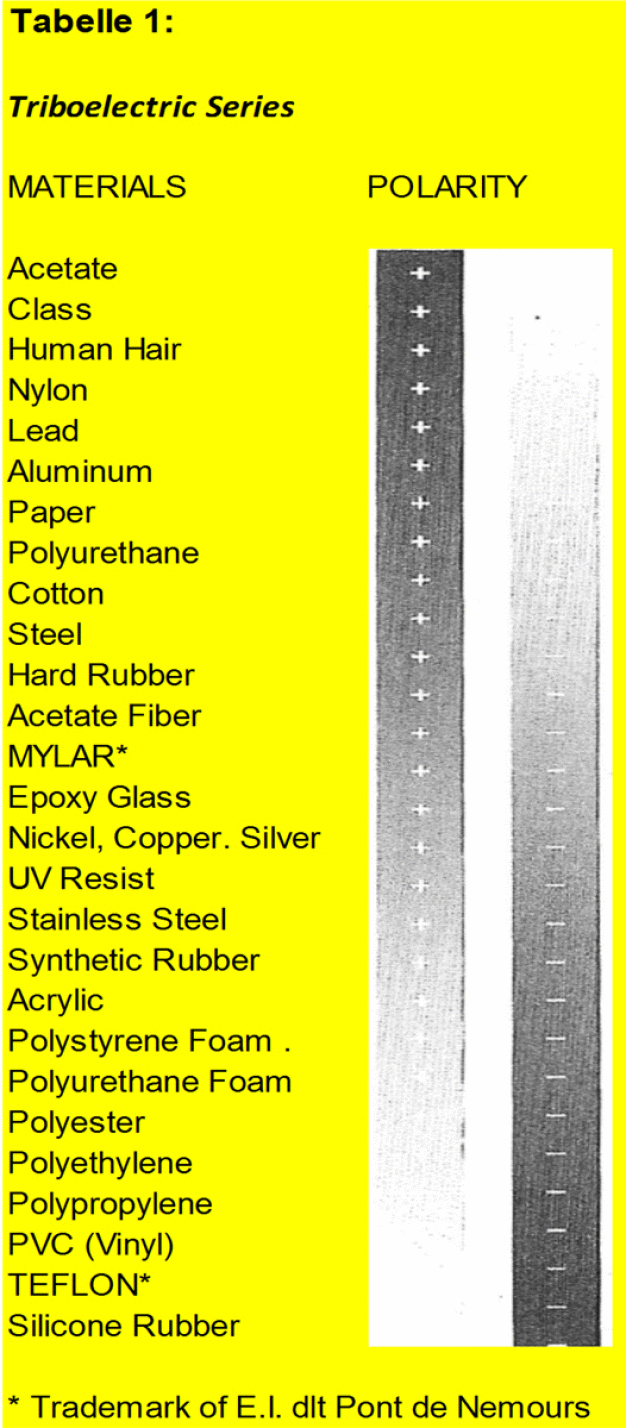
Table_01_web
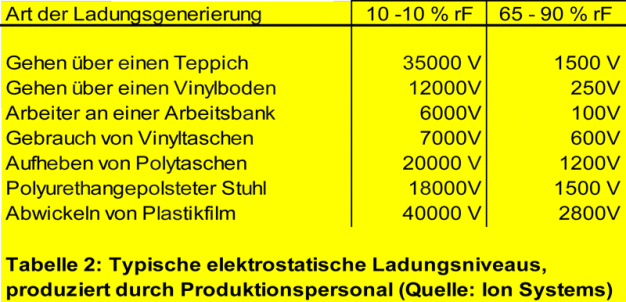
Table_02_web
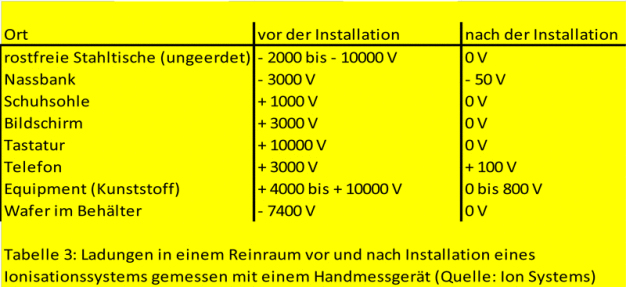
Table_03_web
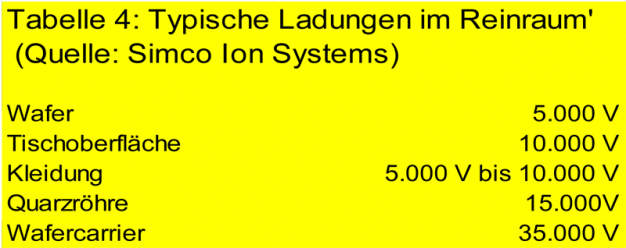
Table_04_web
Recently, significant advances have been made in production optimization regarding scrap in ultra-clean semiconductor manufacturing as well as in other manufacturing processes under cleanroom conditions. Nevertheless, even in Class 1 cleanrooms, the problems of unwanted effects caused by particles generated within the cleanroom itself remain. Electrostatic charges also create additional production problems beyond the negative influences on particle elimination in the cleanroom. Therefore, comprehensive cleanroom monitoring must also include measures against electrostatic charges.
Formation of Electrostatic Charges
Triboelectric Charging
Charges arise through various effects. The main cause is known under the term triboelectric charging. Friction, movement, and separation of materials, as well as liquid and gas movements, produce electrostatic charges triboelectrically. Whenever two touching parts are separated, one surface loses electrons and becomes positively charged, while the other surface gains an excess of electrons and thus becomes negatively charged. The expected polarity depends on the respective materials, as listed in Table 1.
The total charge of the two objects does not change; only upon separation do they acquire their positive and negative charges. Any material, solid, liquid, or gaseous, can be triboelectrically charged. The strength and polarity of the charge depend on surface properties, contact area, separation or friction speed, and other factors. Whether a material charges or not further depends on its conductivity and grounding possibilities.
Induction
Another type of electrostatic charging is induction. When an object is charged, an electrostatic field builds around it. If a conductive object is introduced into this electrostatic field and is grounded, this grounded object becomes oppositely charged relative to the original charge field. This effect also occurs without direct contact between the parts. The electrostatic field induces an opposite charge on the surface of the new object. When the newly charged object is separated from grounding and removed from the electrostatic field, it will carry an induced charge. It is easy to imagine that triboelectrically charged containers or wafer carriers can induce electrostatic charges on the products stored inside them.
Electrostatic Discharge (ESD)
In most cases, electrostatic charges are not immediately visible, but can be detected and measured with appropriate measuring devices. Once a charge has developed, it can often be transferred directly (or via induction) from one material to another.
This transfer occurs as electrostatic discharge (ESD), which can cause problems especially in the cleanroom environment. Just as the formation of electrostatic charges can happen unnoticed, discharges can also occur without detection. The effects of these invisible electrostatic charges are easier to observe when they occur. Coulomb forces attract airborne particles from the laminar airflow to charged wafer surfaces, leading to defects. Particles depositing on charged photomasks cause scrap; ultimately, a variety of defects on ICs can be traced back to ESD events. Failures of production machines, often attributed to various reasons, are frequently due to static discharge events. In the cleanroom, the effects are very obvious: electrostatic charges lead to lower yields and thus lower profits.
ESD Control
A variety of methods have been developed to treat electrostatic charges. In modern cleanrooms, conductive and anti-static materials are used wherever possible to prevent electrostatic buildup from the outset. To ensure reliable control of charges, a discharge path via grounding must be available. Grounding quickly neutralizes charges on machines, materials, and personnel—safely and effectively. However, many cleanroom items are neither conductive nor resistant to static. Good insulators such as plastics, quartz, ceramics, and glass are essential materials in the production process. These highly chargeable insulators tend to retain their charges for very long periods and are often in direct contact with the product.
The requirements of cleanrooms exclude the use of carbon particles or surface-active additives that would make these insulating materials static-resistant. Chemical sprays or solutions would also cause contamination issues. For some time, humidity control was used to address electrostatic problems, but this proved to be too costly and ineffective, not to mention that it could lead to corrosion and processing issues.
Reducing Failures
The practice of designing cleanrooms to achieve as low particle concentrations as possible often has the opposite effect concerning electrostatic charges. The expected improvement in reducing scrap is often not achieved. Ultra-clean air filtration also reduces the natural ion content of unfiltered air, leading to increased electrostatic charge densities in the cleanroom.
Continuous handling and repeated cleaning of charge-insensitive materials gradually destroy this property. Storing wafers in charge-insensitive cassettes or transport containers only makes sense if they are grounded. However, grounding these numerous items or the moving personnel working with them is practically unfeasible. To ensure product purity, gloves are necessary, but the friction between glove layers and other cleanroom objects causes electrostatic charging. Table 2 lists typical charge levels generated by operating personnel.
It has been proven that, due to electrostatic contamination in the cleanroom, the intended reduction in scrap cannot be achieved solely through particle control methods. To neutralize electrostatically charged insulators (or isolated conductors), some form of air ionization system is required. Ionization systems produce clouds of positive and negative air ions, which, dispersed through the filtered cleanroom air, neutralize electrostatic charges regardless of where they are formed in the cleanroom. Air ionization supports other defect reduction methods to maximize the potential to increase 'yield.' Additionally, air ionization significantly helps prevent product defects caused by discharge events and avoids microprocessor malfunctions of cleanroom equipment.
Air Ionization
The air mainly consists of nitrogen, oxygen, carbon dioxide, and other trace gases. Air ions are gas molecules that have either lost or gained an electron. The two most common air ionization methods are corona discharge and nuclear ionization.
Corona Discharge
Corona discharge involves creating a very strong electric field at a pointed emitter tip through high voltage. This field is sufficient to strip electrons from air molecules or add electrons to them, depending on the polarity of the high voltage. When electrons flow toward the emitter point, they leave behind electron-deficient air molecules, creating positive ions. Conversely, when electrons are emitted from the emitter point, they attach to neutral air molecules, which then become negative ions.
Nuclear Ionization
In nuclear ionization, a radioactive source (typically Polonium-210) is used, which emits alpha particles. These alpha particles collide with air molecules, knocking electrons off and producing positive ions. The freed electrons are captured by other neutral molecules, forming negative ions. This process is similar to the natural formation of ions in the atmosphere, which occurs through radioactive decay of substances in the earth (e.g., uranium), gases in the air (e.g., radon), and interactions with cosmic radiation. In normal ambient air, positive and negative ions are present but are largely removed by highly efficient air filtration. This results in the cleanroom air acting as an insulator and promoting the formation of electrostatic charges.
Effects of Air Ionization
Air ionizers restore or increase the ion content in the cleanroom air. When ionized air contacts charged surfaces, it neutralizes the surface charge by absorbing ions of the opposite polarity. For effective neutralization, ions of both polarities are necessary, since electrostatic charges of both polarities can occur in the cleanroom. There are various ways to produce and transport these 'bipolar' air ions to work level, but no single method can be considered the best for all applications. The following section describes some examples of air ionization applications for controlling electrostatic contamination in cleanrooms.
Special Applications of Air Ionization
Wafer Cassettes
During most of the manufacturing process, wafers are stored in cassettes. Although carbon-impregnated, anti-static cassettes can be used for some applications, the process still dictates the use of Teflon and quartz in many stations. Cassettes charged up to 35,000 V electrostatically are not uncommon (see Table 4).
These cassettes act as particle magnets around the wafers, contaminating their surfaces. A study demonstrated that even a relatively low electrostatic charge of 500 V on the wafer surface was sufficient to attract particles from the laminar airflow [1].
Cassettes are notoriously difficult to clean and inspect for cleanliness. Carbon-impregnated cassettes are subject to wear effects that are neither controllable nor avoidable. The most effective method to control cassette charging is air ionization, which neutralizes electrostatic charges at their source. The ionized cleanroom air surrounds the cassettes and wafers at every stage of the manufacturing process. The air ions neutralize any electrostatic charge before it can attract particles or cause defects on the product surfaces.
Photolithography
Photolithography processes require defect-free masks; otherwise, a 'deadly' defect would be continuously reproduced during each exposure. Multiple exposures would lead to multiple defects. Quartz and glass substrates of masks are good insulators capable of accumulating absolutely high electrostatic charges in the cleanroom environment. Charged substrates again attract particles, leading to mask defects. Proper cleaning would significantly reduce the lifespan of masks and worsen the charge problem.
Air ionization in photolithography areas controls static buildup and increases yield. It removes charges from masks and other surfaces, nearly eliminating particle deposition on these surfaces. Besides increasing yield, it allows for lower cleaning frequencies. The resulting prolongation of mask life reduces production costs. Naturally, air ionization also minimizes the occurrence of ESD events. Users have reported that air ionization significantly eliminated errors on reticles. In summary, wafers ultimately exhibit the same defect mechanisms caused by electrostatic charges as photolithographic objects.
Production Equipment
In addition to previously discussed issues caused by particle contamination and ESD, electrostatic charges can also cause malfunctions of production machinery. Problems may arise from the charged product being processed or from static-charged personnel operating the equipment. Modern microprocessor-controlled machines can be particularly sensitive to ESD events. These problems are often mistakenly attributed to software issues. Regardless, the problem of electrostatic charging leads to machine downtime and production failures. Automated work systems are very prone to these error types. A study by Akashic Memories showed an increase in machine operational time from 45% to 99.5% after installing air ionization in an area where a robot handled various cassettes [2]. Various manufacturers working with robotic systems, such as Infineon, Texas Instruments, and Siltronic, use air ionization systems for similar applications. Other cleanroom companies found that their apparent software errors on various process tools disappeared after implementing electrostatic charge control on these machines. Air ionization systems have been used for many years in the printing industry and plastics processing industry, which face similar challenges related to static buildup during product handling.
Selection Criteria for Ionization Systems
When choosing an ionization system, several criteria should be considered. First, such a system must not act as a 'particle launcher.' For example, Simco-Ion Systems uses different emitter materials for various applications. For cleanroom classes 5 (according to EN ISO 14644-1) and better, ultra-clean silicon tips are offered, which have proven in tests in the USA and Europe that they do not emit particles (> 0.1 µm). This property is further supported by the fact that each emitter tip is only responsible for one polarity of ionization, resulting in less material stress compared to alternating polarities on each emitter tip. Next, the system should produce as homogeneous an ion balance as possible. This is only achievable with individually adjustable emitter modules, as different cleanroom equipment causes varying ion absorption. In the model series 5509 and 5511, the ionization strength of each polarity at the emitter can be individually adjusted. An important criterion is the ease of installation of such systems, which should not hinder normal operations, even during installation. Additionally, retrofitting to accommodate changes in the cleanroom should be possible with minimal effort. Simple connectors and trouble-free cable connections, similar to telephone systems, are advantageous. A low-voltage power supply of 24 VAC is preferable to high-voltage supplies, as it avoids interference from wiring and is more stable. The necessary high voltage is generated within the emitter itself, and contact with the emitter tip is safe. A mature ionization system is the control unit model 5084e/5024e, which meets the above criteria and has a special feature: each emitter in this system, which is computer-controlled (FMS-compatible), also functions as a monitoring sensor for its counter-emitter, allowing the system to detect and display potential faults or failures.
Summary
Particle-reducing technologies are continually evolving; however, it will not be possible to create and establish an absolutely particle-free environment. Therefore, it is necessary to expand the definition of contamination control to include other sources of contamination, including electrostatic charges. As a significant part of a comprehensive contamination control program, monitoring electrostatic charges achieves greater success compared to other control methods. Air ionization is one of the few control options for electrostatic charges in highly developed cleanroom environments; in some cases, it is even the only applicable method. Besides reducing contamination-related defects, air ionization minimizes machine downtime and product damage caused by electrostatic charges or ESD. Under cleanroom conditions, air ionization is the most cost-effective method for monitoring static electricity, the invisible source of contamination.
Dipl. Ing. (FH) Reimund Rieger is Managing Partner of QC-Quality Control GmbH in 85757 Karlsfeld.
References:
[1) Inoue M., Sakata S., Chirifu S, "Aerosol Deposition on Wafers", Proceedings of the 34th
Annual Technical Meeting of the IES, King of Prussia, PA, pages 423-428, 1988.
[2) Hili J., "Ionisation Improves Robot Performance", Evaluation Engineering, Issue 31 (4): pages 128 - 134, 1992.
QC-Quality Control GmbH
85757 Karlsfeld
Germany