



- Translated with AI
Einstein verified – Precision experiments with lasers in space
Tests in weightlessness aboard the research rocket FOKUS conducted. Successful technology demonstration for the QUANTUS mission.
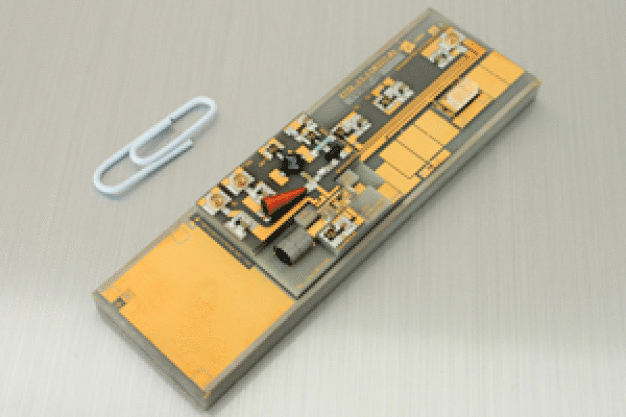
High-performance space module: Micro-integrated Extended Cavity Diode Laser (ECDL) for spectroscopy of rubidium atoms in space. Tests were conducted onboard the high-altitude research rocket FOKUS on April 23, 2015. The goal is to demonstrate whether different types of clocks actually keep time equally in space, as Einstein claimed. (© FBH/P. Immerz)
According to Albert Einstein, clocks run slower the deeper they are in the gravitational potential of a mass – that is, the closer they are, for example, to a celestial body. This effect is called gravitational redshift within the framework of General Relativity – it manifests as spectral lines shifting toward the red end of the spectrum. General Relativity also predicts that the rate of all clocks is affected by gravity in the same way, regardless of how these clocks are physically or technically realized. However, newer theories of gravitation suggest that the type of clock may indeed influence the strength of the gravitational redshift.
To test this, various types of clocks were sent into space today using a high-altitude research rocket in the DLR-funded FOKUS project and then brought back. The conditions there are ideal for testing because the gravitational potential varies particularly strongly. This allows us to check whether the rate of the clocks actually differs – and ultimately whether one of the newer theories of gravitation provides a more accurate description than Einstein's. The first experiments in space have now been successfully conducted: a team of scientists has launched a highly stable quartz oscillator, which "ticks" in the radio frequency range like a modern wristwatch, and a complete laser system for comparison into space. The core of the laser system is a micro-integrated semiconductor laser module, developed, built, and tested at the Ferdinand-Braun-Institut in Berlin, Leibniz Institute for High-Frequency Technology (FBH). The overall integration of the laser system took place at Humboldt University of Berlin. The frequency of the semiconductor lasers is stabilized to an atomic transition of rubidium atoms in a module developed by the University of Hamburg. These rubidium atoms, in conjunction with the lasers, form an "optical atomic clock" that operates on a different physical principle than the quartz clock and "ticks" about ten million times faster than it. For comparing the rates of the two clocks, an optical frequency comb developed by the project-leading company Menlo Systems is used.
The scientists demonstrated for the first time with these tests that such "optical atomic clocks" and the laser systems required for them can be used in space for tests of gravitational redshift and other precision measurements. With this demanding technological demonstration, they also laid the technological groundwork for tests of Einstein's equivalence principle using potassium and rubidium atom interferometers within the MAIUS project. MAIUS is part of the DLR-funded QUANTUS mission, which aims to develop new quantum physical technologies to cool, trap, and manipulate atoms. Further miniaturization of the laser modules is also to be advanced, and a fully automated quantum sensor is to be tested in space. The long-term goal here is to verify Einstein's equivalence principle, which states that all bodies in a gravitational potential "fall at the same rate."
Compact and extremely robust diode laser modules from FBH for space
Countless drop tower experiments at the Center for Applied Space Technology and Microgravity (ZARM) in Bremen prepared the sophisticated experiment in space. The laser module was realized at the Ferdinand-Braun-Institut within the framework of the Joint Lab Laser Metrology with the Optical Metrology working group of HU Berlin. The Joint Lab has long been researching and developing ultra-precise and extremely compact semiconductor laser modules for space use. Their core component is a DFB (distributed feedback) laser that emits light in a very narrow frequency or wavelength range. This spectral narrowness is one of the central requirements for the laser module, which is needed for the spectroscopy of rubidium atoms and thus for precision measurements. Using a unique hybrid micro-integration technology worldwide, the diode laser chip is integrated together with electronic and optical components into an extremely compact, rocket-capable setup. Ultimately, the modules, only palm-sized, must also function flawlessly under the extremely harsh conditions of space. During rocket launch, they are subjected to strong mechanical stresses, with accelerations up to eight times Earth's gravity. "Our integration technology also allows for stresses up to 30 times Earth's gravity," says Dr. Andreas Wicht, head of the Laser Metrology working group at FBH, who considers the system well-prepared for future requirements. "We are also working on spectrally even narrower lasers with hybrid-integrated optical amplifiers, which are excellent for even more complex experiments." With this, FBH is also expanding its expertise in optical and spectroscopic precision measurements, which are among the most precise and accurate measurement methods of our time and open up further applications.
Ferdinand-Braun-Institut gGmbH
12489 Berlin
Germany