


- R+D & Community of Interest
- Translated with AI
Effectively utilizing AI resources in operations
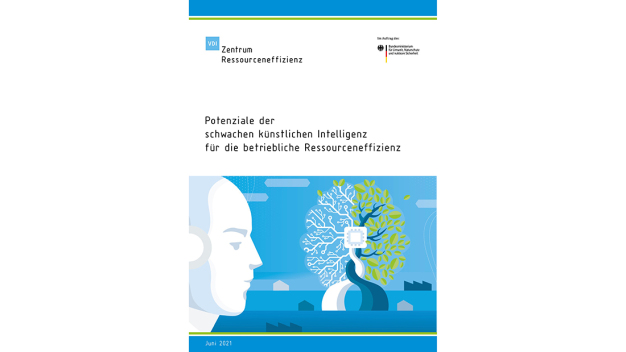
The study commissioned by the Federal Ministry for the Environment, Nature Conservation, Nuclear Safety and Consumer Protection (BMU) titled "Potentials of Weak Artificial Intelligence for Corporate Resource Efficiency" examines specific application possibilities of AI to increase resource efficiency, especially in small and medium-sized enterprises (SMEs).
On May 5th, it was that time again: Earth Overshoot Day in Germany. For a month now, we have been living at the expense of the environment and future generations. We are operating outside planetary boundaries and consuming more resources than our Earth can regenerate. That was the bad news.
And now the good news: Sustainable business practices are increasingly recognized as a necessity — also to ensure the future viability of the middle class. The driving forces include, among others, demands from customers, investors, and society, as well as tightening regulations and legal requirements. This is prompting more and more companies to take action.
Support in Implementation within the Company
It is therefore high time to make our production and way of life sustainable. This includes significantly increasing resource efficiency. The now published study by the Fraunhofer Institute for Production Technology and Automation IPA and the consulting firm Deloitte Artificial Intelligence & Data investigates to what extent methods of artificial intelligence are suitable for efficiently using natural resources such as water, energy, and materials in manufacturing, thereby avoiding greenhouse gases. Its focus is on SMEs. Because especially for SMEs, it is difficult to identify the right approaches for AI deployment. Often, there is a lack of time and personnel to get an overview of the possibilities of AI and the associated methods and technologies. The necessary expertise for selecting and implementing AI projects within their own operations is often not available. Thus, implementing and applying AI often presents a significant challenge. The study therefore not only highlights AI examples for operational resource efficiency but also offers practical support for implementation within one's own business.
Research Questions
The study is guided by the following questions:
- Which technologies and methods of weak AI can SMEs in manufacturing use to improve their operational resource efficiency?
- What potentials does weak AI offer for operational resource efficiency in SMEs in manufacturing?
- Which application scenarios of weak AI are the most promising for increasing operational resource efficiency in SMEs?
- What success factors and barriers exist for the systematic application of weak AI to enhance operational resource efficiency in SMEs?
- What implementation examples are available for successfully increasing operational resource efficiency in SMEs through the use of weak AI?
Competitive Advantages and Unique Selling Points for SMEs
Since analyzing large amounts of data and deriving possible optimization measures often only becomes possible with the implementation of digital solutions, digitalization has long been regarded as a central instrument for improving the sustainability of manufacturing companies. "The integration of AI methods is the logical next step on the way to unlocking resource efficiency potentials in production environments," says Professor Alexander Sauer, head of the Fraunhofer IPA and the Institute for Energy-Efficient Production (EEP) at the University of Stuttgart. "Especially for SMEs, targeted integration of AI offers opportunities to gain competitive advantages and strengthen or establish unique selling points."
The study "Potentials of Weak Artificial Intelligence for Corporate Resource Efficiency," commissioned by the Federal Ministry for the Environment, Nature Conservation and Nuclear Safety (BMU), was coordinated by the VDI Center for Resource Efficiency (VDI ZRE) and conducted jointly by the Fraunhofer Institute for Production Technology and Automation IPA and Deloitte Artificial Intelligence & Data. The study was published on June 7, 2021, and was publicly presented for the first time at the 25th Network Conference "Artificial Intelligence – Opportunities and Challenges for Resource Efficiency."
The study "Potentials of Weak Artificial Intelligence for Corporate Resource Efficiency" is available for download at: https://www.ressource-deutschland.de/fileadmin/user_upload/downloads/studien/VDI-ZRE_Studie_KI-betriebliche-Ressourceneffizienz_Web_bf.pdf
What is Weak AI?
In general, a distinction is made between "weak" and "strong" AI (English: artificial narrow intelligence vs. artificial general intelligence). Strong AI is characterized primarily by possessing cognitive abilities that will be superior to or on par with humans in nearly all aspects. In contrast, weak AI may be superior to humans but usually only in the areas for which it has been explicitly programmed and trained. Weak AI focuses on solving specific application problems based on known methods from mathematics and computer science. The developed systems are capable of self-optimization.

Fraunhofer-Institut für Produktionstechnik und Automatisierung IPA
Nobelstraße 12
70569 Stuttgart
Germany
Phone: +49 711 970 1667
email: joerg-dieter.walz@ipa.fraunhofer.de
Internet: http://www.ipa.fraunhofer.de