




- R+D & Community of Interest
- Translated with AI
Economic viability assessment for CPS technologies
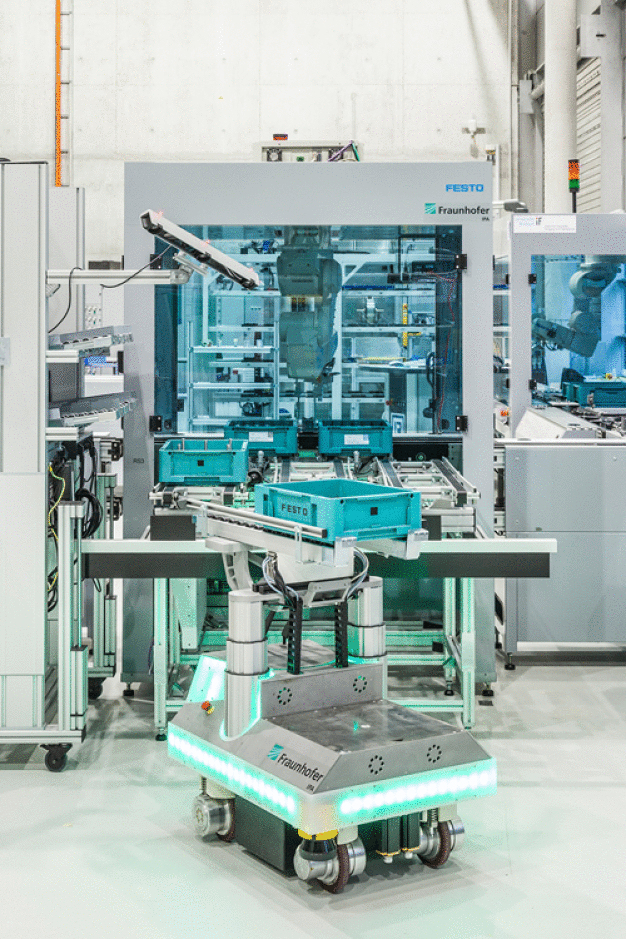
Researchers from Fraunhofer IPA and the International Performance Research Institute (IPRI) have compared the costs and benefits of driverless transport vehicles and other cyber-physical systems in a profitability assessment. (Source: University of Stuttgart IFF/Fraunhofer IPA, Photo: Rainer Bez)
Researchers from Fraunhofer IPA and the International Performance Research Institute (IPRI) have compared the costs and benefits of cyber-physical systems in a profitability assessment. Entrepreneurs can, for the first time, forecast expenses over the entire deployment period and determine the most cost-effective offer.
When robots pick orders in the warehouse and autonomous transport systems load goods, it increases, among other things, the flexibility within the company. Because cyber-physical systems (CPS) are networked with the Enterprise Resource Planning (ERP) and, for example, report the withdrawal of raw materials in real-time. If inventory runs low, the ERP system can immediately order replenishment. This automated information supply reduces, for example, the number of errors. At the same time, CPS facilitate handling a high variety of variants and adapt flexibly to short-term fluctuations in order volume.
However, all of this has so far been difficult to quantify. "Anyone looking to acquire an autonomous transport system finds it hard to reliably assess costs and benefits," notes Martina Schiffer from the Factory Planning and Production Management Department at Fraunhofer IPA. The reason: each potential CPS user has their own IT infrastructure. Integrating the technologies with existing ERP or Manufacturing Execution Systems (MES) can involve significant effort. "Likely, existing processes even need to be adjusted because they were not previously designed for the application of these new technologies," says Schiffer.
Unlikely to make wrong investments
Few can rely on experience because, firstly, CPS technologies are new and not yet widely deployed. And secondly, every company is structured and organized differently. "Small and medium-sized enterprises especially have major difficulties estimating the investment costs for CPS technology," says Philip Autenrieth, a research associate at IPRI in Stuttgart. To provide a rough orientation, Autenrieth and Schiffer, together with their colleagues, developed a methodology to compare the costs incurred when investing in CPS technology with the expected performance improvements in a profitability assessment.
The basis is a typology of all common CPS technologies, assigned to specific intralogistic processes. This allows for quick identification of which products are suitable for the respective application case. Wrong investments become less likely. Once the choice is made, an Excel application based on Visual Basic for Applications (VBA) provides qualitative statements about their benefits: "A sensor bracelet during picking has a high impact on data quality." Or: "An autonomous transport system has a medium impact on throughput time."
Eases investment decision-making
Furthermore, users can compare current and future costs with or without the use of CPS technologies. This makes it visible from which usage duration the investment pays off. Multiple offers from different manufacturers can also be entered to identify the best deal. For small and medium-sized enterprises, the profitability assessment now enables them to forecast the costs of CPS technologies over the entire deployment period. The investment decision is thus facilitated, increasing competitiveness and customer satisfaction.
Project Profile
Name: Industry 4.0 profitable – Life Cycle Costing and Performance Quantification of Cyber-Physical Systems in Intralogistics
Duration: 01.12.2016 to 31.05.2019
Partner: International Performance Research Institute (IPRI), Fraunhofer IPA
Funding: 396,260 euros from the Federal Ministry for Economic Affairs and Energy
The profitability assessment can be ordered via the following link:
https://www.ipri-institute.com/industrie40profitabel

Fraunhofer-Institut für Produktionstechnik und Automatisierung IPA
Nobelstraße 12
70569 Stuttgart
Germany
Phone: +49 711 970 1667
email: joerg-dieter.walz@ipa.fraunhofer.de
Internet: http://www.ipa.fraunhofer.de



