



- Fire protection
- Translated with AI
Dipl.-Ing. Patrick Frey
Economic solutions using modern engineering methods in fire protection
When renovating existing buildings, extensive and costly fire protection measures are often necessary. An effective alternative can be engineering methods within the framework of performance-based fire safety assessments.
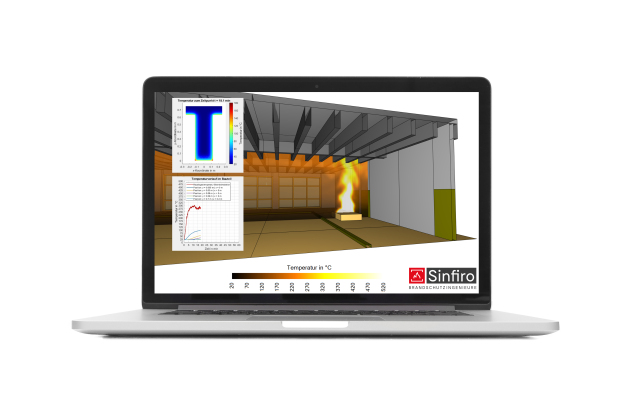
Laptop Mock-Up Thermal Analysis
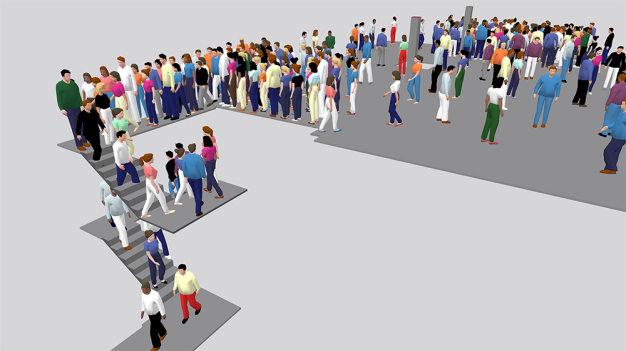
Eviction_01
Fire protection engineers today have modern computer-aided methods, the so-called engineering methods, available as effective tools. By applying these engineering methods, it is possible to demonstrate compliance with the required safety level in a goal-oriented manner within the framework of the fire protection concept – even in cases where the prescriptive requirements of the relevant fire protection regulations cannot be met. The engineering methods thus allow for sustainable fire protection solutions for new and existing buildings to be developed in an object-specific and tailored manner.
Especially in the renovation of existing buildings, this often helps to avoid extensive approval measures, achieve cost and time savings, and thus realize economical solutions.
Although the engineering methods represent the state of the art and rising construction costs of public buildings are currently in the media spotlight, it is noticeable that the versatile possibilities of applying modern engineering methods and the resulting advantages and savings potentials are not always presented to the public.
The following briefly introduces these engineering methods and typical questions. Depending on the complexity of the issue, the engineering methods are applied individually or in combination.
Fire and Smoke Extraction Simulations
A main criterion regarding the effectiveness of fire protection concepts is ensuring the safe usability of escape and rescue routes in the event of a fire. It must be ensured that the smoke situation and temperature distribution during a fire do not compromise the usability of escape and rescue routes (proof of personal safety, ensuring effective firefighting measures).
Computer-based fire simulations are used to assess smoke spread during building fires. The specially developed programs for fire simulation model the flow mechanical and thermodynamic processes of a building fire. This allows for the calculation of smoke spread within the building to assess the resulting smoke situation and the calculation of the resulting temperature distribution or heat flux exposure.
In which questions are fire simulations used?
- To verify the effectiveness or optimize the heat and smoke removal concept
- How long is the usability of escape and rescue routes (self-rescue and intervention) ensured?
- What temperature load results at the glazing? / Can the fire protection requirements for the glazing be reduced?
Evacuation Simulations
This involves analyzing pedestrian flow with a focus on building evacuation. Considering the building geometry, the existing technical systems, and the expected behavior of fleeing building users, a computer model can be used to examine escape and rescue routes. Problematic bottlenecks can be analyzed, and the evacuation time of buildings can be determined. Computer-assisted evacuation simulations are an accepted engineering testing method to demonstrate sufficient escape and rescue route dimensions in case of deviations from building regulations.
In which questions are evacuation simulations used?
- When there are deviations in rescue routes in existing buildings to justify deviations
- In complex buildings to identify bottlenecks and optimize the evacuation concept
- To investigate the duration of building evacuation or evacuation of partial areas
Thermal Analysis
Thermal analyses examine the thermal impact of a fire event on load-bearing components. First, the resulting time-dependent temperature distribution within the component is calculated. This involves defining a design fire scenario considering the specific use of the object and existing fire loads, and calculating the resulting smoke gas temperatures using computer-aided fire simulation. In a further step, the heat flux into the component and the resulting temperature distribution within the component are calculated based on the smoke gas temperatures. Based on the calculated time-dependent temperature distribution across the component cross-section, conclusions can be drawn about whether the resulting temperatures for the component under investigation (e.g., under beams) are in a critical range or not.
In which questions are thermal analyses used?
- In renovations of existing buildings (e.g., schools, etc.) or repurposing of existing buildings, it often occurs that structural components or parts of the load-bearing structure do not
- meet the prescriptive requirements of the current building permit,
- the building code, or
- the current standards (e.g., insufficient concrete cover in concrete ribbed ceilings).
- Is the fire protection quality of the components sufficient regarding the achievement of safety goals?
Summary and Conclusion
The application of engineering methods in fire protection enables the investigation of a wide range of fire safety questions. Practice shows that it can be worthwhile on many levels to incorporate engineering methods as a modern and up-to-date tool (more) into the process.
Through an engineering proof and compliance with the object-specific safety goals using engineering methods, for example, extensive approval measures in the renovation of existing buildings can often be avoided, better decision-making bases (by comparing the possible measures) can be provided for all involved in planning, and resource-efficient, sustainable, and economical solutions can be implemented in new and existing buildings.
Authors:
Dipl.-Ing. Patrick Frey
Head of Engineering Methods
Sinfiro GmbH & Co. KG
David Binder
Bachelor of Engineering (Aerospace Engineering)
Sinfiro GmbH & Co. KG
Dipl.-Ing. (FH) Ralf Galster
Expert for Fire Protection according to VwV Fire Protection Examination
Managing Director Sinfiro GmbH & Co. KG

Sinfiro GmbH & Co. KG
Ebertstraße 2
72336 Balingen
Germany
Phone: 0743399980
email: info@sinfiro.de
Internet: http://www.sinfiro.de