



- Translated with AI
Dust-free and vibration-protected
New campus building of Hamm-Lippstadt University in Hamm - pbr AG provided the overall planning and won first prize with their design
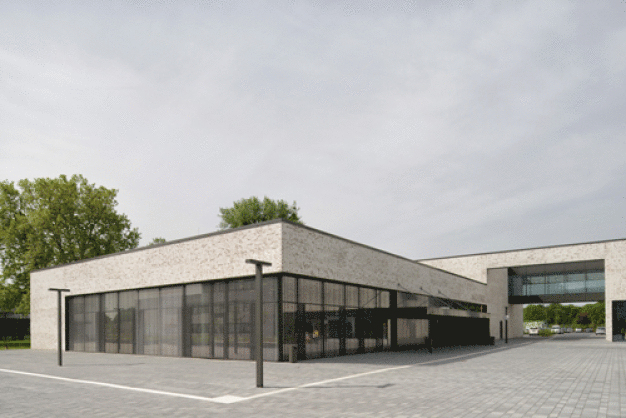
Photo: Andreas Secci and Klemens Ortmeyer
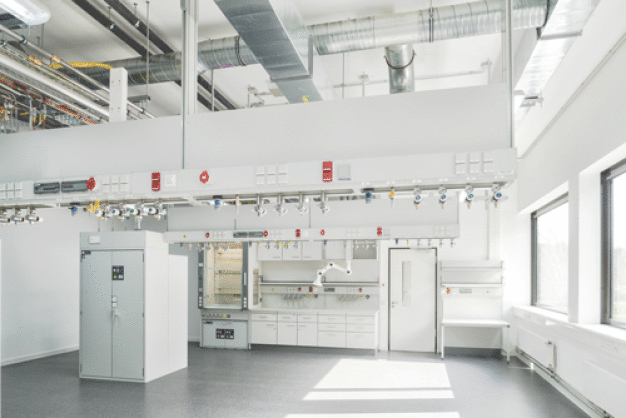
Photo: Andreas Secci and Klemens Ortmeyer
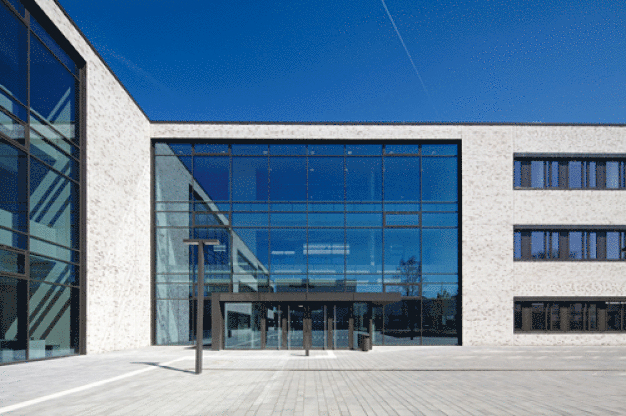
Photo: Andreas Secci and Klemens Ortmeyer
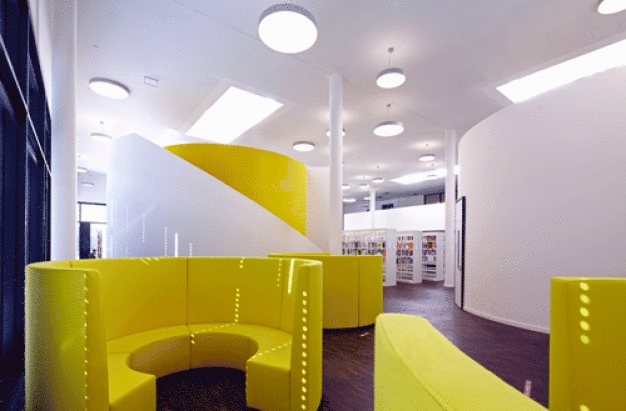
Photo: Andreas Secci and Klemens Ortmeyer
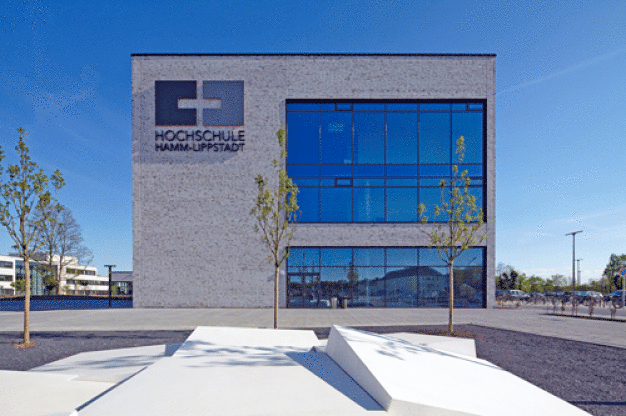
Photo: Andreas Secci and Klemens Ortmeyer
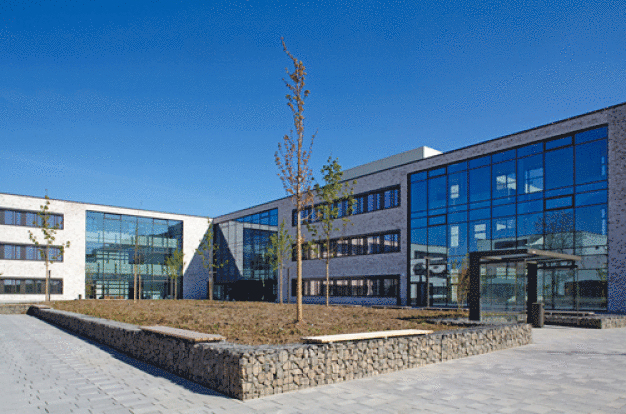
Photo: Andreas Secci and Klemens Ortmeyer
The Hamm-Lippstadt University of Applied Sciences is one of four universities founded in 2009 by the state government of North Rhine-Westphalia. On the site of a former Bundeswehr hospital covering an area of 57,000 m², a dedicated new campus for the STEM university Hamm-Lippstadt was established in 2014 in Hamm, featuring specialized rooms, including cleanroom areas and vibration-isolated laboratories. The planning firm pbr Rohling AG provided the overall planning for this project and won first prize with their design.
Laboratories arranged in ridge structures
The two satellites H1 and H2 house the central functions of lecture halls, cafeteria, campus office, media center, and administration. In the ridge structures of the large building complex H3/H4, all departmental functions are located on three levels, including individual offices, open-plan offices, seminar rooms, and laboratories. At the angular main street of the campus, three wings for offices are located in the direction of Marker Allee, and three wings for laboratories in the direction of Holunderweg. Between the building wings, glass staircases along the main street provide vertical access to the floors.
Room-in-room construction for experiments under dust-free conditions
In addition to physical, biological, and chemical laboratories, the university also has a cleanroom area and light technology laboratories. The cleanroom laboratory area is a room-in-room construction on a hollow-floor, enabling experiments under dust-free conditions. The cleanroom laboratories with an airlock system operate with positive pressure. Air is continuously cleaned via high-efficiency filters, blown in, and extracted through a ventilation system at the floor level. The continuous flow of filtered air ensures that airborne particles are pushed to the ground, maintaining a low particle concentration in the room. The air exchange rate depends on the ISO cleanroom class. Room users change into protective clothing in the adjacent social rooms and enter the cleanroom laboratory via a personnel airlock.
Vibration-free laboratories for sensitive measuring equipment
On the ground floor of building H3 at the corner of Marker Allee/Holunderweg, there are vibration-free optical laboratories. These laboratories house highly sensitive measuring devices with a high intolerance to vibrations. Structural measures in the foundation and footing areas reduce vibrations in these rooms. Additionally, a expansion joint was installed to prevent the transmission of vibrations from neighboring building sections.
Technical facility for large experimental setups
In the southern part of building H3, there is a two-story technical facility. The university uses this technical facility, among other things, for large experimental setups, such as those in mechanical engineering. The hall structure is equipped with a crane system that spans the entire length of the hall, allowing the transport of loads weighing up to 10 tons. The technical facility is also accessible by trucks for delivering large components. Adjacent to it are workshops that serve not only the technical facility but the university as a whole.
Infrastructure supply for the laboratory rooms
The infrastructure supply of the laboratories is managed via collection shafts located at the ends of each room unit. Cooling is provided by a custom-made, environmentally friendly CO₂ compression chiller with a cooling capacity of 120 kW and a conventional chiller with an additional capacity of 600 kW. The CO₂ compression chiller generates waste heat year-round, as laboratories and server rooms need cooling even during cold outdoor temperatures.
pbr Planungsbüro Rohling AG
49076 Osnabrück
Germany