

- Systems
- Translated with AI
Frederik Effenberger
Direct Air Capture: The Path to an Efficient Industrial Process
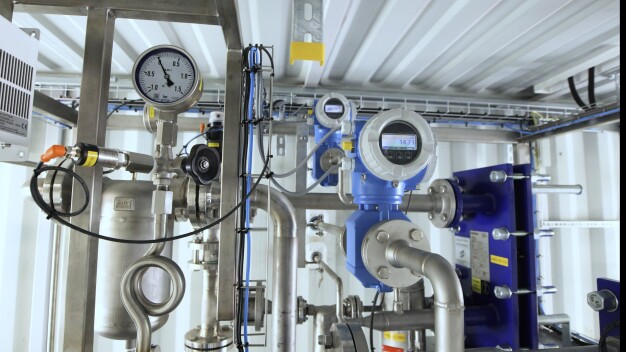
The measurement technology used must deliver reliable results even under changing process conditions. Both measurement accuracy and integration into the compact system architecture are crucial. © Endress+Hauser
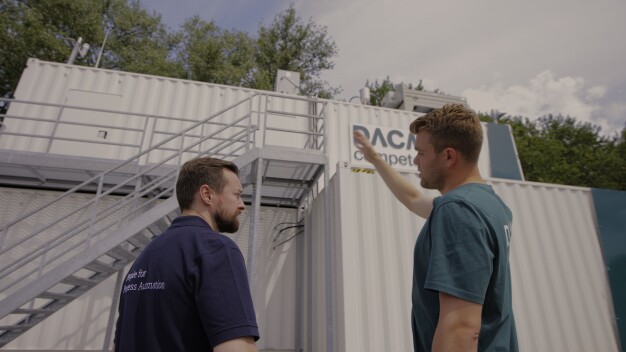
At the DACMA Competence Center, modular systems for CO₂ capture are further developed and tested under real-world conditions. © Endress+Hauser
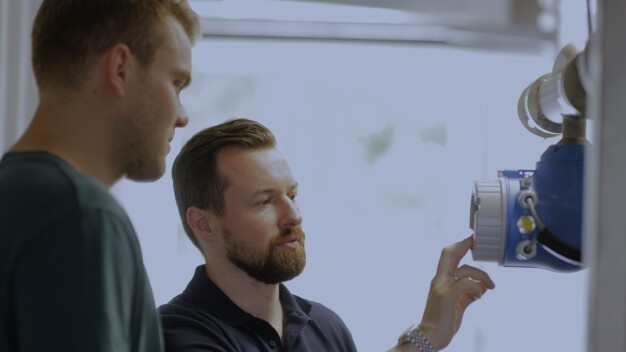
Technical exchange directly at the plant: DACMA and Endress+Hauser are working together to implement the measurement technology requirements of the direct air capture process in practice. © Endress+Hauser
Capturing CO₂ directly from the atmosphere opens up new opportunities for climate protection and the industrial supply of raw materials. However, the path from technological innovation to economically viable operation on an industrial scale is challenging. Precise measurement data is essential, making capture performance and energy consumption transparent and thereby providing the basis for targeted process optimization and scaling.
Carbon dioxide is not only a key factor in climate change, but also a valuable raw material for industrial applications. Capturing it directly from ambient air opens up new prospects for producing synthetic fuels and chemical products, as well as for permanently removing CO₂ from the atmosphere. This is where Hamburg-based DACMA operates at the interface between climate protection and industrial value creation. Its modular plants capture CO₂ using solid adsorbents, before releasing and collecting it again through temperature and vacuum. For their joint development work, DACMA, together with its partners eFUEL GROUP and eFuel DAC GmbH, was named “INNOVATOR of the Year 2026” and also received the Audience Award in November 2026.
The next challenge is to further develop the process for large-scale industrial applications. The precise interaction between capture performance, energy demand and process conditions is crucial. Precise measurement technology provides an essential foundation for this.
When every molecule counts
How much CO₂ is actually captured from ambient air? What initially sounds like a simple material balance proves to be a demanding measurement task in practice. “It sounds simple. But it isn’t,” says Adrian Kortmann, Project Manager at DACMA. The precisely recorded amount of CO₂ is not only an important characteristic for evaluating capture performance. It also forms the basis for reliable evidence for authorities, investors and the market. Even minor measurement deviations can become significant.
The difficulty lies primarily in the special properties of the captured carbon dioxide. It must be measured in a gaseous state and with a high degree of purity. Under these conditions, many measurement methods reach their limits. At the same time, the plant architecture places high demands on the equipment used: It must be compact, require as little inlet and outlet piping as possible, and deliver reliable results even under dynamic process conditions.
However, accurately determining the amount of CO₂ is only part of the task. To assess the efficiency of the capture process, other process variables such as pressure, temperature, and energy and material flows must also be recorded. Energy consumption plays a particularly important role. How much steam is required? What quantities of condensate are produced? And what conclusions can be drawn from this for process optimization? Only by considering these measurement values together is it possible to understand the relationships within the plant and identify opportunities for targeted improvement.
Technical insight instead of simply selecting equipment
To meet these requirements, DACMA brought measurement technology specialist Endress+Hauser on board. At the outset, the focus of the collaboration was not on the question of which measuring device was suitable, but rather on which measurement variables were the right ones. Together, the partners analyzed the process conditions, defined relevant parameters and determined where which measurement methods should be used. “Endress+Hauser helped us refine the question before we looked for the solution,” says Adrian Kortmann of the collaboration.
This approach was crucial, because the individual measuring points not only had to meet stringent accuracy requirements, but also had to be sensibly integrated into the existing plant architecture. Compact design, minimal requirements for inlet and outlet piping, and reliable measurement results under changing operating conditions were therefore just as important as economic feasibility.
The result is a coordinated measurement solution that records both the amount of captured CO₂ and the relevant energy and material flows.
Keeping CO₂ quantity and energy consumption in view
To reliably determine the actual capture performance, DACMA uses highly precise flow measurement for gaseous CO₂. However, the efficiency of the process can only be assessed in relation to the energy required. That is why Endress+Hauser’s measurement technology records not only the amount of CO₂ produced, but also the steam and condensate flows. Continuous level measurement also supports stable and safe plant operation.
The measurement data can be used to determine where energy can be saved and capture further optimized. They therefore serve not only to monitor ongoing operations, but also provide important insights for the further development of the technology.
“The combination of these devices has given us truly complete transparency into our processes for the first time. We can now see exactly what goes in and what comes out—both in terms of energy and materials. That is the foundation for everything that follows,” says Kortmann.
From pilot plant to industrial scaling
With this transparency, DACMA gains an important basis for decision-making in the further development of its technology. What works in pilot operation must also prove itself on an industrial scale in terms of energy demand, process stability and economic viability. “What we have learned in our pilot plant flows directly into the next generation of our plants. The measurement data show us where we can save energy, how we can optimize capture and how we can scale,” says Kortmann.
The importance of considering complete process chains is also demonstrated by the DACMA Competence Center, which opened at the Port of Hamburg in October 2026. There, the company and its partners are continuing to test and develop CO₂ capture under real-world conditions. At the same time, they are investigating how the technology can be integrated into downstream industrial production processes.
One example is the PEGASUS research project, in which DACMA, together with eFuel DAC GmbH and Hamburg University of Technology, is working on combining Direct Air Capture with an e-methanol process chain. The focus is on the interaction between CO₂ capture, hydrogen supply and methanol synthesis. Examining the energy, heat and material flows is intended to help better coordinate the individual process steps from both a technical and economic perspective. This brings a question to the fore that was already decisive in the development of the DAC plants: How can complex processes be made so transparent that they can be improved in a targeted manner?
Measurement technology as part of process engineering
The DACMA example demonstrates that measurement technology goes far beyond simply monitoring individual process variables. It is an integral part of process engineering and already influences during the development phase how well a process can be understood, evaluated and further developed. Particularly in the case of new technologies, this determines at an early stage whether a functioning technical solution can also become an economically viable industrial process.
Endress+Hauser AG
4153 Reinach BL 1
Switzerland