



- R+D & Community of Interest
- Translated with AI
Digitalization solutions and material development for battery production
Research Project DigiBattPro4.0
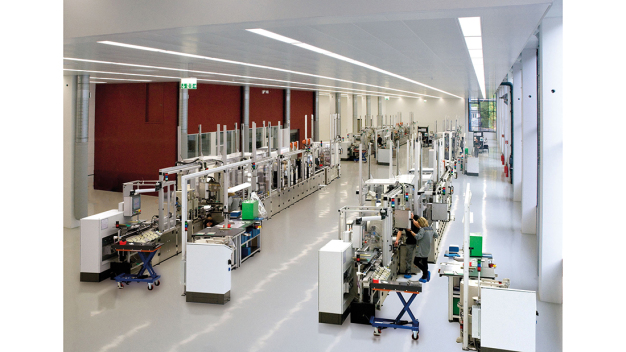
Battery cell manufacturing at Varta. © VARTA Microbattery GmbH
Smartphone, forklift, electric car – efficient energy storage systems are essential to transition from fossil fuels to clean electricity. The Fraunhofer Institute for Manufacturing Engineering and Automation IPA in Stuttgart has now launched a project together with partners to make battery cell production more cost-effective and improve their quality.
The goal is fully automated production that not only detects defective workpieces but also identifies the cause – and immediately counteracts without human intervention. This is only possible if the entire process chain is digitized and sensors collect countless data. In this future factory, everything is recorded: from the settings of all machines to the thickness of the applied coating, as well as room temperature and humidity. To find meaningful correlations in the data jungle, artificial intelligence is needed. It determines which settings and parameters are associated with which results.
Digitization concepts for battery production
DigiBattPro4.0 stands for Digitized Battery Cell Production with Industry 4.0 technologies. Of course, the project's goal cannot be achieved in the lab alone. Reliable results require real manufacturing with high batch sizes. This is made possible by the Baden-Württemberg battery company Varta, which produces tens of thousands of batteries daily. Here, Fraunhofer experts will first network all machines and create a computer model. The entire production process will then run not only physically but also virtually. The model aims to show how process parameters influence product properties, where improvements can be made – the precursor to self-regulating manufacturing.
Self-learning manufacturing process
What is successful in the existing production line is to be transferred in the next step to lithium-ion batteries, such as those used in electric cars. The standard cells are cylindrical and measure 70 millimeters in height and 21 millimeters in diameter. Experts refer to this as the 21700 format. By the end of its term, the project aims to create the conditions to produce such cells fully automatically using self-regulating, disturbance-free processes, thereby shortening throughput times and reducing waste.
Development of environmentally friendly high-performance materials
The cells are also to become more powerful and the manufacturing process more environmentally friendly through new materials: a watery cathode material replaces the environmentally harmful solvent, and an enriched nickel content increases energy density.
Securing technological sovereignty and maintaining competitiveness
The combination of digitization and material development, involving the Fraunhofer Institute, Varta, and the Center for Solar Energy and Hydrogen Research Baden-Württemberg (ZSW), ensures rapid results. The project started on March 1 and is planned to run for four years. "In the long term, the digital solutions developed will promote the economic viability of battery cell production and secure the manufacturing location in Germany," says IPA Institute Director Professor Alexander Sauer.
Profile
Project name: DigibattPro4.0 – Digitized Battery Cell Production 4.0
Program: From Material to Innovation
Project sponsor: Jülich (PtJ)
Project duration: March 1, 2021, to February 28, 2025
Funding agency: Federal Ministry of Education and Research (BMBF)
Funding amount: 30 million euros
Funding code: 03XP0374C
Partners: Fraunhofer IPA, VARTA Consumer Batteries GmbH & Co. KGaA, VARTA Microbattery GmbH, Center for Solar Energy and Hydrogen Research Baden-Württemberg (ZSW) Ulm

Fraunhofer-Institut für Produktionstechnik und Automatisierung IPA
Nobelstraße 12
70569 Stuttgart
Germany
Phone: +49 711 970 1667
email: joerg-dieter.walz@ipa.fraunhofer.de
Internet: http://www.ipa.fraunhofer.de



