




- Translated with AI
Dr. Marc Sacher
Development of the world's first ultra-flat, bipolar meta-lens successful
Material made of glass and gold 2,000 times thinner than human hair - used in photonics for optical circuits and light-emitting diodes
2013-03-14_EBL
Prof. Dr. Thomas Zentgraf, head of the "Ultrafast Nanophotonics" research group at the Department of Physics at the University of Paderborn, and Dr. Shuang Zhang, head of the team at the University of Birmingham, have jointly developed the world's first ultrathin lens for visible light.
Unlike conventional ground glass lenses, the new lens is flat and extremely thin. It is only 20 to 30 nanometers (nm) thick, which is 0.00002 to 0.00003 mm. A human hair is comparatively about 2,000 times thicker.
The lens consists of a novel so-called metamaterial, a combination of glass and gold, which magnifies or reduces objects depending on the type of incident light, i.e., its polarization state. "The meta-lens demonstrates the potential that can be unlocked with innovative optical materials to influence light very effectively," says Thomas Zentgraf. "It opens up flexible new possibilities for creating specific material properties, as the structuring of the surface can be changed arbitrarily."
The meta-lens can be used in components for photonics and allows for a very compact design due to its flat shape, e.g., in integrated optical circuits or in the beam shaping of LED light. Other applications are conceivable in biophysics, such as for the so-called "optical tweezers." In this application, the meta-lens can generate a special light beam profile with which objects can be "trapped" and held. And for future developments of a quantum computer, the lens could take over the function of transistors when used as a "light switch."
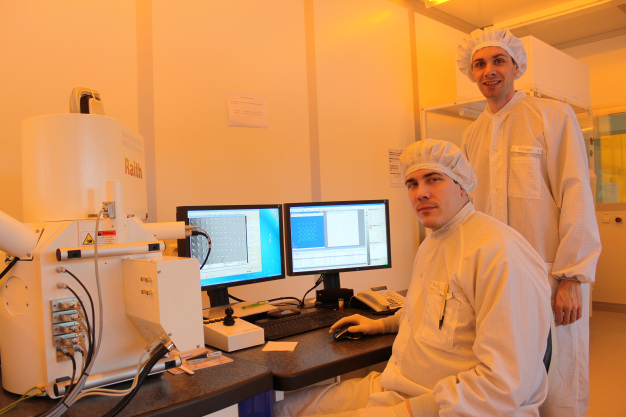
The metamaterial of the new lens consists of an artificially manufactured, microscopically fine structure. On a glass substrate, 100 to 200 nm long gold rods are produced using electron beam lithography. Depending on how these rods are aligned, they influence the incident light like tiny antennas in a locally different manner. This can achieve the effect of a normal diverging or converging lens. When right circularly polarized light hits the meta-lens, it acts focusing. With left circularly polarized light, the light beam is scattered, i.e., defocused. The property of the meta-lens (focusing or defocusing) can thus be changed simply by altering the oscillation state of the light, unlike a classical lens where this property is fixed.
Since the size of the gold rods in the lens must be tuned to the color, i.e., the wavelength of the used light, the structures on the lens are correspondingly small. "We tested at the end of the visible spectrum at around 700 nm," says Thomas Zentgraf. "Here we are operating at the limit of current technical feasibility with electron beam lithography, but this will also develop."
Prof. Dr. Thomas Zentgraf heads the "Ultrafast Nanophotonics" working group at the Department of Physics at the University of Paderborn and is a member of the Central Scientific Institution "Center of Optoelectronics and Photonics Paderborn (CeOPP)." His group is engaged in developing artificial optical materials as well as new concepts for influencing light propagation. The original publication can be found online: http://www.nature.com/ncomms/journal/v3/n11/full/ncomms2207.html