
- Translated with AI
Christian Worsch, Marcel Kleßen, Michael Flämmich, Ute Bergner
Detection of filmic contaminants with VIDAM - an innovative cleanliness measurement method
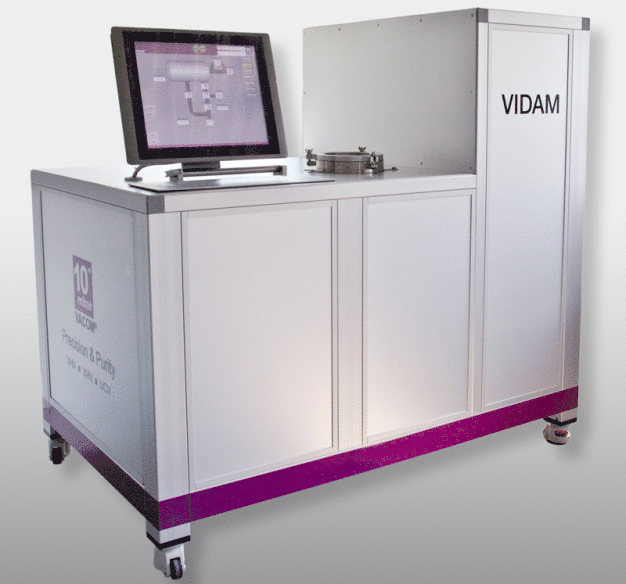
Fig. 1: A VIDAM device – compact and mobile, usable in a variety of process environments.
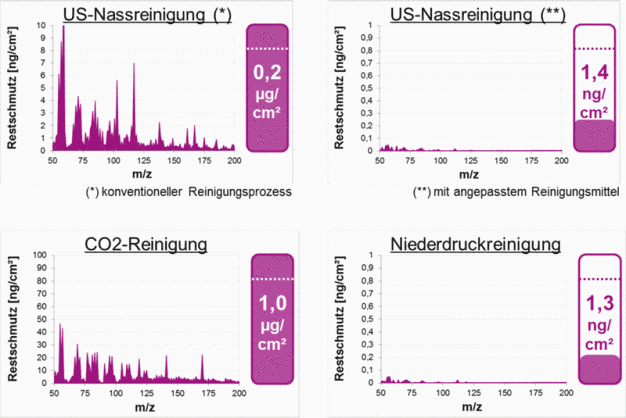
Fig. 2: Residual dirt on surfaces of components with complex geometry after various cleaning procedures. Note the different residual dirt intensities (y-axis).
In many industries, the cleanliness of component surfaces is a critical quality attribute. Any contamination must be thoroughly removed to ensure that the component has sufficient cleanliness for subsequent manufacturing steps (e.g., joining, painting) or suitability for use in cleanrooms. In a variety of innovative products, contamination during mass production cannot always be completely avoided. The cleanliness status of components can only be assessed by determining and thereby understanding the level of contamination (residual dirt on a surface). By controlling the cleaning results, component cleanliness can be assured and reproducible quality guaranteed. With additional knowledge of component history and delivery condition, cleaning processes can be stabilized and individually adapted. This makes them reproducible and optimizable according to the respective requirements, considering technological and economic factors.
However, cleanliness control is not only about detecting particulate contamination, which is already established in many process chains. For film-like contaminants (e.g., manufacturing aids such as oils, fats, lubricants, residues from corrosion protection, fingerprints), there are, apart from highly developed surface analysis methods (e.g., TOF-SIMS, XPS, TD-GCMS), which are often quite time-consuming and costly and require well-trained personnel, only qualitative, at best comparative testing methods (e.g., visual inspection, wipe test, contact angle measurements, gravimetric measurements, and fluorescence measurements). These usually do not provide information about the cause or origin of the contamination. It is also generally true that the larger and more complex the components and geometries, and the more components need to be examined, the more complex the analysis becomes. For film-like contamination, there are currently no standardized, methodical procedures to measure them easily, non-destructively, and geometry-independently, both qualitatively and quantitatively.
This gap can be filled by a novel cleanliness measurement method that allows spectral and quantitative measurement of film-like contamination (residual dirt in g or g/cm²) on component surfaces through vacuum-induced desorption. Film-like or chemical contamination is usually solid or liquid under atmospheric conditions at room temperature. In a vacuum, existing contamination can detach from the component surface and be detected using suitable measurement technology. The method enables integral detection of contamination, i.e., on the entire surface of individual components as well as entire assemblies of arbitrary geometry. The measurement method is non-destructive, meaning the components can be processed immediately afterward.
VIDAM devices use this direct measurement method to check and evaluate component cleanliness. A VIDAM measurement is based on a fully automated process with simple operation, meaning no specialist is needed to perform the measurements.
An example of the VIDAM device is shown in Fig. 1. It consists of a vacuum chamber into which the components are placed, a pumping system, suitable pressure measurement technology for detecting contamination, and a system control with integrated data recording and analysis. Film-like contamination can thus be extracted, separated, and detected from the component surface.
As a measurement quantity, VIDAM provides a quantitative result, i.e., the amount of residual dirt on the surface in grams (or relative to the component surface in g/cm²), enabling the setting of appropriate threshold values. The spectral measurement method allows contamination to be clearly identified and attributed to their causes (e.g., residues from manufacturing aids and cleaning agents).
The minimum detection limit of < 0.3 ng/cm² for organic substances allows detection of very small amounts of contamination, and the upper measurement limit exceeds what is generally referred to as "oil- and fat-free". Both the chamber size, cycle times, component throughput, and detection limit can be tailored to the specific measurement task.
As an application case, the following describes the evaluation of various cleaning procedures for components with complex geometries (due to many blind threaded holes). For example, an automotive supplier that requires components with sufficient cleanliness for subsequent processes can be considered. The cleaning of the components is to be carried out in-house in the future, and several cleaning methods are under consideration: ultrasonic wet cleaning, CO₂ cleaning, and low-pressure cleaning. The threshold for organic contamination on the components, i.e., film-like residual dirt, was previously determined to be < 1 µg/cm² (ISO-SCC Class -6 (VOC)), better < 0.1 µg/cm² (ISO-SCC Class -7 (VOC)).
The effectiveness of the candidate cleaning methods was evaluated using test parts contaminated with a defined test soil and then cleaned with the respective method. Subsequently, the residual dirt on the component surfaces was measured with a VIDAM device, and the component cleanliness was determined. The results of the VIDAM measurements are shown in Fig. 2.
Among the investigated cleaning methods, CO₂ cleaning yielded the poorest results (residual dirt of 1.0 µg/cm²), while low-pressure cleaning achieved the best component cleanliness (residual dirt of 1.3 ng/cm²). On an existing ultrasonic wet cleaning system, components could be cleaned to a residual dirt level of up to 0.2 µg/cm² with standard parameters, but clear residues of manufacturing aids were still visible. By adjusting the cleaning agent, the cleanliness was significantly improved again (residual dirt of 1.4 ng/cm²). The target threshold of < 0.1 µg/cm² (ISO-SCC Class 7 (VOC)) was clearly exceeded on the existing ultrasonic wet cleaning system with adjusted cleaning agents.
Other typical applications for VIDAM measurements besides validation, verification, and optimization of cleaning processes include testing the effectiveness of cleaning agents for specific manufacturing aids, monitoring the drying degree of components after cleaning, and verifying and ensuring sufficient component cleanliness before surface finishing processes (e.g., coating, painting, galvanizing, printing) and joining processes (e.g., bonding, welding, soldering).
VIDAM can be flexibly integrated into existing production chains and enables in-house optimization of manufacturing and cleaning processes, thus ensuring high overall process reliability and reproducible quality of the final product.
VACOM Vakuum Komponenten & Messtechnik GmbH
07751 Großlöbichau
Germany