




- R+D & Community of Interest
- Translated with AI
Designing a future-proof production
Study "Holistic Production Systems 4.0"
© Fraunhofer IPA
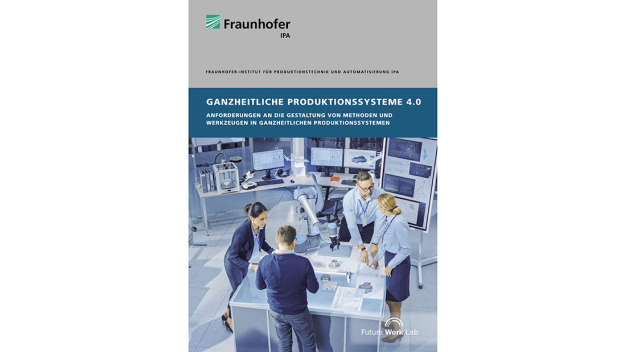
Digital, lean, and human-centered: Ten guidelines for designing future-proof production systems have been developed by scientists from the Fraunhofer Institute for Production Technology and Automation IPA in the study "Holistic Production Systems 4.0". Their practical requirements for designing methods and tools provide a concrete framework for managers and factory operators.
Digitalization is transforming production. Under the keyword Industry 4.0, it marks a turning point. What role do humans and Lean Production play in designing production systems with new Industry 4.0 technologies? What requirements are placed on design, and how does the digital transformation affect the individual levels of holistic production systems? Numerous experts from practice were surveyed on these and other questions in the study prepared by Fraunhofer IPA.
With Lean and Industry 4.0 to Flexibility and Agility
The Fraunhofer study clearly shows: The digital transformation does not shake the fundamental principles of Holistic Production Systems (HPS). "The company-specific methodological framework, which serves to continuously align all business processes with the customer, remains valid – especially since Holistic Production Systems are established as an industry standard in Germany," summarizes Simon Schumacher, project manager of the Future Work Lab and lead author of the study. The methods of Lean Production will continue to determine factory processes. However, they are constantly evolving in conjunction with increasing digitalization and networking. The goal of this change is to make production more flexible. A company should be able to respond quickly to customer wishes, even very specific ones. Industry 4.0 even makes it possible to produce custom-made items at the price of mass-produced goods. This is aided by the fact that the assembly line will no longer be the measure of all things in the future. In the factory of the future, traditional line production with conveyor belts and takt time can be dismantled – and at reduced costs.
Cooperative Data Management
This, of course, only works with good data management. It must be guaranteed that all data from every machine and every process are always available. More than that: in the future, optimizing one's own production processes will no longer be sufficient. A company must also look beyond its own boundaries and integrate data from its customers and suppliers into its processes. Schumacher speaks of "End-to-End processes without system breaks." The networking thus goes far beyond the company's own machinery.
Toolbox and Use Cases
All of this greatly increases the complexity of production. To still be able to control processes, assistance for industrial engineering is necessary. This is an important result of the study. A toolbox must be created. A toolbox should enable problems to be solved using standardized procedures. For every change in processes or machines, the well-structured toolbox provides hints on what to do. Prerequisite: It must be easy to handle and as intuitive as possible to operate. The toolbox should also include application examples, so-called use cases. The research group for implementation methods for digital production plans to establish an industry working group "Holistic Production Systems 4.0" in summer, in which the development of such a toolbox will be practically carried out with experts from industrial engineering.
Two-Stage Study
The study is part of the research activities at the Future Work Lab and is based on a two-stage survey. In the first part of the survey, a web-based questionnaire, 73 experts participated. Seven general hypotheses from research were tested in practice.
In the second part, the project team conducted 18 detailed interviews with professionals from manufacturing companies. "Our study provides insights into the current state of designing production systems of leading German companies in the automotive industry as well as machinery and plant engineering. Our hypotheses from research could largely be confirmed by industry. Companies also report that by combining Industry 4.0 and Holistic Production Systems, they can achieve annual improvements in the double-digit percentage range," says Schumacher.
Further research activities on the production work of the future are being gathered at Fraunhofer IPA under the new leadership and future topic "Technologies for Human-Centered Production," coordinated by Simon Schumacher for IPA.
Funding Notice
This study is part of the research project "Future Work Lab." The Future Work Lab is supported as a pilot project with funds from the Federal Ministry of Education and Research (BMBF) within the program "Innovations for Production, Services, and Work of Tomorrow," program line "Future of Work," and is managed by the project sponsor Karlsruhe (PTKA).

Fraunhofer-Institut für Produktionstechnik und Automatisierung IPA
Nobelstraße 12
70569 Stuttgart
Germany
Phone: +49 711 970 1667
email: joerg-dieter.walz@ipa.fraunhofer.de
Internet: http://www.ipa.fraunhofer.de



