

- Translated with AI
Doris Schulz
Deburring for the particular component cleanliness
Particle cleanliness and deburring
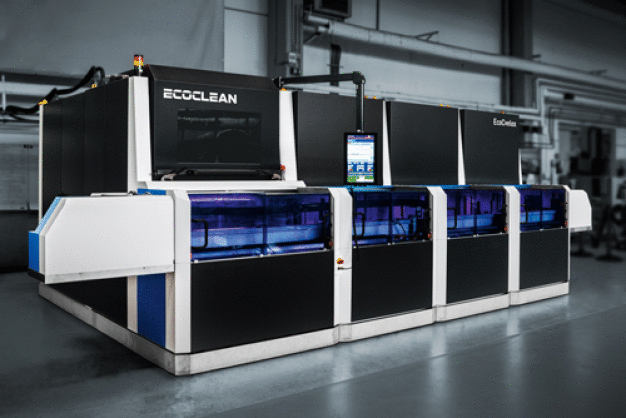
The new EcoCvelox combines deburring and cleaning with very fast automation, allowing these processes to be efficiently carried out in a single system. (Image source: Ecoclean GmbH)
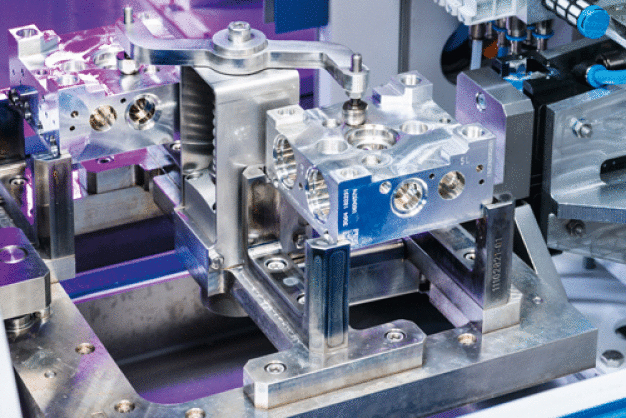
The deburring and cleaning modules are designed for components measuring 200 x 200 x 200 mm. The individual operations can be performed in cycle times of 15 seconds per pallet, with approximately 14.5 seconds allocated to the process time. (Image source: Ecoclean GmbH)
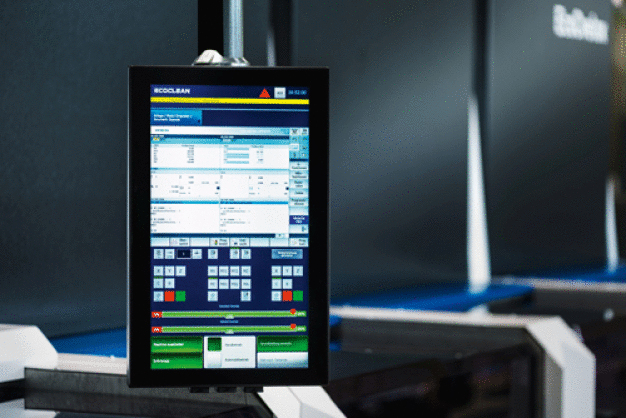
On the 19-inch flat-screen display (HMI) of the new, intuitive control panel, each module of the system is shown in a comprehensive overview, similar to a smartphone, presented separately and clearly. (Image source: Ecoclean GmbH)
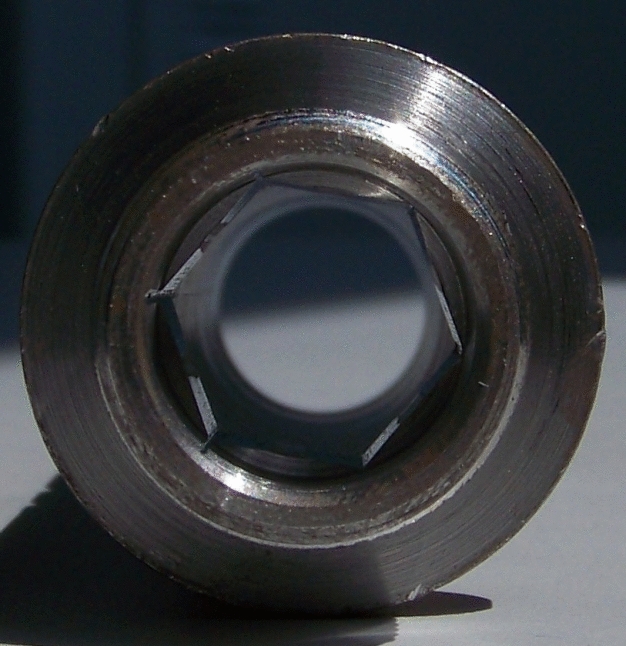
A reliable deburring is a prerequisite to reliably meet high cleanliness requirements. (Image source: Ecoclean GmbH)
Particular cleanliness specifications in the range of a few hundred micrometers are commonplace in many industries today. They can – especially with machined components with complex geometries – only be reliably fulfilled if a trustworthy deburring process has taken place beforehand. A new solution combines both processes with very rapid automation, enabling deburring and cleaning to merge in a highly flexible system.
Components are increasingly smaller and more complex. This typically correlates with higher sensitivity to particulate contamination, leading to increased cleanliness requirements for the workpieces. Depending on the component and application, specifications such as "no particles larger than 200, 300, or 400 micrometers" must be met. This results in manufacturers, especially those producing or machining metal parts with complex geometries, undertaking significant cleaning efforts to meet these standards. However, despite these efforts, particles larger than allowed are often found on the analysis filter during subsequent cleanliness checks. The component or even an entire batch of parts is thus not sufficiently clean for final assembly.
Particles – often replaced burrs
The cause is frequently unremoved burrs and flitter burrs that detach during cleaning but are not completely rinsed away. Another source is handling the parts during residual dirt inspection, which can also cause burrs to break off. These are undesired material fragments that form along machined edges and on the component surface due to material displacement, still firmly attached to the workpiece. Since machined parts often have hard-to-reach areas such as undercuts, slots, grooves, internal and crossing bores, they pose a particular challenge during deburring. Regardless, these machining residues must also be removed here, because in cleanliness-critical components—such as hydraulic components like gearboxes, brakes, and steering systems, as well as valves and housings for engines and pumps—burrs can loosen during operation, impair function, or even cause system failure.
Deburring – a manufacturing or cleaning task?
Despite its great importance for component quality, deburring is often still viewed as an unproductive manufacturing step. This frequently leads to controversial discussions between operators and manufacturers of cleaning systems. Especially when high cleanliness standards are required, it is now common for system manufacturers to guarantee the achievement of specified particulate residual dirt levels only for parts that are fully and properly deburred.
High-pressure water jet – targeted removal of burrs
In industrial practice, deburring is carried out using various methods, generally divided into non-targeted and targeted procedures. For steel and aluminum components with complex internal geometries, high-pressure water jet deburring has become established for targeted removal of burrs. Various deburring tools such as different nozzles or lance systems are used to penetrate holes and internal geometries, applying a water jet directly to the burrs. The water jet pressure is significantly higher than the subsequent operating pressure used to circulate fluids like hydraulic oil through the component. For example, if an oil pump operates at 150 bar, deburring is performed at at least 300 bar. Burrs that cannot be removed at this stage pose no risk during the later operation of the pump.
This targeted deburring requires that the burr locations resulting from manufacturing are predefined and that the mechanical processing method is known. From this information, a component-specific deburring program can be created. It ensures that the water jet applies force to the burr in such a way that it is not merely pressed into the bore but actually removed.
Interface issues – removing burrs and cleaning
Since deburring is performed with minimal pressure and water volume for energy and resource efficiency reasons, chips/particles remain on the workpieces afterward. The detached burrs are not rinsed away by the small water quantities used. This is where component cleaning comes into play, typically carried out in a separate system and often in batch processes. This setup presents several challenges for operators. These include the need for two systems to produce "demand-appropriate clean components" and the fact that process responsibility often lies with the operator, especially if different suppliers are commissioned for each system. When cleanliness issues arise, solutions can become complicated because responsibility for the overall result is distributed. Additionally, cleaning parts in batch processes involves extra handling and requires specially designed workpiece carriers, and only general cleaning of parts is possible. Targeted treatment of cleanliness-critical areas is not feasible in this setup.
One process – targeted deburring and individual cleaning of components
Parts with high cleanliness requirements are ideally deburred not only as individual pieces but also cleaned in the same process. Solutions for this have so far been very limited. A completely new and highly flexible system concept with an integrated linear transport system for parts and demand-oriented automation offers a remedy. The modular EcoCvelox system from Ecoclean combines 5-axis high-pressure water jet deburring with various processes for component cleaning and drying. Standard modules are designed for parts measuring 200 x 200 x 200 mm, delivered on pallets. The individual operations can be completed in cycle times of 15 seconds per pallet, with approximately 14.5 seconds dedicated to process time.
Deburring and cleaning – configurable individually
The various elements for deburring, component cleaning, and drying can be configured individually and expanded according to requirements. High-pressure deburring can be performed with the standard single spindle and pressures up to 1,000 bar (or up to 3,000 bar if needed), or with an optional HD rotary head equipped with up to five different tools. In both cases, these can be tailored to the specific part. For component cleaning, processes such as injection flood washing, spray cleaning, ultrasonic cleaning, and targeted rinsing are available, which can be combined. Drying can be achieved through high-speed blow-off and/or vacuum drying, with blow-off drying potentially integrated into a cleaning module if cycle times permit.
CAD/CAM interface – fast and simple programming
Adapted to the equipment of machine tools, a CAD/CAM interface can be integrated into the deburring module. Existing data from component manufacturing can be used for programming high-pressure deburring, allowing it to be performed easily and quickly offline and then uploaded into the system control. Additionally, deburring processes for new components can be implemented in the shortest possible time and with minimal effort. Workpiece recognition can be achieved, among other methods, through an integrated camera system, enabling effective and economical deburring of batch sizes of one.
Thanks to the high flexibility in system configuration and process design, this new solution comprehensively covers all requirements in deburring, cleaning, and drying in an economical manner. Furthermore, its ease of operation and high maintainability make it an efficient response to increasingly higher cleanliness standards.
Ecoclean GmbH
70794 Filderstadt
Germany