




- Translated with AI
Data processing reaches the smallest dimension: Integrated "nano-circuit" made of pure magnons
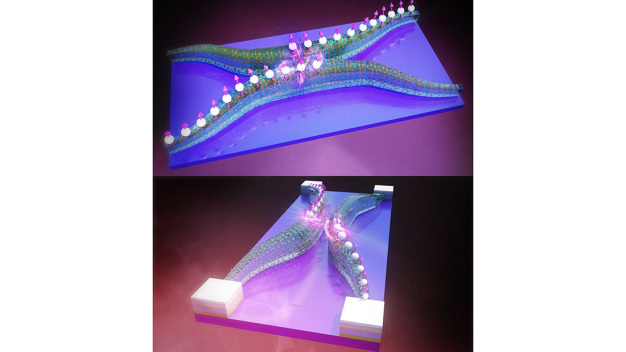
Fig. 1: The directional coupler is depicted with visible atomic structure. The spin wave jumps from one nanowire conductor to another nanowire conductor — where the conductors approach each other. (Niels Paul Bethe, SYNC audiovisual design)
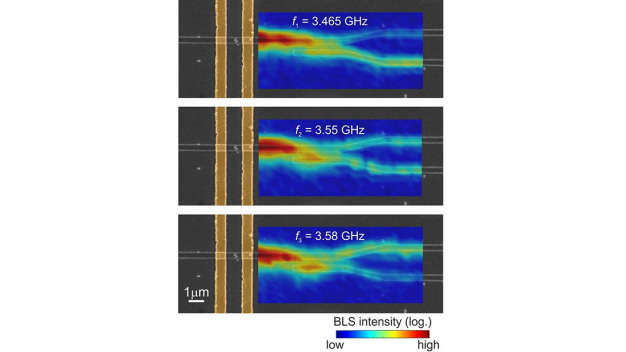
Fig. 2: The main functionality of the nanoscale directional coupler is that it can guide a spin wave into different outputs depending on its frequency, intensity, or the applied magnetic field. (Qi Wang, University of Vienna)
Researchers led by the Technical University of Kaiserslautern (TUK) and the University of Vienna have succeeded in constructing the fundamental building block for a novel computer circuit: Instead of electrons, magnons in the nanoformat take over information transfer. The so-called “magnonic half-adder,” described in the journal Nature Electronics, requires only three nanowires and significantly less energy than modern computer chips.
A team of physicists has achieved a milestone in the search for smaller and more energy-efficient components for computer-assisted data processing: Together, they developed an integrated circuit made from magnetic material and magnons. This allows binary data – a sequence of ones and zeros – to be transmitted, on which the basic language of today's computers and smartphones is based.
The new circuit is extremely tiny and features a streamlined 2D design that consumes about ten times less energy than modern CMOS technology-based computer chips. Although the current magnon prototype is not as fast as the CMOS system, the successful demonstration now opens the opportunity to further explore the magnonic half-adder for applications in quantum or neuromorphic computing.
Successful Collaboration
The prototype is the result of four years of research funded by a Starting Grant from the European Research Council (ERC) for Andrii Chumak. Closely involved were Jun.-Prof. Dr. Philipp Pirro from TUK and Dr. Qi Wang, who is currently working as a postdoc at the University of Vienna. Univ.-Prof. Chumak began the work at TUK and now leads a research group at the University of Vienna.
“We are very happy that the project, which was planned several years ago, has now succeeded. And the result is even better than expected,” says Chumak. The first design of the magnonic circuit was still very complex. Thanks go to Wang, the main author of the work, who improved the design “at least a hundred times” during the project. “We now see that magnon-based circuits can be just as good as CMOS. However, that is unfortunately not enough to excite industry. For that, our circuit would probably need to be at least a hundred times smaller and operate a hundred times faster,” says Chumak. “Nevertheless, our component opens up fantastic possibilities beyond binary data, for example for quantum magnonic computing at very low temperatures. Pirro adds: ‘We are also interested in adapting the circuit for neuromorphic magnonic computers that mimic the way our brain works.’”
How it works
The components of the nanoscale circuit measure less than one micrometer, are much thinner than a human hair, and are barely visible under a microscope. The circuit consists of three nanowires made from a magnetic material called yttrium iron garnet. The wires are positioned close together to form two directional couplers that guide the magnons through the wires. Magnons are quanta of spin waves – one can imagine these as waves on the surface of a pond after a stone has been thrown in. In this specific case, however, the waves are formed by distortions in the magnetic order of a solid material at the quantum level. The team invested significant effort to determine the optimal nanowire length and the best distance between the wires to achieve the desired results. Wang worked on the project for his doctoral thesis at TUK. “I conducted a few hundred simulations for different types of half-adders,” he says. “The current prototype is the third or fourth design.”
In the first coupler, where two wires are very close together, the spin wave is split into two halves. One half goes to the second coupler, where it bounces back and forth between the wires. Depending on the amplitude, the wave exits either the upper or the lower wire, corresponding to a binary “1” or “0.” Since the circuit contains two directional couplers that add two information streams, it forms a half-adder, one of the most universal components of computer chips. Millions of these circuits can be combined to perform increasingly complex calculations and functions.
“What typically requires hundreds of components and 14 transistors in conventional computers only needs three nanowires, a spin wave, and nonlinear physics here,” summarizes Pirro.
Future Applications
Pirro, who currently leads the field of spintronic computing (spintronics = spin electronics) at TUK within the framework of the Collaborative Research Center “Spin+X,” will now explore the use of the magnonic circuit for neuromorphic computing. This is not about data processing based on the binary principle, but rather about mimicking the functioning of the human brain. Spin waves are much better suited for a more complex and noise-tolerant design. They also have the potential to transmit significantly more information because they offer two parameters – amplitude, i.e., wave height, and phase, i.e., the wave angle. In the current approach, the team had not yet used the phase as a variable to keep it as simple as possible for binary data processing.
“If this device can already compete with CMOS, even if it does not utilize the full potential of wave-based approaches, we can be quite sure that a concept that exploits the full spectrum of spin wave capabilities could be more efficient than CMOS in specific areas,” says Pirro. “Because the ultimate goal is, of course, to combine the strengths of CMOS and magnonic technology.”
Questions answered:
Jun.-Prof. Dr. Philipp Pirro
Technical University of Kaiserslautern
Tel.: +49 631 205 4092
Email: ppirro[a]physik.uni-kl.de
Tel.: +43 1 4277-73910
Email: andrii.chumak[a]univie.ac.at
Technische Universität Kaiserslautern
67663 Kaiserslautern
Germany