




- Buildings & Rooms
- Translated with AI
Cutting-edge research on high-performance substrates
Various requirements, one design: cross-functional design with rubber floors at the Berlin Institute for Medical Systems Biology
(Copyright: Horst Krüger / Volker Staab Architects Berlin)
(Copyright: Horst Krüger / Volker Staab Architects Berlin)

(Copyright: Horst Krüger / Volker Staab Architects Berlin)
(Copyright: Horst Krüger / Volker Staab Architects Berlin)
(Copyright: Horst Krüger / Volker Staab Architects Berlin)
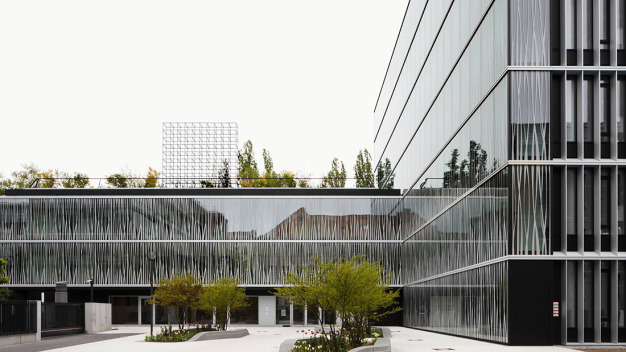
(Copyright: Horst Krüger / Volker Staab Architects Berlin)
Plenty of space for cutting-edge research: The new building of the Berlin Institute of Medical Systems Biology (BIMSB) is part of the Max Delbrück Center for Molecular Medicine (MDC) in the Helmholtz Association. Since 2019, scientists from around the world have been working in an optimal environment in this building in Berlin-Mitte, with state-of-the-art facilities for work, research, and study. Accordingly, the requirements for the building materials were also demanding. It was about outfitting offices and corridors, but also laboratories and even a fish farm. As in other buildings of the Max Delbrück Center, the choice for the flooring was Nora rubber coverings, which now cover more than 5,500 square meters. The floors appear uniformly throughout, despite the different requirements of each area – such as electrostatic discharge capability, special slip resistance, or high sound insulation. "The possibility of cross-functional design was a key reason for the architects to again choose products 'Made in Weinheim' for the new building. But also their durability, sustainability, and good acoustics convinced us of Nora floors," says Frank Bähr, Market Segment Manager Industry at nora systems.
Special Colors and Special Coatings
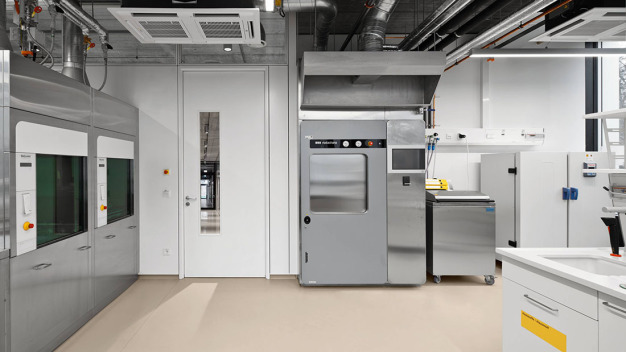
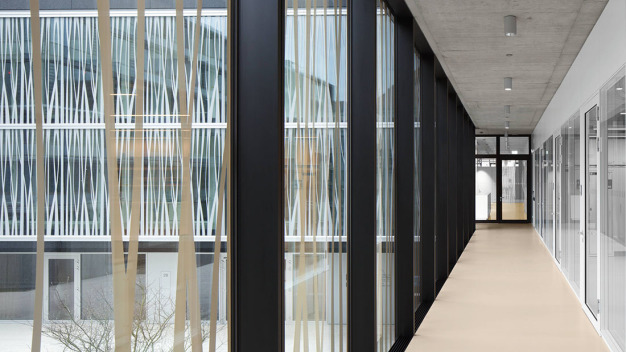
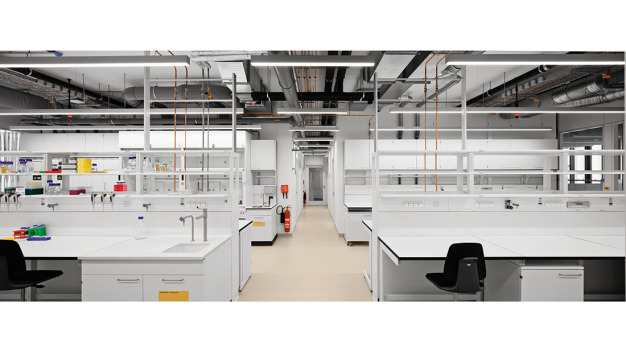
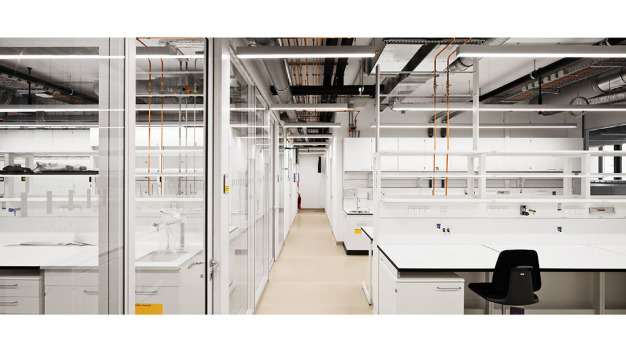
Medical Systems Biology is a young research field that is developing rapidly worldwide. At the Berlin BIMSB, around 250 top researchers work in interdisciplinary teams to analyze how genes control the life of cells, creating the prerequisites for personalized medicine of the future. The new building, designed by Staab Architekten GmbH, features open, flexible spaces that promote communication and cooperation. Computer workstations can be easily converted into laboratory workstations and vice versa when needed. Raw exposed concrete and robust materials emphasize the workshop character. The idea of transparency is reflected in the glass facade with its organically patterned printing, reminiscent of plant tendrils or DNA strands. The structure reduces sunlight exposure while still allowing clear views in and out. The design and functionality of the floors also complement each other. In the laboratory and office areas, noraplan uni was installed. Some areas with higher requirements for a quiet environment received the particularly sound-absorbing noraplan uni acoustic. In the isotope laboratory, electrostatically dissipative noraplan stone ed was installed, and in the fish farm, the particularly slip-resistant noraplan ultra grip was used. The warm beige of the noraplan uni floors was produced as a special color to match the overall color concept, based on the NCS code. Although noraplan uni and noraplan uni acoustic have different technical properties, they appear visually uniform across the surface. Likewise, noraplan stone ed and noraplan ultra grip from the standard range match in color with the areas covered with noraplan uni.
Robust and Sustainable
To design a durable, sustainable building with low maintenance costs, the architects reduced the material use in planning the BIMSB to a few robust building materials. "Nora rubber floors are valuable in terms of material, wear-resistant, and environmentally advantageous," emphasizes Ulf Theenhausen, Project Manager at Staab Architekten. Additionally, the possibility of implementing a continuous floor design throughout the building was considered. Nora rubber coverings contain neither PVC nor phthalate plasticizers. They were the first elastic floors to be awarded the "Blue Angel" eco-label and contribute to good indoor air quality – a crucial aspect for a healthy working environment. Their extremely dense surface also makes the rubber floors particularly resistant – an essential requirement for the heavy equipment or forklifts used in the research center, ensuring a long-term impeccable appearance. "The user has again opted for rubber because it has proven itself in other buildings of the Max Delbrück Center," adds Theenhausen.
Good acoustics for undisturbed work
Due to the open space concept at BIMSB, good sound insulation was especially important to enable scientists to work without disturbances. Therefore, an acoustic concept was developed before planning, in which the rubber floors fit perfectly. "The permanently elastic rubber significantly reduces walking noise and sound propagation between the individual areas, ensuring a pleasantly quiet working atmosphere even in the open laboratory and office spaces," explains Bähr. In the areas directly above a conference room, noraplan uni acoustic was installed. The four-millimeter-thick covering with a damping underlay reduces impact noise by up to 20 dB. An additional advantage: the permanent elasticity of the rubber floors also ensures that employees at standing workstations do not tire as quickly, protecting their backs and joints.
Design-oriented, durable, and comfortable – Nora floors not only contribute significantly to the sustainability of buildings but also to the well-being of the building occupants.
Building Data
Object: Max Delbrück Center, Institute of Medical Systems Biology (BIMSB), Berlin
Client: Max Delbrück Center for Molecular Medicine in the Helmholtz Association, Berlin, www.mdc-berlin.de
Architect: Staab Architekten GmbH, Berlin, www.staab-architekten.com
Installer: Raumstudio Falter GmbH & Co. KG, Berlin, www.raumstudio-falter.de
Products: noraplan® uni, special color 6838, noraplan® uni acoustic, special color 6838, noraplan® stone ed, color 1146, noraplan® ultra grip, color 6017, total installed area approx. 5,500 m²
Installation: 10/2017 – 08/2018
Application areas: laboratories, offices, corridors, fish farm

nora systems GmbH
Höhnerweg 2-4
69469 Weinheim
Germany
Phone: +49 6201 2743934
Mobile radio: +49 172 6330484
email: frank.baehr@nora.com
Internet: http://www.nora.com