




- Furnishing & equipment
- Translated with AI
Correctly interpret active power and specifications
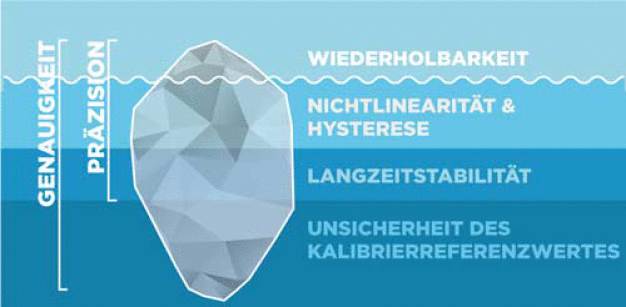
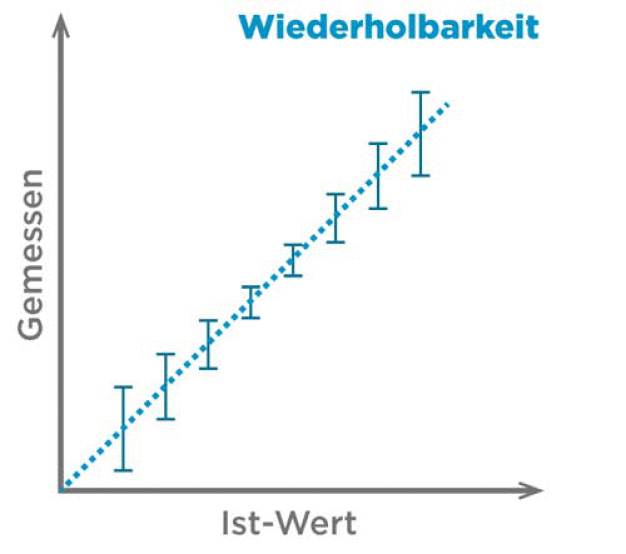
Fig. 1. Reproducibility
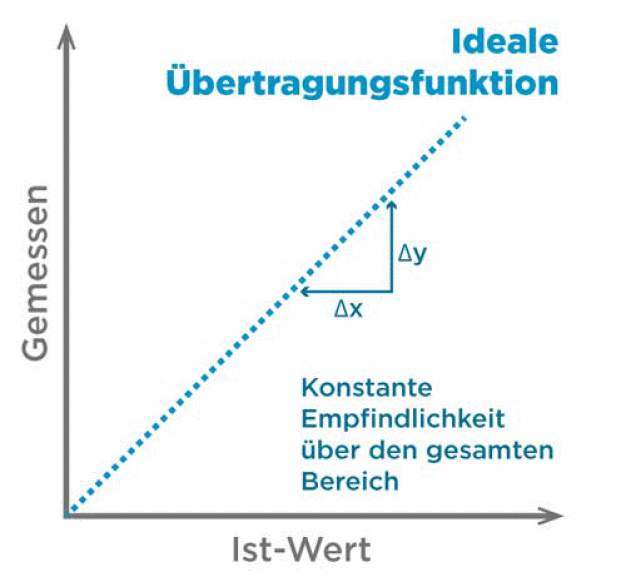
Fig. 2. Transfer function
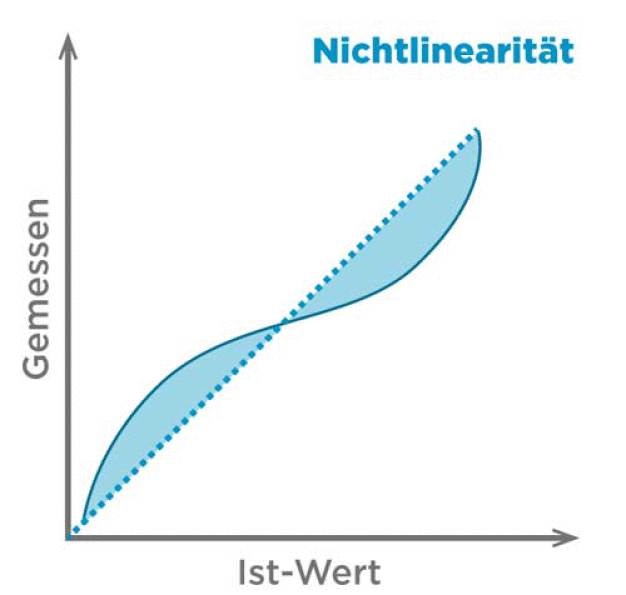
Fig. 3. Nonlinearity
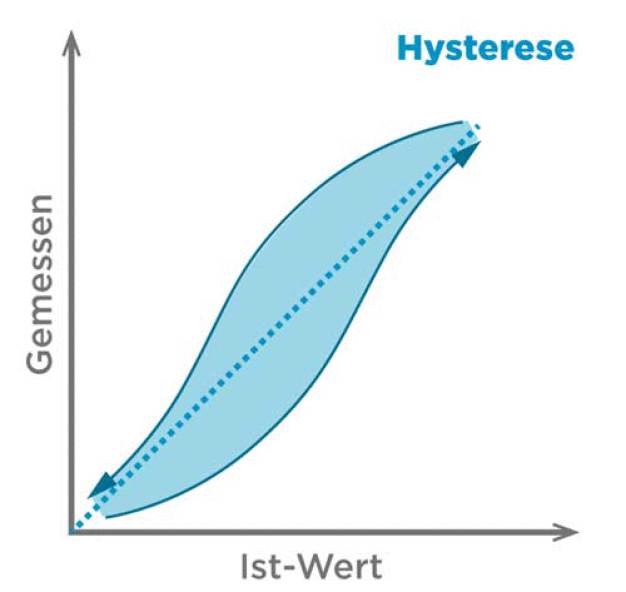
Fig. 4. Hysteresis
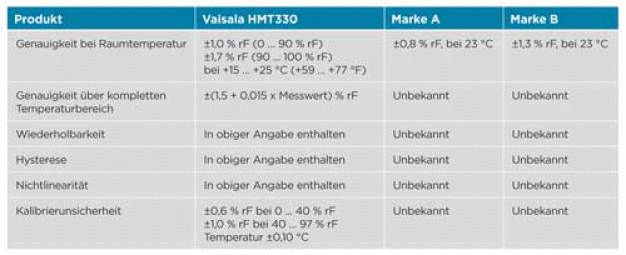
Fig. 5: Comparison of accuracy specifications in the specifications of three manufacturers of a high-precision humidity sensor.
Glossary
The quality of a measuring device is often reduced to a simple question: How accurate is the measurement? As simple as this question may sound, it cannot always be answered so easily. Choosing the most suitable measuring device requires knowledge of the factors that contribute to measurement uncertainty. Only then can one understand what the specifications indicate – and what they do not.
The measurement performance is determined by its dynamics (measuring range, response time), accuracy (repeatability, precision, and sensitivity), and stability (wear resistance, operation under extreme environmental conditions). Accuracy is often considered the most important property, but at the same time, it is among the features that are the most difficult to specify.
Sensitivity and Accuracy
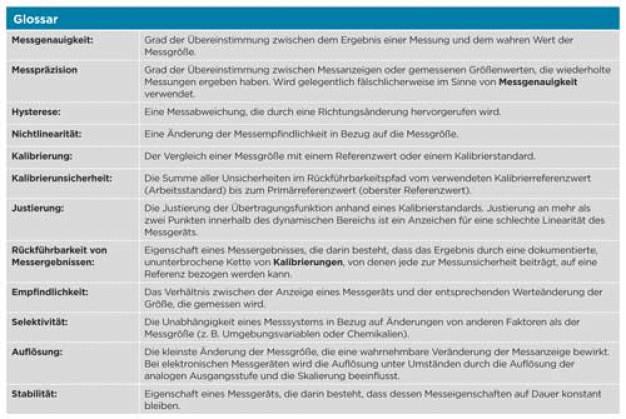
The change in the output value of a measuring device relative to the change in the reference value is called sensitivity. In theory, this ratio is perfectly linear. In practice, all measurements exhibit certain imperfections or uncertainties.
The agreement between the measured value and the reference value is often simply called "accuracy," but this is a somewhat vague term. Specified accuracy usually includes repeatability, i.e., the device's ability to deliver the same result when the measurement is repeated under constant conditions (Fig. 1). However, hysteresis, temperature dependence, non-linearity, and long-term stability may also be included. Repeatability alone is usually a less significant source of measurement uncertainty. If the accuracy specification does not specify other uncertainties, it can give a false impression of the actual measurement performance.
The relationship between measured values and a known reference value is often called the transfer function (Fig. 2). During calibration, this ratio is fine-tuned based on a known calibration reference value. Ideally, the transfer function is perfectly linear across the entire measurement range. However, in most practical measurements, sensitivity varies depending on the measurement value. This type of imperfection is often called non-linearity (Fig. 3). This effect becomes more pronounced at the upper and lower limits (extrema) of the measurement range. Therefore, it is advisable to check whether non-linearity is accounted for in the accuracy specification and whether the accuracy is given for the entire measurement range. If not, doubts about accuracy at the extrema are justified.
Hysteresis is the change in measurement sensitivity depending on the direction of the change of the measured value (Fig. 4). This can be an important source of measurement uncertainty in humidity sensors made from materials with strong binding to water molecules. If the specified accuracy does not indicate whether hysteresis is considered, this source of measurement inaccuracy remains unclear. If the calibration sequence only proceeds in one direction, the hysteresis effect during calibration may be masked. If the specification lacks information on hysteresis, it is impossible to determine the hysteresis magnitude in the measurement. Vaisala's thin-film polymer sensors exhibit negligible hysteresis, which is always included in the specified accuracy.
Environmental conditions such as temperature and pressure also affect measurement accuracy. If temperature dependence is not specified and the operating temperature varies significantly, this can potentially compromise repeatability. The specification may refer to the entire operating temperature range or only to a specific, limited, or "typical" range. Such specifications do not consider other temperature ranges.
Stability and Selectivity
The sensitivity of a measuring device can change over time due to aging. Occasionally, this effect is exacerbated by exposure to chemicals. If long-term stability is not specified or if the manufacturer cannot provide recommendations for the average calibration interval, the specification only applies to the accuracy at the time of calibration. A slow change in sensitivity (sometimes called drift) is dangerous because it may be barely perceptible and can cause latent problems in control systems. Selectivity is defined as the insensitivity of the measuring device to changes in factors other than the actual measured value. For example, when measuring humidity in an atmosphere containing certain chemicals, these chemicals may influence the measurement result. This effect can be reversible or irreversible. The response to certain chemicals is sometimes extremely slow, and this cross-sensitivity to chemicals can be mistaken for drift. A device with good selectivity does not respond to changes unrelated to the actual measured value.
Calibration and Uncertainty
If the measurement deviates from the reference value, the device sensitivity can be corrected. This process is called adjustment. Adjustment performed at a single point is called offset correction: two-point adjustment is a linear correction of offset and gain or sensitivity. If the measurement needs to be adjusted at multiple points, this may indicate poor linearity, which must be compensated with non-linear multi-point corrections. If the adjustment points coincide with the calibration points, the measurement quality between the adjustment points remains unverified.
Once the device has been adjusted, it is calibrated to verify its accuracy. Calibration, which is sometimes confused with adjustment, involves comparing the measurement value with a known reference value, called the working standard. The working standard is the first link in the traceability chain, which encompasses a series of calibrations and references up to the primary standard. A number of devices calibrated based on a specific measurement value can be accurate relative to each other (high precision), but if the calibration uncertainty is not specified, the absolute accuracy relative to the primary standard cannot be verified. Traceability of calibration means that the chain of measurements, references, and related uncertainties up to the primary standard is known and professionally documented. This allows the calculation of the uncertainty of the calibration reference value and the determination of the device's accuracy.
What does "sufficient accuracy" mean?
When choosing a measuring device, the required accuracy must be considered. For example, a standard ventilation system that controls relative humidity for comfortable indoor climate likely requires a tolerance of ±5 % rF. However, for applications such as controlling a cooling tower, more precise regulation with tighter limits is needed to improve operational efficiency.
If the measurement value serves as a control signal, repeatability and long-term stability (accuracy) are important, while the absolute accuracy relative to a traceable reference value is less critical. This is especially true for a dynamic process with large temperature and humidity variations, where the stability of the measurement, rather than the absolute accuracy, plays a decisive role.
On the other hand, if a measurement is used, for example, to verify whether test conditions in a laboratory are comparable with those in other laboratories, then the absolute accuracy and the traceability of calibration are of greater importance. An example of such a requirement for accuracy is the TAPPI/ANSI T402 standard "Standard conditioning and testing atmospheres for paper, board, pulp handsheets, and related products," which specifies test condition values at 23 ±1 °C and 50 ±2 % rF. If the specified measurement accuracy is ±1.5 % rF but the calibration uncertainty is ±1.6 % rF, then the total uncertainty relative to the primary calibration standard would be outside the specification. The analyses – which depend heavily on environmental humidity in the test facility – would thus be incomparable. Confirmation that the analyses were conducted under standard conditions would not be possible in this case.
A specification of accuracy without information on the uncertainty of the calibration reference value leaves the device's absolute accuracy undefined.
It is standard practice at Vaisala to provide professional and comprehensive specifications based on international standards, scientific testing methods, and empirical data. This allows our customers to rely on comprehensive and reliable information when selecting suitable products.
Checklist for Choosing a Measuring Device
- Does the specified accuracy include all potential uncertainties: repeatability, non-linearity, hysteresis, and long-term stability?
- Does the specified accuracy refer to the entire measurement range, or is it limited to a specific range? Is temperature dependence included in the specification, and is the temperature range defined?
- Can the manufacturer provide a corresponding calibration certificate? Does the certificate include information on the calibration method, the reference values used, and the professionally calculated uncertainty of the reference? Does it contain more than one or two calibration points, and does it cover the entire measurement range?
- Is a recommendation provided for the calibration interval, and is long-term stability included in the accuracy specification? What level of selectivity is required in the intended operating environment? Can the manufacturer provide information or references regarding the suitability of the device for the intended environment and application?

Vaisala GmbH
Rheinwerkallee 2
53227 Bonn
Germany
Phone: +49 228 249710
Fax: +49 228 2497111
email: vertrieb@vaisala.com
Internet: http://www.vaisala.de