

- Surface
- Original text
Zhengzhuo Zhang
Controlling Residues After Mechanical Surface Finishing
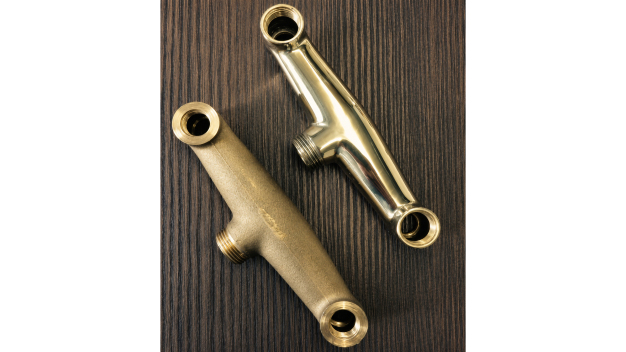
Figure 1. Brass sanitary components before and after cleaning and polishing. AI-enhanced photograph; appearance comparison only. © Inovatec Machinery.
A component can leave a finishing machine with smooth edges and still carry contamination into a controlled production area. Abrasive fines, process chemistry and trapped moisture can survive an apparently successful wash. For manufacturers supplying contamination-sensitive production, the decisive question is what reaches the next operation after cleaning, drying and handling.
Define cleanliness at the point of handover
The downstream process determines the required surface condition. A sealing face, an adhesive bonding area and an internal fluid passage may have different contamination sensitivities. The specification should identify the controlled surfaces, relevant contaminants, acceptance criteria and inspection method. It should also state when the condition applies, such as immediately after cleaning or after an agreed period of storage and transport.
Cleanroom classification cannot replace this component specification. ISO 14644-1 classifies air cleanliness by airborne particle concentration; it does not certify the cleanliness of an incoming part [1]. A component entering a classified area can still carry particles or chemical films from upstream processing. The release decision therefore needs evidence from the part and its defined handling route, alongside environmental controls.
Identify the residues from finishing
Wet mass finishing produces a mixture of metal abrasion, media fines and process liquid. Incoming machining oils and greases can add to this load [2]. Depending on the process, the workpiece may also retain fragments of media, polishing compounds or temporary corrosion protection. Particle removal and chemical residue removal require separate attention because a satisfactory result in one category does not establish cleanliness in the other.
A residue inventory should connect each potential contaminant to its source and removal step. The finishing supplier can identify the media and compound used; the cleaning specialist can then assess compatibility and removability. Any protective treatment intended for storage belongs in this discussion. A film that serves one operation may create an additional cleaning task before bonding, coating or precision assembly.
The inventory should also consider carryover between different batches. Shared media, baskets and liquids can transfer contamination from earlier work. When an application restricts particular foreign materials, changeover procedures need verification. A change in alloy or finishing compound should prompt a review of the cleaning route before routine production continues.
Separate media before fine cleaning
Separation removes the bulk media and reduces the load entering subsequent washing. Screen openings, component orientation and the media size distribution must work together. New media alone do not represent the operating condition: wear and breakage introduce smaller pieces that can enter features previously considered safe. Media selection should account for geometry and separation as well as the finishing effect [3].
The separation check should include blind holes, threads, intersecting passages and recesses. A screen can separate loose media while a fragment remains lodged inside a component. Trials should therefore distinguish external separation from internal retention. When a feature repeatedly traps media, changing the medium or the finishing route may be more effective than adding washing time. Fine cleaning should not become the default remedy for an unsuitable mechanical process.
Match washing to contamination and geometry
The cleaning process must both detach contamination and carry it away. In aqueous cleaning, chemistry, temperature, mechanical action and exposure time interact. Spray washing, immersion, injection flood washing and ultrasonics provide different means of reaching surfaces and removing soils [4]. Selection should follow the alloy, residue type, component geometry and required condition. Compatibility trials must also check for etching, discolouration or damage to sensitive features.
Loading deserves the same attention as the cleaning recipe. Nested parts, close contact areas and trapped air can prevent liquid from reaching a surface. Fixtures should support liquid exchange and drainage without generating unacceptable contact marks. A successful trial on one freely exposed component may not represent a production basket. Qualification should use representative quantities, orientations and contamination loads, including the expected delay between finishing and washing.
Bath maintenance then preserves the qualified conditions. Relevant controls may include cleaner concentration, temperature, oil loading and particle removal. A maintenance plan should define how these variables are measured and when intervention is required. Clear-looking liquid alone provides little information about dissolved residues or the remaining ability of a contaminated bath to clean consistently.
Control rinsing and liquid carryover
Rinsing removes cleaning chemistry and released contamination carried out of the wash stage. Drainage time, component orientation and retained liquid determine the load transferred into the next bath. Blind passages and pockets need adequate liquid exchange; increasing rinse duration offers limited benefit if fresh liquid cannot reach them. Separating heavily contaminated initial rinsing from a controlled final rinse can help manage this transfer, subject to process trials.
Process-water recycling also needs a defined boundary. Removing suspended solids does not establish that dissolved finishing chemistry has been removed. Recirculated liquid may remain suitable for an earlier operation without meeting the requirements of the final rinse. The final stage needs its own water-quality criteria and replenishment controls, verified against the required component condition [2,5].
Water quality and monitoring should follow the contamination requirement. Conductivity indicates ionic contamination, while organic impurities require other measurements, such as total organic carbon [5]. A low conductivity reading therefore cannot, by itself, demonstrate that the component is free of organic films or particles. Rinse monitoring needs a defined sampling point and a relationship to the actual release criteria. Filter condition, tank deposits and contaminated fixtures also belong in the investigation when results deteriorate.
Qualify drying on the actual component
Drying removes retained liquid; it does not reliably remove the non-volatile material dissolved or suspended in that liquid. If washing or rinsing leaves residues, evaporation can leave them concentrated on the surface. The drying stage should therefore receive adequately cleaned parts, with drainage already considered in the loading arrangement.
Hot air and vacuum drying, including combinations of the two, are established options for industrial cleaning systems [6]. Their suitability depends on geometry, material limits, throughput and the required residual moisture condition. A dry exterior does not establish that a blind bore or an overlapping contact area is dry. Trials should examine the locations most likely to retain liquid, using an agreed method sensitive enough for the application.
Where a vibratory dryer uses granular absorbent media [7], the assessment must also cover particles or fragments transferred from that medium and material trapped in features. A satisfactory drying time does not resolve this contamination question. Qualification should include the condition after unloading and any subsequent particle-removal step.
The drying medium can also introduce contamination. Where compressed air contacts cleaned parts, its particle, oil and moisture quality needs assessment at the point of use. ISO 8573-1 provides a framework for specifying these contaminants in compressed air [8]. Air used successfully for workshop blow-off should not automatically be accepted for the final stage. Temperature limits, drainage position and the condition of filters and air lines should remain part of the controlled process. Packing trials should consider cooling and residual moisture before containers are closed.
Preserve the result during transfer
After drying, contact with a dirty tray, glove or protective material can change the surface condition again. The transfer route should identify every contact surface and exposure between the cleaner and the receiving process. Suitable handling and packaging depend on the component and contamination limits; a material described as clean is not sufficient evidence of compatibility.
Reusable trays require a cleaning and inspection routine. Packaging trials should consider particle shedding, contact transfer and any films deposited during the intended storage period. Separating dirty incoming containers from containers used for released parts helps avoid an otherwise hidden route for recontamination. The receiving department should know the approved storage interval and whether opening the package triggers further cleaning or inspection.
Verify the complete route before release
Inspection should address the contamination that can affect function. For particles, an agreed extraction and analysis method can assess size and quantity on defined surfaces. ISO 16232 provides a framework for particulate cleanliness inspection of road vehicle components, where applicable; it does not prescribe universal component limits or cover film contamination [9]. Other industries need methods and criteria appropriate to their own products and requirements.
Where chemical films are critical, suitable methods may include analysis of non-volatile residue or chemical identification by infrared spectroscopy. The method must match the residue and surface being assessed [10]. An area-averaged residue result can conceal a local hotspot, so sampling should reflect the functional surface rather than convenience. Qualification should also address contamination introduced by sampling itself. Procedural blanks and a demonstrated extraction method help make particle results interpretable; changing the inspection procedure can otherwise look like a change in manufacturing performance [11].
Qualification should cover both a freshly prepared bath and the condition approaching its proposed service limit. Samples should include difficult surfaces at the proposed maximum loading. A laboratory demonstration using fresh solution and a small sample set cannot establish the operating window for a full production run. Planned monitoring then checks whether that window remains appropriate.
Samples taken after washing, after drying and after representative handling can help locate the stage responsible for an unexpected result. Records should link the component batch to media condition, cleaning recipe, bath maintenance and packaging. Once the route meets the agreed criteria, changes to compounds, loading, drying or storage require a defined review. Reliable handover means preserving a demonstrated component condition until the next operation receives it.
References
[1] ISO. ISO 14644-1:2015. Cleanrooms and associated controlled environments — Part 1: Classification of air cleanliness by particle concentration. Official scope: https://www.iso.org/standard/53394.html
[2] Walther Trowal. Process water technology in mass finishing. https://www.walther-trowal.com/en/mass-finishing-technology/process-water-technology
[3] Rösler Oberflächentechnik. Consumables. Selection criteria for media and compounds, pp. 6–7. https://www.rosler.com/fileadmin/Files/Prospekte/Gleitschleifen/EN_Consumables_EN_130.pdf
[4] Ecoclean. Knowledge Base. Cleaning procedures and aqueous media. https://ecoclean-group.net/company/academy/knowledge-base/
[5] Merck. Water Contaminants: Types, Sources and Impacts in the Lab. https://www.merckmillipore.com/DM/en/technical-documents/technical-article/water-purification/understanding-lab-water/overview-water-contaminants
[6] Ecoclean. High Purity Cleaning, November 2025. System technology and drying options. https://ecoclean-group.us/fileadmin/pdf/ECOCLEAN/High_Purity_Optics/EN/HighPurity_EN_2025_11.pdf
[7] Walther Trowal. Dryers for industrial mass finishing technology. https://www.walther-trowal.com/en/mass-finishing-technology/dryers
[8] ISO. ISO 8573-1:2010. Compressed air — Part 1: Contaminants and purity classes. Official scope: https://www.iso.org/standard/46418.html
[9] ISO. ISO 16232:2018. Road vehicles — Cleanliness of components and systems. Official scope: https://www.iso.org/standard/70267.html
[10] Fraunhofer IPA. Chemical Cleanliness. https://www.ipa.fraunhofer.de/en/current-research/ultraclean-technology-and-micromanufacturing/cleanliness-technology/Chemical_Cleanliness.html
[11] Fraunhofer IPA. Inspector for Technical Cleanliness, 2026. Inspection method qualification and blank values. https://www.ipa.fraunhofer.de/en/Events/2026/inspector_technical_cleanliness.html
Sources accessed on 19 November 2026.
About the author
Zhengzhuo Zhang is the founder of Inovatec Machinery in Huzhou, China. The company supplies mass finishing equipment and media, together with related cleaning, drying and process-water treatment systems.
Inovatec Machinery
313000 Huzhou City, Zhejiang Province
China