



- Translated with AI
Constant start conditions for 3D cell culture methods: Unique platform allows the cultivation of up to 9,000 uniform and size-controlled spheroids
Regenerative medicine and stem cell research - No need for pretreating the plate and centrifuging after seeding
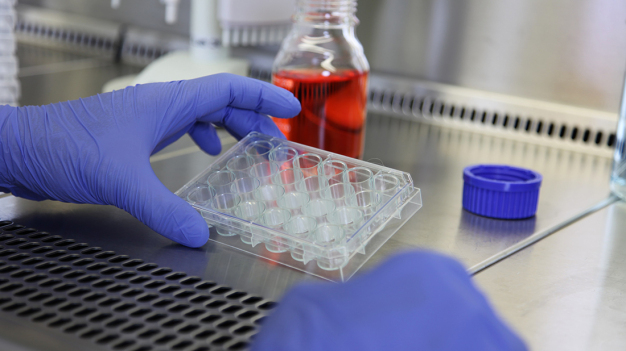
Working with the ready-to-use SP5D is particularly user-friendly, so that handling the platform is quickly learned: Cultivation requires no pretreatment. Changing media by simple pipetting is also very convenient. (Source: Kugelmeiers Ltd.)
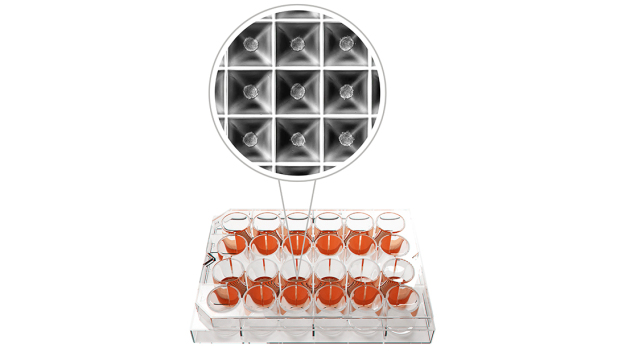
With the SP5D and its patented geometry, it is possible to cultivate a large number of uniform spheroids – up to 9,000 on a single plate. Twelve wells, each with 750 microwells, are available on an SP5D, ensuring a very high yield. (Source: Kugelmeiers Ltd.)

SP5D stands for “Spherical Plate 5D”: The name refers to the 3D structure of the cell cluster growing in the plate, the time needed for cultivation as the fourth dimension, and the so-called cell-cell communication as the fifth dimension. (Source: Kugelmeiers Ltd.)
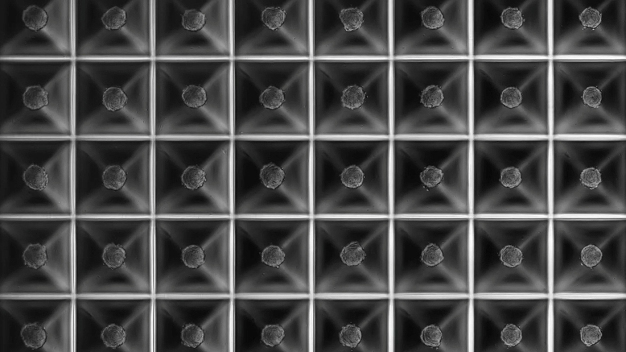
The cells slide into square "pyramid holes" with rounded tips and thus form spheres of the same size each time. This setup results in a scaffold-free, regular cluster formation, ensuring that the aggregate is always held in the center of the individual micro recess (well). (Source: Kugelmeiers Ltd.)
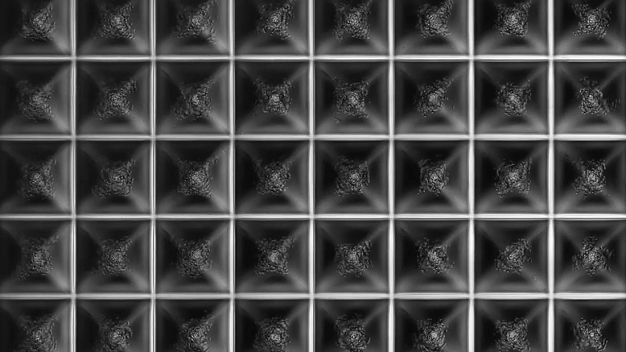
The cells slide into square "pyramid holes" with rounded tips, forming spheres of the same size each time. This structure results in scaffold-free, regular cluster formation, ensuring that the aggregate is always maintained at the center of each micro-depression (well). (Source: Kugelmeiers Ltd.)
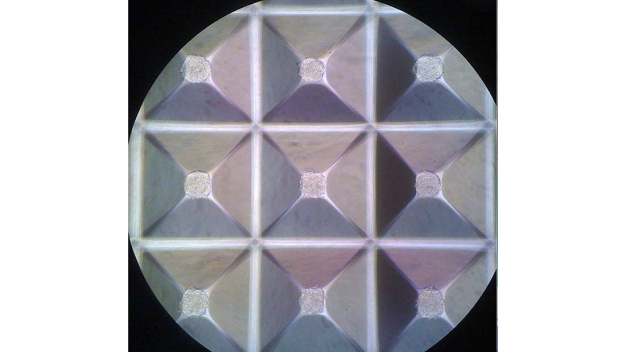
The special angle of the individual recesses causes the cells to settle in a consistent number, eliminating the need for additional centrifugation. The special nanocoating prevents the adhesion of protein residues and ensures smooth sliding off. (Source: Kugelmeiers Ltd.)

"Organized within the human body, cells form tissue groups and organs, meaning they grow in three dimensions and are not simply flat," explains Cordula Böttger, application specialist in the Life Science sector at Heidolph Instruments GmbH & Co. KG. "With a 3D cell culture, an artificial environment can be created in which cells grow in all three dimensions and can interact with their surroundings. This makes their behavior much closer to the real conditions in the body, enabling clinically more relevant results." (Source: Heidolph Instruments GmbH & Co. KG)
3D cell culture experiments allow growth simulation that is closer to the processes in the human body. For this reason, they are becoming increasingly significant in life sciences. However, many plate designs are limited with regard to their reproducibility or maximum number of cultivated cell clusters in a test. As a consequence, 3D cell cultivation is time-consuming and cost-intensive for many laboratories. The Kugelmeiers Ltd. startup that is partnered with Heidolph Instruments & Co. KG has therefore developed the SP5D cell culture plate that makes do without these limitations. Its 5D principle combines the three spatial dimensions with the factors time and cell-to-cell communication: The special design allows the controlled, speedy cultivation of up to 9,000 uniform clusters on a plate, which enables a larger yield per pass. The SP5D is ready for use directly; there is no need to pretreat the plate and centrifuges after seeding. The specially developed, patented geometry and the unique non-fouling clinical grade coating ensure uniform growth so that the results are particularly precise and are reproducible to a higher degree. Numerous cell types can already be cultivated in the plate successfully, including human island and embryonal stem cells as well as mouse stem cells.
The cultivation of cells in three-dimensional space is increasingly developing into the standard in many laboratories – particularly in areas such as stem cell research or regenerative medicine. “Cells in the human body are organized in cell clusters and organs, i.e. they grow three-dimensionally and are not simply flat”, explains Cordula Böttger, specialist in life science applications at Heidolph Instruments GmbH & Co. KG. “A 3D cell culture can be used to create an artificial environment in which cells grow in all three dimensions and can interact with their surroundings. This makes it possible to their simulate their behavior far closer to the real conditions in the body, which enables clinically relevant results.“” in the ideal case, the research can be made to be translational, so that the knowledge acquired can be translated into therapeutic measures far faster than before.
However, many 3D cell culture plates are limited either in the number or the uniformity of the spheroids to be cultivated which, despite its advantages, makes the method less of an economic alternative for laboratories. Also, several things must be noted when using the application: The substrate material must be such that the spheroids do not become too large, since otherwise they would die due to the lack of oxygen supply because of the absence of blood vessels. Interaction of the cells during the growth phase should also be between each other to prevent uncontrolled cell differentiation due to false signals. The goal was therefore to develop a safe plate design, which eliminates these risks and at the same time allows flexible scalability with easy handling. With the SP5D and its patented geometry it is now possible to cultivate a large number of uniform spheroids – up to 9,000 on a single plate. The design is therefore 400 times more space-saving the currently customary 3D hanging drop technology. The platform is set up so that the reproducibility of follow-up tests is increased, since the experiments always start under identical initial conditions due to the low size variance of the grown cell clusters.
Three-dimensional geometry with rounded down bottoms
“The designation SP5D stands for “spherical plate 5D”, whereby the 5D refers to the five dimensions involved”, explains Böttger. “They are made up of the 3D structure of the cell cluster growing in the plate, the time needed as the fourth dimension, which is reduced by a larger yield and easier application, and the so-called cell-cell communication as the fifth dimension, which is necessary for a physiologically correct cell environment and prevents unwanted signals.” Homogeneous interaction of these parameters is also achieved, among other things, by the patented geometry of the microwells on the plate. The principle can be visualized in simplified terms as follows: The cells slide in square rounded off “pyramid holes” and therefore always form equal-sized spheres. This setup leads to a scaffold-free, regular cluster formation so that the aggregate or rather the cell sphere is always held within the center of the individual micro recess (well). This is often not possible in other designs and impedes identical cluster formation accordingly.
“Twelve wells, each with 750 microwells are available on an SP5D, which ensures a very large yield. The special angle of the individual recesses allows a uniform number of cells to sink so that there is no need for additional centrifuging”, says Böttger. Meanwhile, the special coating prevents protein residues from adhering and cell-surface signaling and thus prevents activation of the receptors on the cell wall with non-cell materials. The special geometric dimensions allow the cells just enough room to grow that they do not exceed a defined size, which would cause hypoxic damage due to the low oxygen supply.
SP5D - optimized for everyday laboratory work and translational medicine
The work with the ready to use SP5D is particularly user-friendly so that handling the platform is learned quickly: The cultivation does not require any pretreatment, time-consuming coating processes are omitted. The media change is also very convenient due to simple pipetting, since the height of the microwells was chosen so that the cell clusters are retained. Thus, 750 cell clusters are delivered with a single pipette movement, which is one hundred times faster than with individual spheroid platforms. The harvesting is also quick: Since the cells do not adhere to the surface, the spheroids are “free-floating” and can be easily removed from the SP5D by pipetting off. The platform is also compatible with standard automation units, so that the 3D cell cultivation can more easily be integrated into existing laboratory processes. The choice of COC (cycloolefin copolymers) as plate material ensures real time imaging with as little background noise as possible.
The high degree of standardization and reliability, the SP5D is predestined for use in high-volume research facilities which work with a large number of cell lines and co-culture systems. Several of the promising applications, in which the SP5D is already used successfully are in-vivo applications and translational research. The SP5D offers scientists plenty of space for discoveries and for the cultivation of high-quality research material for downstream processes. This is demonstrated well using the example of cancer and stem cell research: “Many types of cancer emerge from stem cells, whereby our platform can be used to reproduce the environment of cancer cells – including cell signal transfer and the physiology. In this way, e.g. chemotherapeutic substances can be compared and the most effective treatment for patients can be determined”, is how Böttger summarizes the translational benefits of the SP5D.
Heidolph Instruments GmbH & Co.KG
93309 Kelheim
Germany