


- 3D printing
- Translated with AI
Components under fire
3D Printing
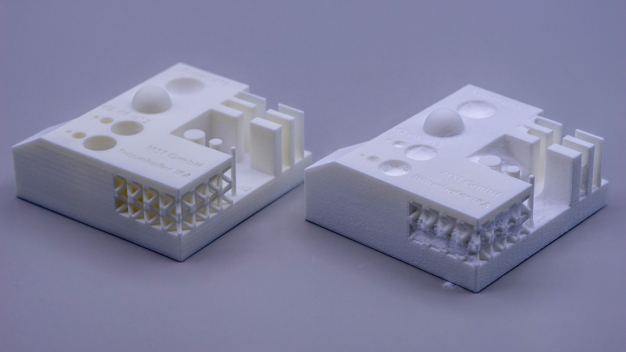
Two test components made of PA12, produced by Selective Laser Sintering: on the left after irradiation with plastic granulate, on the right without radiation treatment. © Fraunhofer IPA / Photo: Mark Becker
Until now, experience-based knowledge was relied upon when it came to irradiating surfaces of additively manufactured components. However, the Fraunhofer IPA and Microstrahltechnik-Vertriebs GmbH have now clarified in a scientific experimental setup which blasting medium with which process parameters is best suited for a particular material.
When additively manufactured plastic parts come straight from the 3D printer, they often appear rough and unfinished. They are coarse, with visible layer lines, and especially in the case of laser sintering, powder residues tend to adhere. To clean the parts and smooth the surfaces, blasting technology, specifically compressed air blasting, is used. In this process, a solid blasting medium, usually mineral, metallic, or synthetic-based, is accelerated by compressed air and directed at the component surface to treat it. Which blasting medium is best suited for which material and with which process parameters the best results are achieved has so far been left to the experience of the operators.
But now, Mark Becker from the Center for Additive Manufacturing (ZAP) at the Fraunhofer Institute for Production Technology and Automation IPA, in close collaboration with MST Microstrahltechnik-Vertriebs GmbH from Reutlingen, has clarified this question in a scientific experimental setup. To do this, the research partners first produced sample components from the three thermoplastics polylactic acid (PLA), polyamide (PA12), and polyetheretherketone (PEEK), which are relevant in various product segments for additive manufacturing. Subsequently, the sample parts were automated at the Fraunhofer IPA and manually blasted at MST with glass fragments, plastic granulate, ceramic balls, or the mineral corundum.
Knowledge of proper blasting treatment is worth its weight in gold
Before and after the blasting treatment, the roughness of the sample components was measured. It was found, for example, that parts made of PLA show a significant surface improvement when blasted with glass fragments. Additionally, it was demonstrated that the automated blasting process produces more uniform and smoother surfaces than manual blasting.
Knowledge of the correct blasting treatment is worth its weight in gold. On the one hand, material costs vary depending on the blasting medium, and on the other hand, the parts require more or less urgent blasting depending on the printing process. "Especially with the high-temperature plastic PEEK, which is in demand in medical technology, using the wrong blasting medium can be costly," says Becker. "The material is quite expensive and difficult to print. It is particularly frustrating if the part is accidentally rendered unusable during blasting."

Fraunhofer-Institut für Produktionstechnik und Automatisierung IPA
Nobelstraße 12
70569 Stuttgart
Germany
Phone: +49 711 970 1667
email: joerg-dieter.walz@ipa.fraunhofer.de
Internet: http://www.ipa.fraunhofer.de