



- Testing and detection equipment
- Translated with AI
COMPAMED Innovationsforum 2021: Successes in the Fight Against the Pandemic Through Microfluidics
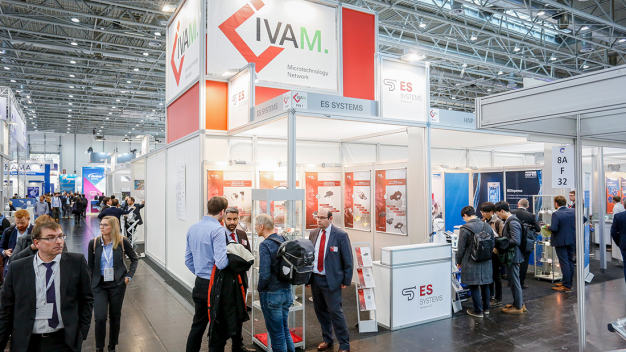
IVAM Product Market (Photo: Messe Düsseldorf, Constanze Tillmann)
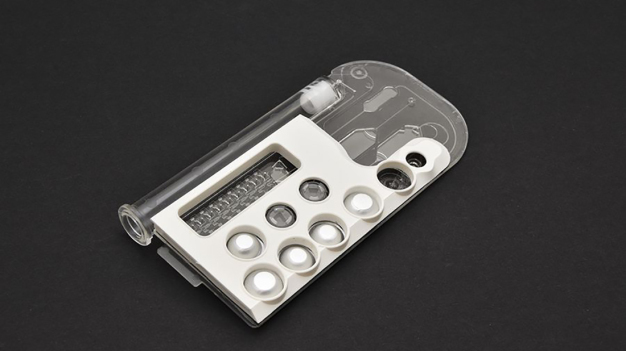
Microfluidic analysis chip (Source: microfluidic ChipShop)

The COVID-19 pandemic has had a profound impact on all areas of life. Almost everyone is affected in some way – in their health, their professional activities, and their entire lives. But there are also notable bright spots. These include, above all, the rapid development of vaccines, test kits, and in the future, medicines, which make a significant contribution to overcoming the crisis. "The pandemic has shown us how important modern high technologies are for conducting rapid, effective research and development, for example, for medicines, vaccines, or diagnostic devices," confirms Dr. Thomas R. Dietrich, CEO of the Microtechnology Industry Association IVAM. Especially microfluidic components are suitable to significantly accelerate development speed. The COMPAMED Innovation Forum, held digitally on June 16 under the theme "Microfluidics for Mobile Diagnostics as well as the Development and Manufacturing of Pharmaceuticals and Vaccines," impressively conveyed this with contributions from experts.
This forum has been conducted for many years in close cooperation between Messe Düsseldorf and IVAM and always provides an outlook on current topics of the internationally leading trade fair for medical technology suppliers, COMPAMED in Düsseldorf (next date: November 15-18, 2021, parallel to MEDICA 2021).
A large number of tests in a very short time
Microfluidic components enable the rapid execution of a multitude of experiments in so-called high-throughput screening (HTS). This allows a large number of tests to be carried out in a very short time, for example, to test the effectiveness of medicines or vaccines on living cells. The speed and accuracy of the tests are achieved, among other things, through microstructures that allow much better control of physical and chemical parameters (e.g., temperature, pressure, reaction time). Another advantage of these small structures is the minimal sample volume required and the economical use of reagents. In recent months, new products and medicines have been developed in a very short time. Without microfluidic components, this would not have been possible. Devices and components such as lab-on-a-chip, mobile diagnostic devices, or chemical microreactors are already helping in the fight against the pandemic.
Optimization potential on one hand – crucial role on the other
Microfluidic platforms are fundamentally well suited for rapid development and commercialization of point-of-care tests (PoCT). However, the "ideal" PoC test presents a major challenge: it should not only be affordable, sensitive, specific, and user-friendly but also fast, robust, device-free, and deliverable to end-users. The tests used during the pandemic show that different methods have different limitations and that there is still room for improvement. For example, PCR tests are more time-consuming, require a testing laboratory, which makes the method expensive and limits throughput. Antigen tests, on the other hand, are only minimally sensitive and sometimes produce false-negative results. Antibody tests for detecting a past infection also have limited sensitivity. "These limitations show that there is no single 'magic bullet' in testing," states Dr. Holger Becker, Chief Scientific Officer of microfluidicChipShop. Nevertheless, the expert is convinced that PoCT will receive a sustainable boost and that microfluidics will play a decisive role, especially in molecular testing.
'Point-of-Care Tests': an important tool in the pandemic
In the future, additional technologies are expected to emerge in the PoCT field that could now be more easily adopted in the context of the pandemic. These include, in particular, direct imaging methods that may be combined with artificial intelligence (AI) or silicon-based sensors (e.g., silicon photonics). A relatively new tool is "CRISPR diagnostics" (CRISPR stands for Clustered Regularly Interspaced Short Palindromic Repeats) for identifying specific RNA sequences. When detecting RNA viruses, typically only relatively short pieces of genetic material are available, in which a virus-specific genetic sequence must be detected. In CRISPR diagnostics, a Cas enzyme and a fluorescently labeled reporter RNA molecule are used. If the target RNA is present in the sample, the Cas enzyme begins to cut both the target and the reporter molecule, releasing the color label, which can then be detected. This is an indirect detection method but has the advantage of being highly specific. "Basically, there will be increasing demand for PoCT and it will become an important tool in managing pandemics," summarizes Holger Becker.
Companies like microLIQUID (from Spain), which specializes in custom microfluidic applications and has expertise across the entire chain from product concept and development to the introduction of new products and manufacturing, stand to benefit. "Often, the critical bottleneck is turning a prototype into mass production," explains Dr. Luis Fernández, CTO of microLIQUID, a key challenge for which solutions are being sought.
Innovation in the fields of life sciences, biotechnology, and analytics is driven by increasing cost pressures. Preparing samples, generating and processing ever larger data sets, and shorter throughput times all lead to continuous miniaturization of important components in glass and plastic. Flow cells, biochips, lab-on-a-chip components, grids, integrated electrodes, microchannels, cuvettes: many components from biophotonics and microfluidics feature functional layers at micro- and nanoscales.
Where microfluidics, biotechnology, and optics overlap and require a multidisciplinary approach and a broad portfolio of processes, the Swiss IMT Microtechnologies sees itself as an ideal partner. "Transferring an assay into a microfluidic solution requires a deep understanding of the analyte and the methods to isolate it or dock it onto a surface within the channel network, as well as identifying the appropriate transduction mechanism and the necessary processes and materials," describes Dr. Alexios Paul Tzannis, Business Development Manager at IMT, part of the complex task. The combination of complex structuring on and in glass wafers with innovative surface chemistry methods enables the development of innovative consumables for life sciences and diagnostics.
Fluid control at the nanoscale
Fluigent from France offers a wide range of solutions for use in micro- and nanofluidic applications, aiming for more control, automation, precision, and user-friendliness. "Microfluidics paves the way for point-of-care diagnostics. It’s about portable, rapid, and precise instruments that bring the capabilities of a medical laboratory into the hands of the user on-site, e.g., in an operating room," comments Jaques Pechdimaljian, OEM Product Manager at Fluigent. This means fluid control down to the nanoscale. As micro-pressure generation and regulation devices become increasingly popular, Fluigent focuses on customizing subcomponents for PoC devices. These include portable devices (battery-powered, compact, and lightweight), as well as precise devices (flow stability, accuracy) and reliable systems (preventing clogging, contamination, bubbles, etc.). The application possibilities of such devices extend far beyond medical technology (ambulatory testing of blood clots in the operating room). Other fields include detecting contaminants in food and beverage production or heavy metal screening of municipal water.
Quantitative measurement of coronavirus antibodies with PoC devices
An additional lesson from the pandemic is that mRNA vaccines could be developed and adapted very quickly, but their production and logistics are challenging. Scaling up to the large quantities required took time. Furthermore, there is still no definitive statement on how long immunity from the vaccines will last. Therefore, it would be extremely helpful if PoC devices could quantitatively measure antibodies. The requirements would be high: just a drop of blood from a fingertip should suffice, and the results of the measurement should be available after a short time (less than 20 minutes). The measurement should be highly sensitive and specific, with digital recording and processing of the data. But how could such solutions be realized, for example, through compact devices with reasonable investment costs and acceptable energy and reagent consumption?
"To better utilize the advantages of microfluidics at the PoC, we need to make use of active fluidic components that are lighter and smaller, as well as energy supplies via batteries and small fluid volumes, enabling systems to save reagents," explains Florian Siemenroth of Bartels Mikrotechnik. According to the company and its partners mementis, microfluidic ChipShop, Honeywell, and Sensirion, "all pieces of the puzzle" are on the table to realize active microfluidic systems. A variety of standard components are available and could be integrated into an ultra-compact and intelligent system. These include miniaturized valves, smart pumps and their control, flow sensors, reagent containers, and tubing systems. These already available components and the systems they can generate offer the desired benefits: automation of fluidic processes with commercial components, low power consumption, small internal volume, and an overall ultra-compact system fitting into a 96-well plate format (about 128 by 85 millimeters). Such active systems can also be produced at costs starting from a few hundred euros.
"Smart Fabs" for future vaccine and drug development
The pandemic has not only increased demand for vital medical products and modern methods for manufacturing advanced therapeutics and vaccines. It has also created a strong need for decentralized working models, affecting not only the medical technology industry. To meet the enormous time pressure, "Smart Fabs" (smart productions) had to be established in less than 12 months. "This can only succeed through high throughput and reliability, full automation, and volume and cost savings," says Dr. Gina Greco, Market Manager for Life Science, Diagnostics, and Analytics at Swiss sensor specialist Sensirion.
The experiences from COVID-19 show that life sciences, diagnostic, and analytical instruments need further optimization. "Microfluidic systems combined with sensors are a key solution," emphasizes Greco. Sensirion considers itself an expert in these components, whose broad portfolio is ideally suited to meet today’s industrial challenges. They are used across all areas in a pharmaceutical factory—whether in research and development, manufacturing, quality control, or intelligent logistics.
The rapid development of effective vaccines during COVID-19 has shifted focus to microfluidics and related fields. Microsystems that can safely handle the smallest amounts of liquids and gases are now indispensable in medical technology. The COMPAMED Innovation Forum 2021 and the participating experts from companies showcased exciting examples and simultaneously fostered enthusiasm for the mix of topics and new products at COMPAMED 2021 in November: from microtechnology and new materials to packaging solutions for medical technology and answers to all questions arising along the process chain of medical product development and manufacturing.
Messe Düsseldorf GmbH
40001 Düsseldorf
Germany