

- Translated with AI
Combining like Lego bricks – Researchers develop gene kit for green algae
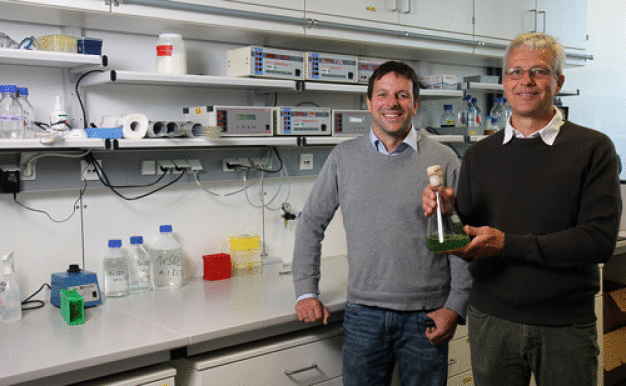
An international research team led by Junior Professor Dr. Felix Willmund (left) and Professor Dr. Michael Schroda has developed a gene toolkit for green algae. (Photo: Koziel/TUK)
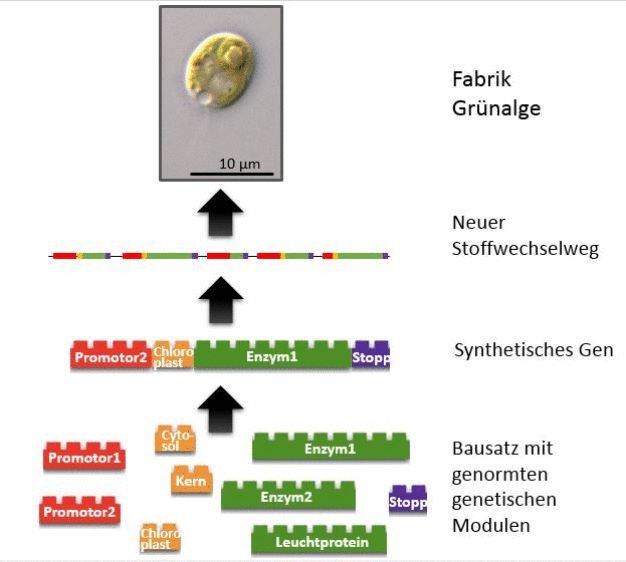
The graphic shows how the building blocks work. The individual gene modules can be combined like Legos. (Photo: Schroda)
In the genetic makeup of cells, it is similar to factories: genes control and regulate protein production. In industry, a modular principle is often useful, where production lines can be exchanged when a different product is to be manufactured. Researchers are also working on combining gene building blocks like Lego bricks in various ways. An international research team, including biologists from Kaiserslautern, has now created a kit with 119 gene functional units for a green algae. This allows the construction of mini-factories from the algae that can produce, for example, color pigments or medicinal compounds. The study has been published in the journal ACS Synthetic Biology.
Legos come in many different sizes, colors, and shapes. They can be assembled in any way. Similarly, researchers want to combine parts of genes like these small building blocks.
A gene consists of various functional units. For example, at the beginning of a gene sequence, there is the so-called promoter. "It controls the activity of the gene and ensures that only a certain amount of protein is produced or that the gene is read only for a specific period," says Professor Dr. Michael Schroda, who holds the chair for "Molecular Biotechnology and Systems Biology" at the Technical University of Kaiserslautern (TUK).
The team around Schroda is working on breaking down genes into these individual units. Besides the promoter, there is a reading region with the genetic information, which can be subdivided into many functional blocks: for example, those that direct a protein to specific areas within the cell, make it glow, or allow it to be easily extracted from cell extracts. There is also a stop region where the reading of the genetic information ends. "Our goal is to arbitrarily combine such units from different genes," says the professor further.
In his current study, the international research team, including Schroda's group and his Kaiserslautern colleague Junior Professor Dr. Felix Willmund, has succeeded in creating a kit of 119 genetic functional units for the green algae Chlamydomonas reinhardtii. Similar to Lego bricks, these genetic building blocks can be easily assembled. "This is possible because these building blocks are standardized. They always have defined sequences at their ends, so they can be assembled in a specific order," explains the Kaiserslautern biologist.
The special aspect of the study: the algae is a higher organism – a eukaryote, as it is called in technical jargon. Until now, such kits were mainly available for lower organisms like bacteria. "The green algae is much more complex and has, for example, more genes," says Junior Professor Willmund, who researches eukaryotic genetics. "Just like bacteria, it reproduces very quickly, which also makes it interesting for industrial production."
The green algae could, for example, be used as micro-factories. "With the help of the gene kit, various proteins can be produced in a relatively short time, ranging from color pigments to active substances used in medicine," says Willmund. But the method is also interesting for basic research. "With it, we can easily modify metabolic pathways and study them more precisely," Schroda cites as an example.
Schroda conducts research in the field of synthetic biology. This still relatively young field of research involves, among other things, creating new biological systems and transferring knowledge from engineering sciences to molecular processes.
Standards and norms are also established in this context, such as at the ends of gene building blocks. This makes them easy to handle as modules and arbitrarily combinable.
The work was carried out within the Collaborative Research Center (SFB Transregio TRR175) "The Green Hub – The Chloroplast as the Center of Plant Acclimation." It has been funded by the German Research Foundation since 2016. Research teams from Berlin, Potsdam-Golm, Munich, and Kaiserslautern are investigating how plants manage to adapt to changing environmental conditions.
In addition to the Kaiserslautern researchers, colleagues from France, England, Denmark, Spain, and Bielefeld participated in the study. The work was published in the renowned journal ACS Synthetic Biology: "Birth of a photosynthetic chassis: MoClo toolkit enabling synthetic biology in the microalga Chlamydomonas reinhardtii."
DOI: 10.1021/acssynbio.8b00251
Technische Universität Kaiserslautern
67663 Kaiserslautern
Germany