


- Translated with AI
Clever solutions with copper
Kundisch expands copper printing in medical technology

Printed electronics on copper substrates are already successfully used in keyboards for integrating RFID chips or NFC tags.
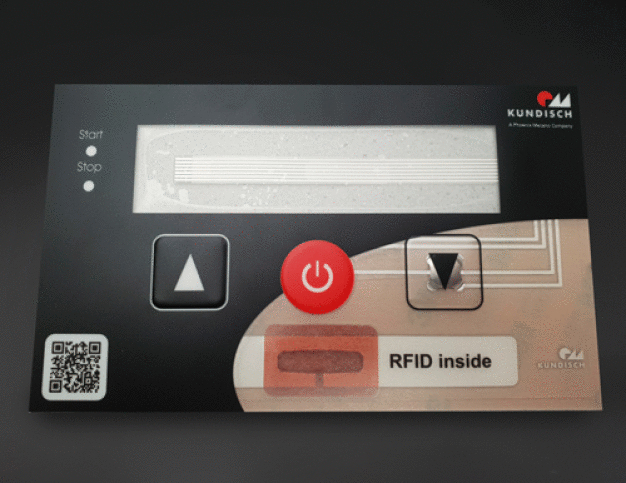
Integrating RFID directly into keyboards saves some manufacturing steps in the production of the devices.
Printed copper offers many opportunities for medical technology applications, from tablet blisters to pressure-sensitive mattresses. Worldwide, there are so far only a few manufacturers capable of offering market-ready products – Kundisch GmbH is among them. The company is working intensively on new applications of the technology.
Copper as a functional ink can be printed on both paper and plastic. For flexible electronics, Kundisch completely coats the surface with a copper layer that is 17µm or 35µm thick, and then removes the unneeded material. Additional conductive layers are produced using silver conductive ink printing. The paste hardens at 80 to 150 degrees to form a solid layer, creating conductive, multilayered, and functional coatings. The surface can optionally be silver-plated or gold-plated.
Copper offers almost no resistance and is therefore clearly preferable to silver conductive ink in signal processing. However, integrating functional coatings and large-area sensors has so far been a challenge for manufacturers due to the complex value chain. Kundisch has now improved the process and can present numerous applications.
Perfectly suited for medicine
In medical applications with pressure sensors over large areas, copper is the material of choice. For example, a mattress measuring 90x200 centimeters equipped with pressure sensors is used for pressure ulcer prevention. The advantage: copper enables the direct integration of electronic components and the connection of the four mat elements needed for signal enhancement. Each element can be equipped with a pressure-sensitive foil and appropriate electronics that evaluate the information and pass a clean signal to the next mat.
Copper is also well suited for use in functional keyboards and control panels – for example, for control elements of medical devices. Unlike circuit board technology, printed electronics allow the integration of many functions into extremely flat components. Today, tablet blisters that document usage, e-paper in control units, touch sensors for curved surfaces, invisible circuit traces in glass, or flat designs for cables, antennas, or sensors are already possible.
Kundisch GmbH & Co. KG
78056 VS-Schwenningen
Germany