


- R+D & Community of Interest
- Translated with AI
Cleanzone 2015: Cleanrooms impose high demands on clothing and its cleaning
Reusable or single-use: The decision is not always easy
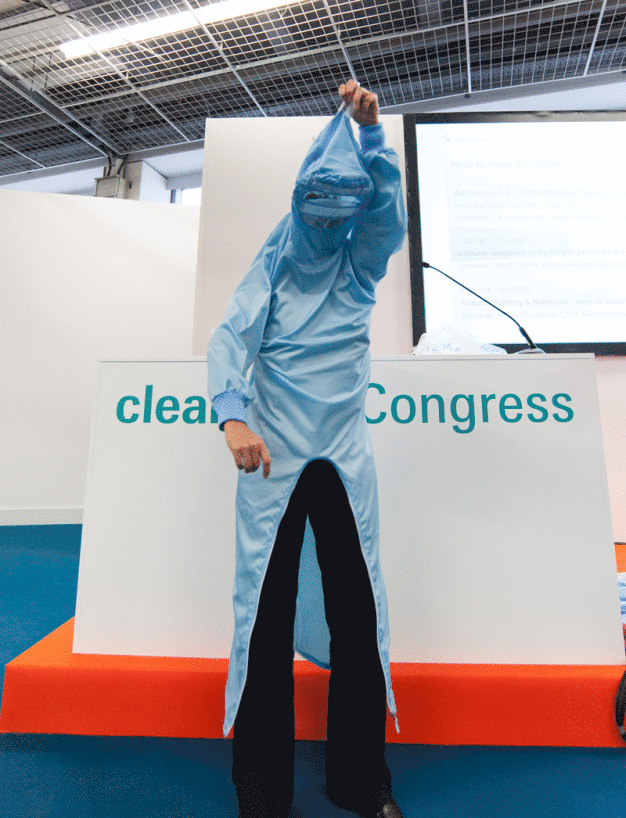
Highly specialized cleanroom clothing © Messe Frankfurt/Sandra Gätke
Clothing and equipment worn in cleanrooms are subject to high standards. This is a field in which only a few specialists are knowledgeable. They will present themselves at the Cleanzone, an international trade fair and congress for cleanroom technology, on October 27 and 28, 2015, in Frankfurt am Main. Among other things, companies like Alsico High Tech, Bardusch, Basan, Decontam, and IAB Cleanroom Products will showcase what's new in cleanroom clothing and accessories.
"A great deal of know-how is indispensable when it comes to textile equipment in the cleanroom," reports Enrico Claretti, Sales Manager at IAB Cleanroom Products from Braunschweig. "The specific requirements that a customer-specific cleanroom situation places on textiles are often not sufficiently known by the user. Therefore, comprehensive consulting is one of the most important tasks of the supplier industry. It leads to an optimal result and always considers the customer's desire for single-use or reusable solutions. That is why we also conduct a customer consultation together with the downstream cleanroom laundry." The special caution exercised in working in cleanrooms naturally also applies in the laundry.
Since humans are considered the main source of particles, germs, and the like, the clothing and components worn during work must meet the highest requirements regarding their particle retention capacity. Accordingly, the specifications for the processed materials and laminates are also very high: for cleanroom applications, in addition to electrostatic dissipativity, mechanical and chemical strength, other values such as pore size, particle retention, abrasion resistance, or sterilization compatibility are required. If the items are to be reused and washed multiple times, the influence parameters of the processing processes (temperature, pH value, disinfectants) on the preservation of the fabric's functionality must be considered. In fact, only a few materials meet such requirements.
Thus, washable underwear is made from polyester fabrics, and cleanroom coveralls are produced from polyester multifilament fabrics with carbon grids. Washable cleaning textiles are usually made from polyester microfibers. But that's not all: the ingredients used, such as zipper closures, sewing threads, or cuffs, must also be suitable for cleanroom use. "For every cleanroom garment, comfort is also an important aspect. It significantly influences employee acceptance. Poor comfort properties directly reduce an employee's performance. As a result, errors may increase, which can disturb or even damage the production process under clean conditions," explains Natalie Schneider, Product Manager at Decontam, a textile service provider specializing in decontamination and sterilization of cleanroom clothing, in Bad Windsheim. The working temperature of 19°C can also affect the well-being of employees. The neck and shoulder areas tend to cool relatively easily. To better protect and keep these areas warm, short jackets and scarves are recommended.
Although reusable clothing has largely established itself in the cleanroom, there are applications that require single-use solutions. Disposable clothing can meet the requirements of a cleanroom while ensuring the protection of workers, which is essential during the manufacture and processing of mutagenic, reproductive toxic, or carcinogenic substances. The chemical protective clothing used in these areas has ultrasonic-sealed seams due to the required liquid or spray tightness, which may become leaky after multiple uses. Other disposable items used in cleanrooms include fleece or full protective hoods, beard covers, gloves, and masks. They are generally disposed of after a single use.
In the future, experts are certain that new industries will also have to comply with the high purity requirements of the cleanroom. A thorough exchange between the involved parties plays a key role in this industry growth, which also affects the USA and Asia. The Cleanzone on October 27 and 28 provides the appropriate framework for this. Around 80 manufacturers will showcase their new developments for construction and planning, operation, as well as qualification and validation of a cleanroom.

Cleanzone
Messe Frankfurt Exhibition GmbH
Ludwig-Erhard-Anlage 1
60327 Frankfurt am Main
Germany
Phone: +49 69 75756290
Fax: +49 69 757596290
email: anja.diete@messefrankfurt.com
Internet: https://cleanzone.messefrankfurt.com