

- Furniture
- Translated with AI
Cleanrooms impose special requirements on people, materials, and workspaces
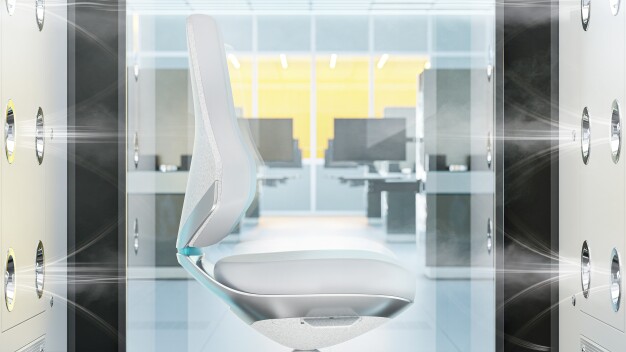
Cleanrooms are among the most demanding work environments of all. Whether in semiconductor manufacturing, medical technology, the pharmaceutical industry, or microelectronics – even the tiniest particles or electrostatic discharges can affect sensitive products, processes, or measurement results.
Correspondingly, the requirements for the entire work environment are very high. Airflow, clothing, materials, and workflows form a coordinated overall system. However, one aspect is often underestimated: the equipment of the workstation.
Because even office chairs make an important contribution to maintaining cleanroom conditions permanently.
Cleanroom compatibility means more than low particle emission
Workplaces in cleanrooms must meet numerous requirements simultaneously. Materials may only cause minimal particle emissions, surfaces must be easy to clean, and all components used must comply with the respective cleanroom classes.
In many application areas, an additional factor comes into play: protection against electrostatic discharges (ESD). Even voltages that are imperceptible to humans can permanently damage sensitive electronic components or impair delicate manufacturing processes.
Therefore, cleanroom workstations are often planned holistically – with a focus on hygiene, ergonomics, and ESD protection alike.
Process safety is achieved through continuous monitoring
The performance of a cleanroom does not depend solely on its technical equipment. More importantly, all components must operate permanently within defined limits.
Regular testing and continuous monitoring help detect changes early. Depending on the application, parameters such as discharge resistance, grounding, humidity, or other relevant environmental factors are checked.
This allows deviations to be identified early before they impact product quality or manufacturing processes.
Especially in sensitive areas such as the semiconductor industry or medical technology, this continuous monitoring significantly contributes to process safety.
Office chairs are also part of the overall system
Office chairs are often considered solely from an ergonomic perspective. In cleanrooms, however, they fulfill additional tasks.
They must not only support long, focused work but also meet high requirements for hygiene, material quality, and – depending on the application – electrostatic discharge capability.
This is not only about individual components. The interaction of all parts – from surfaces to mechanics to casters or gliders – is crucial.
Only when all elements are coordinated can the workstation permanently meet the required properties.
Ergonomics supports precision
Many activities in the cleanroom require maximum concentration over several hours. At the same time, employees often work in leaning postures, perform precise hand movements, or regularly switch between different working positions.
Ergonomically designed workstations help reduce physical strain and maintain concentration over the long term.
Dynamic seating mechanisms, individually adjustable backrests, and flexible adjustment options support natural movement patterns and promote a healthy sitting posture – without compromising the stability needed for precise work.
Material quality determines long-term performance
In addition to ergonomic features, the materials used also play a decisive role.
Closed surfaces facilitate cleaning and prevent particle accumulation. At the same time, materials must withstand the regular use of cleaning and disinfecting agents permanently without loss of function.
In cleanrooms, therefore, not only the performance immediately after installation counts but especially the long-term durability of all workstation components.
Consider cleanrooms holistically
The requirements for modern cleanrooms are continuously increasing. Higher quality standards, more complex manufacturing processes, and more sensitive products make a holistic view of the workstation necessary.
In addition to room technology, airflow, and work processes, ergonomically designed and cleanroom-compatible workstation solutions also make an important contribution to process safety. They not only support compliance with technical requirements but also create working conditions that enable focused and precise work in the long term.

Bimos - eine Marke der Interstuhl Büromöbel GmbH & Co. KG
Brühlstraße 21
72469 Meßstetten-Tieringen
Germany
Phone: +49 7436 8710
Fax: +49 7436 871110
email: bimos@bimos.com
Internet: http://www.bimos.com