
- Modular rooms, Cabins
- Translated with AI
Cleanroom within a cleanroom – how SwissOptic integrated new work areas into production
Individual, walk-in enclosures for the cleanroom
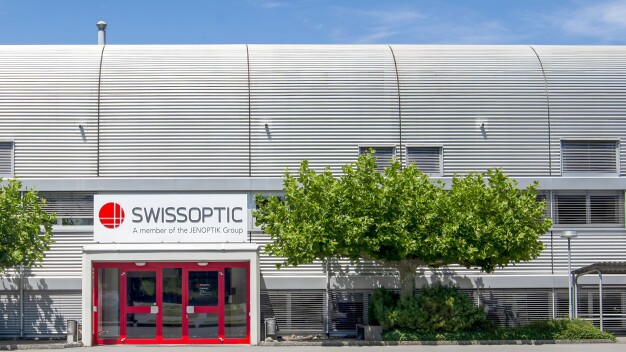
SwissOptic AG was founded in 1997 from Leica Geosystems AG and specializes in high-precision, custom optics for industrial applications. (Source: item and SwissOptic)
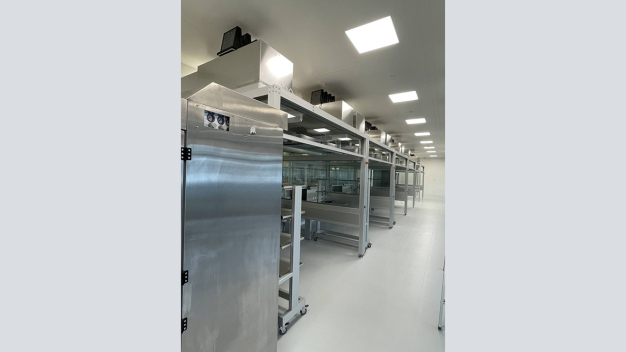
For the sensitive production processes in the cleanroom, item provides the Mini-Environments as an ideal working environment. Thus, 16 functional assembly cells of cleanroom class ISO 5 were created. (Source: item and SwissOptic)
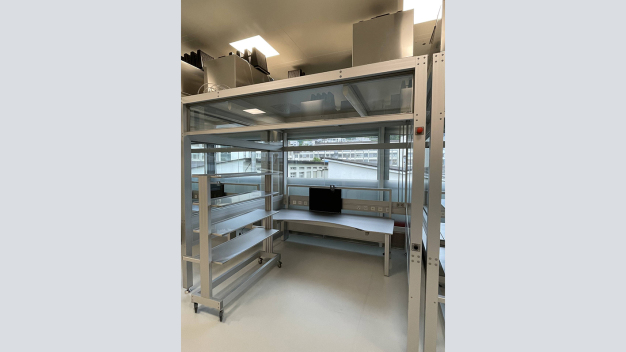
The mini-environments consist of partial enclosures based on item aluminum profiles with integrated workstation systems. (Source: item and SwissOptic)
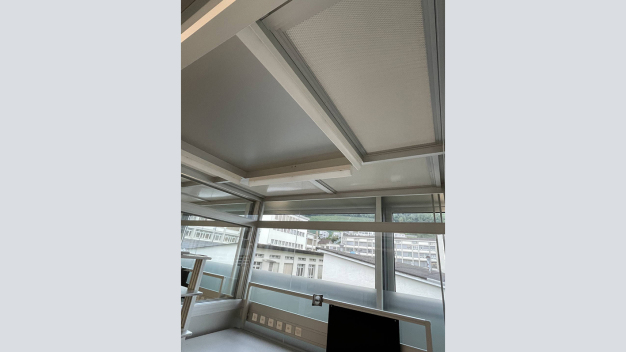
Four Filter Fan Units are integrated into the cell ceilings. Since the air within the cells is guided in a laminar flow from the ceiling to the floor, particle deposits on the workpieces and work surfaces can be prevented. (Source: item and SwissOptic)
SwissOptic stands for highly precise, customized optical solutions. The company produces ultra-precise optical components and complex assemblies for various industries in cleanroom environments. For a new production line, SwissOptic expanded its existing cleanrooms and upgraded the work areas to a higher cleanroom class. The company relies on systems and components from item. This resulted in isolated, controllable process areas that meet the highest cleanroom standards and can be flexibly adapted to different workflows.
The SwissOptic AG was founded in 1997 from Leica Geosystems AG. The company specializes in highly precise, custom optical solutions for industrial applications and considers itself a full-service supplier for optical OEM solutions in measurement technology, semiconductor industry, and medical technology. The optics production at the Heerbrugg site in Switzerland dates back to the early 20th century. Entrepreneurs Heinrich Wild, Jacob Schmidheiny, and Roland Helbing established "Heinrich Wild, Workshop for Fine Mechanics and Optics" in 1921. The company grew rapidly thanks to innovative solutions for geodesy and expanded its portfolio to include photogrammetry – capturing precise measurement data from photos – as well as microscopy. Additional applications in measurement technology and optoelectronics, combining optics and semiconductor electronics, followed. Since 2021, SwissOptic has been part of the Jenoptik Group. This group employs approximately 4,500 people and is listed on the DAX. In addition to its headquarters in Switzerland, SwissOptic has a branch in Wuhan, China, with around 120 employees. As a full-service OEM provider, the company handles not only the development of optical components, assemblies, and optomechatronic systems but also the manufacturing of custom products based on customer drawings.
Existing workstations outdated and inflexible
SwissOptic has been working with item Industrial Technology GmbH for over 20 years and has numerous applications in use – from workstation systems to linear technology to machine enclosures. For setting up a new cleanroom, the optics expert approached item. "We were very familiar with the modular system based on aluminum profiles and therefore asked item if they could support us in setting up new workstations," says Mark Rüdisser, Head of Facility Management at SwissOptic AG. "For the production of components for the semiconductor industry, we needed flexible work areas that had to meet the high requirements of cleanroom class ISO 5." The company WHO Cleanroom Technology was commissioned for the general planning. Although production already takes place in the cleanroom, the new areas needed to meet an even higher cleanroom class and thus comply with stricter particle concentration requirements. The previously used work areas could no longer meet SwissOptic's requirements. The workstations were outdated and could not be adapted to different processes.
High demands on cleanroom production
"To increase our production capacity, we had to redesign our cleanroom and create more work and production areas. We wanted to keep costs and renovation efforts as low as possible," says Dario Fusinato, Head of Cleanroom Assembly at SwissOptic AG. "For the sensitive production processes in the cleanroom, item now provides an ideal working environment with the Mini-Environments." Sixteen functional assembly cells of cleanroom class ISO 5 were created. These consist of partial enclosures based on item aluminum profiles with integrated workstation systems. Complex optomechanical assemblies for the semiconductor industry are manufactured, inspected, and cleaned there. Both optical and fine mechanical components are used, precisely positioned and adjusted with special fixtures at the micrometer level. Temperature fluctuations, vibrations, and shocks must be strictly avoided. At the same time, no particles of 0.025 mm or larger may be present in the work area. Therefore, SwissOptic conducts optical inspections of the assemblies using specialized microscopes. Particle freedom is essential to ensure product quality and longevity.
Uniform design of the assembly cells
All 16 assembly cells are built identically. Each is equipped with an adjustable-height table, a mobile shelf with four storage surfaces, and a movable side cart from item components. The partial enclosures are approximately 2.70 m wide, 2.40 m high, and have a depth of 2.40 m. The basic frame consists of profiles from the X 8 series combined with XMS profiles. Integrated cable management ensures safe wiring, as cables are securely concealed within the profile frame. "The surfaces of the cells are made of easy-to-clean glass," says Michael Hasler, Sales Manager at item Switzerland. "The item framing system is used for surface attachment and is particularly suitable for cleanroom environments because it optimally connects base profiles, covers, and seals." This results in surfaces that are easy to clean. Four filter fan units are integrated into the cell ceilings. Essentially, the cells form a self-contained unit within the cleanroom, like a cleanroom within a cleanroom. They can be flexibly relocated within the production if needed. The air inside the cells is directed from ceiling to floor in a laminar flow, preventing particle deposition on workpieces and surfaces.
Not all materials are suitable for cleanroom use
The assembly cells must be made from cleanroom-compatible materials. They must not outgas. Additionally, requirements regarding volatile organic compounds such as gases, oils, and fats must be met. "The final product will operate in a high vacuum," explains Dario Fusinato. "Therefore, we need to ensure that no molecular contamination occurs during assembly." Due to their small size, these substances can pass through air filtration systems. In addition to ISO 14644-1, which defines cleanroom classes based on particulate reduction, the guideline ISO 14644-8 regarding classification based on airborne molecular contamination (AMC) must also be observed. The VDI 2083 Part 9.1 standard describes a procedure for qualifying operating equipment and ventilation components for cleanliness-critical areas. "Evaluating outgassing behavior is a comprehensive task," emphasizes Dario Fusinato. "From the outset, certain materials like silicones or specific plastics were not permitted. Since height-adjustable tables are used, the lubricants employed must also meet these standards." All open profile grooves must be sealed with appropriate covers to prevent dust accumulation or other contamination.
Installation during ongoing operation
Before final assembly, SwissOptic tested the functionality of the item enclosures combined with the FFUs in a digital model. The assembly of the partial enclosures was challenging because it was performed during ongoing operation. First, item conducted a test project and assembled a partial enclosure, including equipment, in another cleanroom. After successful completion, the enclosures were pre-assembled at item and then transported to the final installation site. The item staff also had to wear protective clothing and adhere to cleanroom protocols to avoid contamination. "We worked in stages and coordinated closely with item," says Mark Rüdisser. "This way, we could ensure that the ongoing operation was never compromised."
Improved working conditions and production processes
The process from delivery to commissioning in fall 2022 took only a few months. "We are very pleased that we were able to set up our new production in such a short time. item supported us optimally throughout the project and implementation phases," says Mark Rüdisser. "This also included implementing a lean concept to optimize production processes." Focus areas included the ideal positioning of tools and digitalization at the workstation. Since the basic equipment is identical across all 16 assembly cells and only varies slightly depending on the process, employees find it easy to navigate. They benefit from the ergonomic design of the spaces. Previously, work processes were tied to specific workstations; now, different processes can be carried out within a single cell—significantly increasing flexibility. With the installation of the Mini-Environments, SwissOptic was ultimately able to increase production capacity and improve working environments. With the cleanroom within a cleanroom, the optics specialist meets the stringent requirements for producing sensitive assemblies in a high cleanroom class, thereby ensuring the quality of its products at all times.
item Industrietechnik GmbH
42699 Solingen
Germany