



- Translated with AI
Cleanliness begins at the door and gate
How to effectively prevent dirt entries in clean zones
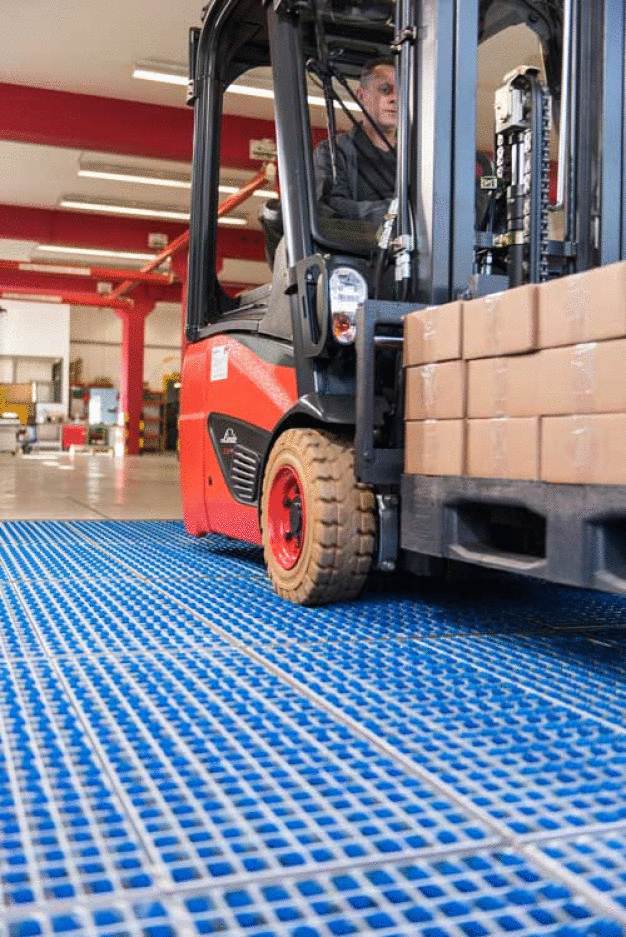
Brush systems combat medium and coarse particles most effectively. Our image shows a profile gate from Heute Maschinenfabrik. (Photo: Heute Maschinenfabrik)
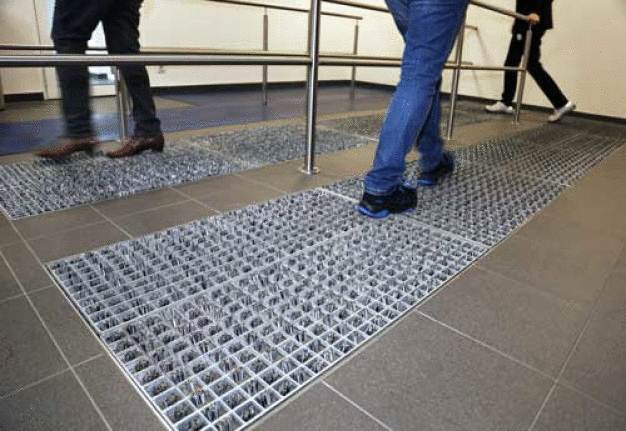
Particles often get stuck in lower intermediate spaces of soles or tires. Only two-stage cleaning solutions prevent them from entering the cleanroom. (Photo: Heute Maschinenfabrik)
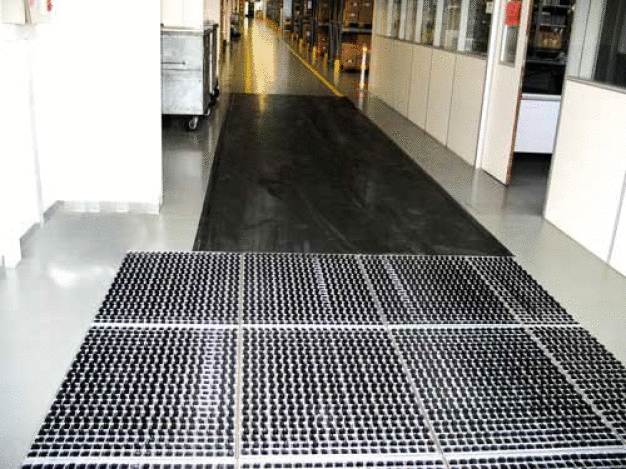
Not all adhesive mats are suitable for floor conveyor use. However, the patented brush product Profilgate is (pictured front). (Photo: Heute Maschinenfabrik)
In companies across various industries, the demands for cleanliness are increasing. This trend is driven by a combination of factors. Components are becoming smaller, tolerances tighter, assemblies more complex, and customers more demanding. Likewise, the potential sources of dirt are diverse. The most significant are manufacturing, environment, personnel, and logistics. A rule of thumb states that 80 percent of all contamination is brought into sensitive areas by shoes and wheels. Our article explains and compares solutions designed to prevent exactly that.
Those looking to prevent the introduction of dirt face the dilemma of choice. More and more manufacturers are entering the growing market. Their offerings can be easily divided into two categories – depending on the size of the particles the user wants to eliminate. The first product category mainly addresses medium and coarse particles; these include, for example, rubber abrasion or dust. In this segment, two subcategories compete for customer favor. Dirt-catching mats are one of them. They resemble oversized foot wipes and are primarily made of synthetic fibers or cotton. The mats can be quickly and easily fixed to the floor with rubber fasteners.
Brushing provides a more thorough clean
However, this method has disadvantages. An engineer at the plant of a Bavarian automobile manufacturer complains, among other things, that conveyor systems on the floor sometimes carry away the dirt on top of the mats when passing over them. And in the case of moisture, "the water is absorbed from the carpets." To avoid these issues, only the second alternative remains: permanently installed dirt trap zones. These are galvanized grates with sturdy brush strips; they are laid flush with the floor or surface-mounted. The Heute Maschinenfabrik from Solingen is considered the inventor of this system for industrial areas. It is called Profilgate and is used in 800 plants across 40 countries on five continents. The tensioning of the patented brushes enables active cleaning of the walking surfaces and the gaps in between – all without electricity. The Fraunhofer IPA Institute has scientifically analyzed and confirmed the effectiveness of the product.
Consider lifecycle costs
Heute Maschinenfabrik specializes in applications in production, storage, and logistics. Emco Bau from Lingen on the Ems supplies the appropriate counterpart for shopping centers, airports, train stations, and public and commercial administrative buildings. The only downside of the integrated solutions is the higher initial investment costs. However, these are expected to be offset over time by very low operating costs. This is in contrast, by the way, to the initially inexpensive fabric mats, which have significantly higher lifecycle costs.
Solution for the finest particles
The second category of dirt barriers for the floor targets fine and ultrafine particles. In this market segment, there are also two competing products: disposable dust-binding mats and permanent adhesive mats. The two terms clearly highlight the difference between the types. While dust and other particles adhere equally well to both variants, the disposable product usually has about 30 thin layers coated with adhesive; when the effect diminishes, the top film is peeled off, revealing a new, sticky layer. The sustainable alternative, on the other hand, must be wiped wet repeatedly to maintain its effectiveness. One of the suppliers, Dycem based in Bristol, guarantees decontamination performance for at least three years.
Two systems for optimal results
All adhesive solutions share the drawback that they are less suitable for medium and coarse particles. Additionally, they only clean the contact surface of a sole or tire – the deeper gaps remain untouched. The optimal effect is achieved by, for example, combining Profilgate with an adhesive mat. More information is available at www.profilgate.de.
Heute Maschinenfabrik GmbH & Co. KG
42699 Solingen
Germany